

Have you heard about Bitcoin runes but have no idea what they are or how they work?
In the world of cryptocurrency, new terms and concepts are constantly emerging. Bitcoin runes are one such concept that has been gaining popularity recently. In this beginner’s guide, we will delve into what Bitcoin runes are, how they work, and why they are significant in the world of cryptocurrency.
What Is the Runes Protocol on Bitcoin?
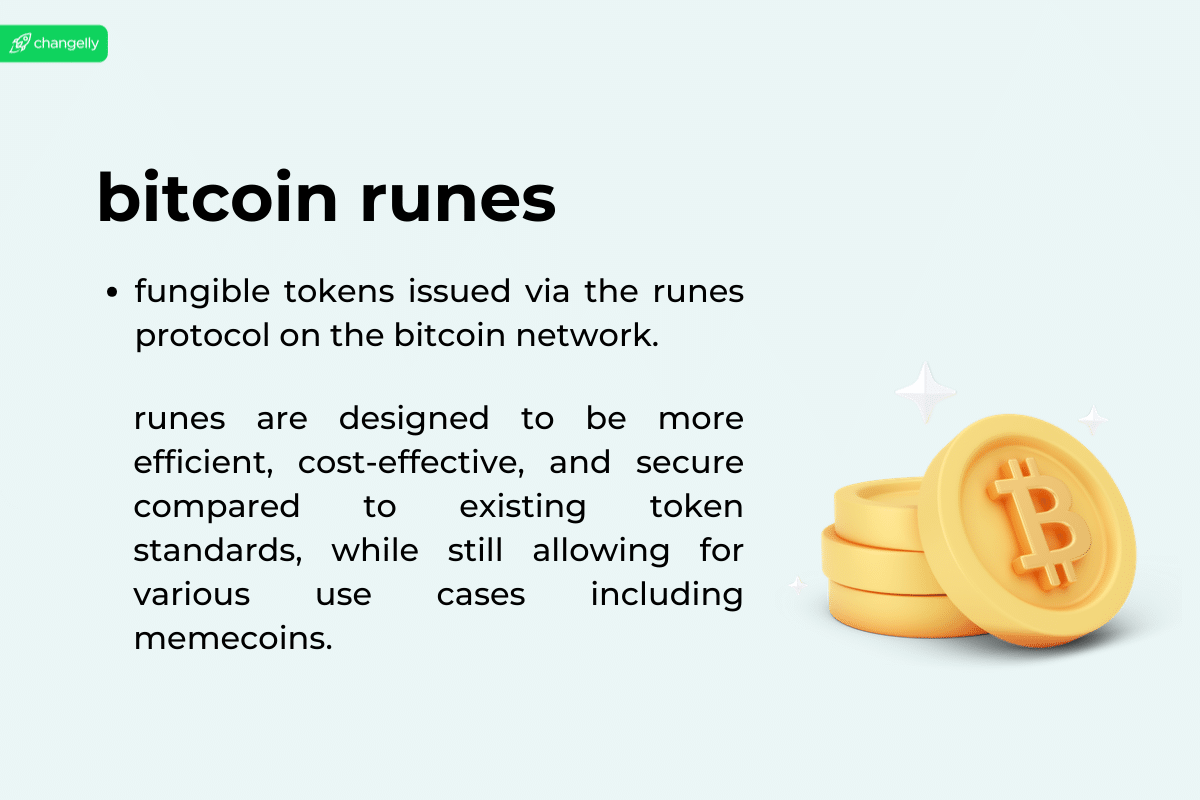
The Runes Protocol is a new token standard that brings fungible tokens to the Bitcoin blockchain. The launch of Runes took place in April 2024 on block 840,000 – accompanying Bitcoin halving event.
Runes enable users to etch, mint, and transfer Bitcoin-native digital commodities, making it easier to create interchangeable tokens for a variety of uses.

Unlike some methods that can overload the blockchain with bulky data, Runes is created to keep their data footprint small, which helps prevent blockchain bloat and ensures scalability. This means Bitcoin transactions stay efficient and don’t add unnecessary strain on the network.
Additionally, Runes can utilize the Lightning Network, a separate layer on top of Bitcoin, for faster transactions.
With this protocol, users now have a more streamlined and efficient way to create fungible tokens on the Bitcoin network, opening up new possibilities for asset tokenization and the creation of digital currencies.
Who Created the Runes Protocol?
The Runes Protocol was created by Casey Rodarmor, an expert in the crypto space with a strong background in developing innovative decentralized protocols.
Casey Rodarmor first made a name for himself in the crypto community through his work on the Bitcoin Ordinals Protocol, where he played a key role in its development.
Why Was the Runes Protocol Created?
The Runes Protocol was created with the objective of addressing the inefficiencies of existing token standards and offering improved functionalities. Through the Runes Protocol, Casey Rodarmor envisions a future where transactions are faster, more secure, and more scalable.
One of the primary reasons behind its creation was the need to replace the Ordinals-based BRC-20 token standard. This particular standard had proven to be inefficient for creating fungible tokens and lacked certain essential features required for an optimal user experience.
In addition to this, Runes Protocol aimed to enhance upon existing fungible token protocols such as RGB and Taproot Assets. These protocols had limitations in terms of their on-chain footprint and the management of Unspent Transaction Outputs (UTXOs). Runes aimed to minimize the on-chain footprint, ensuring that unnecessary information and bloat were avoided.
An Overview of Runes’ Conception
The Runes Protocol is a game-changer for Bitcoin, aiming to streamline the network while giving traders more freedom with their assets. Let’s dive into the innovations Runes brings and how Bitcoin stands to benefit from its launch.
Cleaning Up the Bitcoin Blockchain Network
Bitcoin Runes Protocol is designed to declutter the Bitcoin network.
As Bitcoin’s popularity grows, so does network congestion, leading to slower transactions and higher fees. Runes addresses this by encoding asset information directly into Bitcoin transactions, minimizing data usage, and speeding up transaction times. This efficient approach helps reduce network congestion, making Bitcoin more scalable and user-friendly.
Attracting a Bigger User Base
Bitcoin Runes’ focus on meme coins as a primary utility has sparked much interest and intrigue within the crypto community. The concept of meme coins as a means to build community and engage users in a fun and interactive way is both innovative and refreshing.
Enhanced Security and Stability
Security and stability are paramount in the Runes Protocol, which uses the UTXO (Unspent Transaction Output) model for token creation and transactions.
By inheriting Bitcoin’s robust security features, Runes minimizes vulnerabilities and ensures transparent linkages between transactions. This makes it easier to detect and prevent malicious activities, providing a stable environment for users.
Attracting More Developers
A vibrant developer community is crucial for the success of any protocol. Runes aims to attract developers by offering comprehensive and user-friendly documentation, including sample codes, tutorials, and guidelines.
As more developers contribute to the Runes protocol, the ecosystem benefits from diverse and innovative token creations. This leads to a wider variety of tokens, promoting excitement and adoption. Developers can leverage Bitcoin’s security combined with the flexibility of fungible tokens to explore new tokenization possibilities, attracting more users and diversifying the Bitcoin ecosystem.
How Runes Protocol Works
At its core, the Runes Protocol utilizes a system of Runes that serve as the fundamental units representing fungible tokens. Each Rune is uniquely identified by a Rune ID, which is a cryptographic hash tied to a specific UTXO on the Bitcoin blockchain.
Creating Runes: Etching
Creating a new Rune is called “Etching.” To etch a Rune, users specify details like the name, symbol, ID, supply amount, divisibility, and other parameters in the OP_RETURN output. Creators can also include a “premine,” where a set amount of the Rune is allocated to the creator before it’s available to the public.
Minting Runes
After etching, Runes can be minted in two ways:
- Open Minting: Anyone can mint new Runes after the initial etching by creating a mint transaction to mint a fixed amount of new Runes.
- Closed Minting: New tokens can only be created when certain conditions are met, such as after a specific time period, capping the token supply.
Transferring Runes: Edicts
Edicts define how Runes can be transferred after etching or minting. They allow for batch transfers, airdrops, and transferring all minted Runes to a single account.
Unlike Ethereum’s ERC-20 standard, where tokens are created and managed via smart contracts, the Runes Protocol relies on the native Bitcoin blockchain infrastructure. This offers several advantages, such as greater security, wider adoption, and compatibility with various Bitcoin wallets and services. Furthermore, as each Rune is tied to a specific UTXO, it allows for improved token tracking and eliminates the need for off-chain balances or complex token transfer mechanisms.
BRC-20 vs. Runes: What’s the Difference?
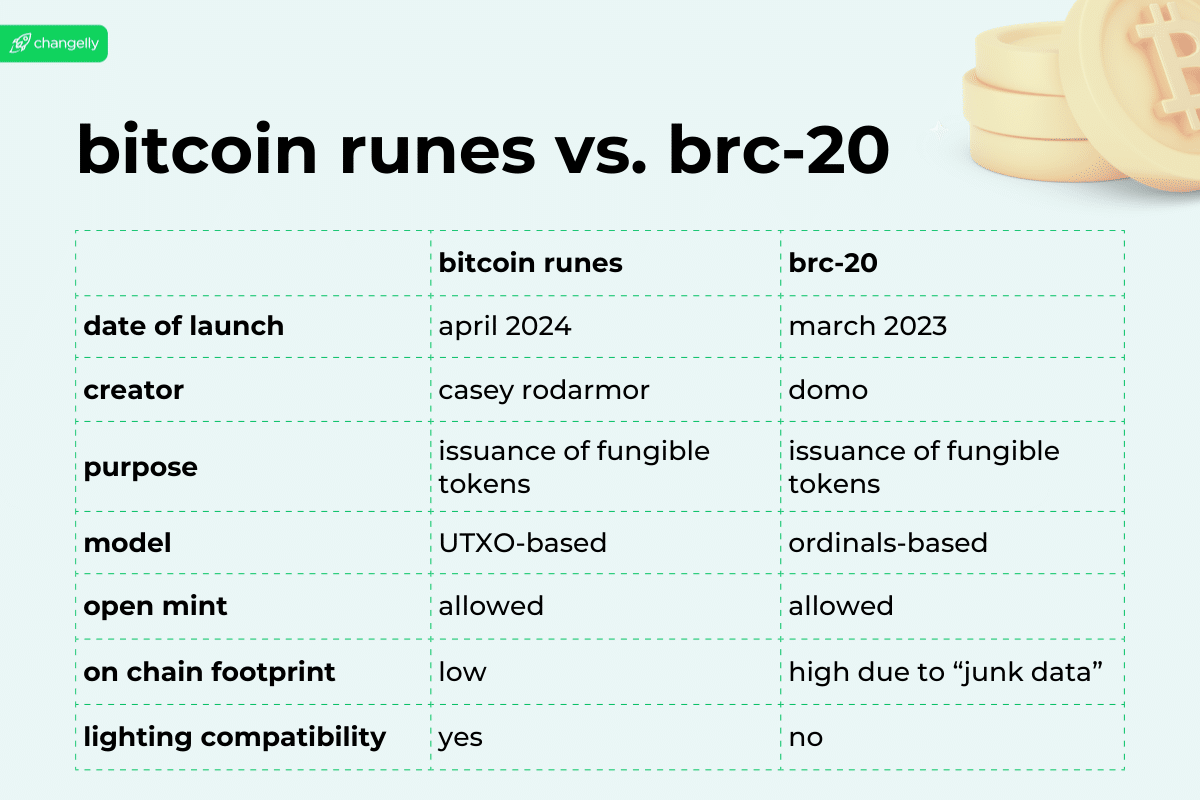
The BRC-20 and Runes token standards differ in blockchain efficiency, ease of use, and security. Here’s a breakdown of these differences to help understand why Runes might be the better choice for certain applications.
Blockchain Efficiency
- BRC-20: Uses the Bitcoin Ordinals protocol, which attaches data to a Bitcoin satoshi. This approach can be demanding on Bitcoin’s network resources.
- Runes: Based on Bitcoin’s UTXO (Unspent Transaction Output) model. It stores data in the OP_RETURN field of a bitcoin transaction, which is more efficient and less resource-intensive.
Asset Creation and Minting
- BRC-20: Tokens are created using inscriptions, and minting is limited to open procedures.
- Runes: Tokens are created through an “etching” process. Runes can be minted via both open and closed procedures, with an option for premining.
Transfers
- BRC-20: Transfers require new inscriptions.
- Runes: Transfers create new sets of UTXOs based on OP_RETURN data, making the process more streamlined.
Compatibility and Use
- BRC-20: Requires wallets that support Bitcoin Ordinals.
- Runes: Compatible with the Bitcoin Lightning Network and supports Lightning clients and SPV (Simplified Payment Verification) wallets, making it more versatile.
Security and Data Integrity
- BRC-20: The issuance process can lead to “junk data” on the blockchain, potentially impacting security and efficiency.
- Runes: Has a built-in mechanism to eliminate poorly formed tokens, promoting a cleaner and safer environment.
While both standards enable the creation of tokens on the Bitcoin blockchain, Runes offers better efficiency, ease of use, and security. Its reliance on the UTXO model, compatibility with existing Bitcoin infrastructure, and mechanisms to ensure data integrity make it a robust alternative to BRC-20 tokens.
Bitcoin Runes: A Catalyst For Memecoins On Bitcoin
Casey Rodarmor, the creator of the Runes Protocol, commented, “I’m highly skeptical of ‘serious’ tokens, but runes are without a doubt a ‘serious’ token protocol.”
Bitcoin Runes simplifies the process of creating memecoins on the Bitcoin blockchain, lowering the barrier for token creation. Memecoins are cryptocurrency tokens inspired by internet memes, and with Bitcoin Runes, even those with limited technical knowledge can easily create their own tokens.
The Runes protocol offers a user-friendly interface and efficient tools, making token creation accessible to everyone. Its scalability ensures that the creation and management of memecoins do not slow down the Bitcoin network.
How to Buy and Sell Bitcoins Runes
Ready to dive into the world of Runes? Here’s a friendly guide to help you get started.
Step 1: Set Up a Bitcoin Wallet
First, you need a Bitcoin wallet to store your Bitcoin securely, which is essential for buying Runes. Choose a reputable wallet provider and create an account. Need help picking one? Check out our list of the best crypto wallets for 2024 here.
Step 2: Get Some Bitcoin
Since Runes operate on the Bitcoin network, you’ll need Bitcoin in your wallet to send Runes and cover transaction fees.
You can buy Bitcoin from Changelly or from any cryptocurrency exchange of your choice. Once you have Bitcoin, you’re ready to explore Runes.
Step 3: Buy Rune Tokens
Visit online marketplaces like UniSat, Magic Eden, or OKX to buy Runes. These platforms let you create, buy, sell, and trade various digital assets, including Runes. Follow the marketplace instructions to purchase your desired Runes using Bitcoin.
How to Sell Your Runes
Selling your Runes is just as straightforward. Go to a Bitcoin Runes marketplace and create a listing for the Runes you want to sell. Set a price in Bitcoin and add any necessary details or descriptions. Once a buyer is interested, they’ll purchase your Runes with Bitcoin, and the transaction will be completed securely through the marketplace.
With these simple steps, you’ll be well on your way to buying, selling, and enjoying your Runes!
Final Thoughts
Bitcoin Runes bring a new level of innovation to the Bitcoin network, adding excitement and possibilities. Despite an initial surge and subsequent decline in activity and fee revenue after the Bitcoin halving, the potential of Bitcoin Runes remains vast. This evolution shows that even the oldest blockchain can adapt and meet the ever-changing needs of its community.
Disclaimer: Please note that the contents of this article are not financial or investing advice. The information provided in this article is the author’s opinion only and should not be considered as offering trading or investing recommendations. We do not make any warranties about the completeness, reliability and accuracy of this information. The cryptocurrency market suffers from high volatility and occasional arbitrary movements. Any investor, trader, or regular crypto users should research multiple viewpoints and be familiar with all local regulations before committing to an investment.


