


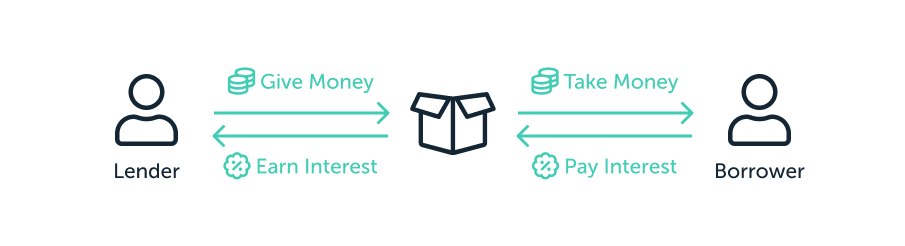
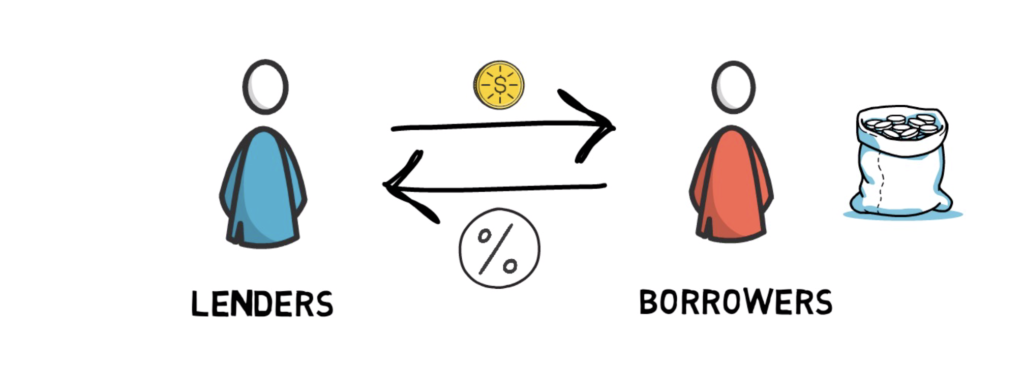
To explain it in simpler terms, let’s say you have bought some Bitcoin or Ethereum which is currently idle in your wallet and not generating any profit. In such a case, you can lend these assets to other users in exchange for interest. However, lending to individuals can be risky, so you can consider lending to companies that specialize in loans and offer lower interest rates but have a higher level of security. These companies are essentially the Lending & Borrowing protocols.
The DeFi market’s Lending & Borrowing segment is broadly categorized into two segments:
- Lending Pool: This includes projects such as AAVE, Compound, Solend, Apricot, and more.
- CDP (Collateralized Debt Positions): This includes projects such as Maker DAO, Venus, Parrot, and more.
The Lending Pool’s operating model is relatively simple. Users who wish to lend will deposit their funds into a pool (smart contract). On the other hand, those who need to borrow will come to the protocol after depositing their collateral into a pool (smart contract). They can then borrow other assets that the project accepts. The interest earned by a pool is distributed equally among all lenders in that pool, which means the interest rate will change according to the market’s needs and the borrowers’ demand.
Users are able to deposit assets to mint their own stablecoins which can be used in different projects and blockchains. The article gives examples of stablecoins that can be collateralized, such as DAO by Maker DAO, VAI by Venus, and PAI by Parrot. The article then draws a comparison between the operating mechanism of CDP projects and state banks.
However, DeFi projects are still quite risky, particularly in terms of hacking. Hackers can exploit vulnerabilities in smart contracts to steal users’ assets or mint stablecoins and sell them on DEXs.
While the general operating model of Lending & Borrowing projects is similar, each project is unique in terms of its vision, development strategies, products, markets, and users.
Importance of Lending & Borrowing
Utilizing idle assets in financial activities is a simple way for users to generate profits. The emerging trend of Lending & Borrowing is opening up a new era for the cryptocurrency market, particularly in the field of decentralized finance (DeFi). This allows users to participate in financial activities without the need for Know Your Customer (KYC) procedures, while still maintaining an extremely transparent data system.
The success of Lending & Borrowing can lay the foundation for even more complex financial instruments, such as derivatives, which include option and future trading. This can provide further opportunities for users to make profits and diversify their investment portfolio.
In summary, the concept of Lending & Borrowing is transforming the way individuals can use their idle assets to generate profits in the cryptocurrency market. It offers a decentralized and transparent system that eliminates the need for cumbersome KYC procedures, which could pave the way for even more advanced financial instruments in the future.
History of Lending & Borrowing Projects
The decentralized finance (DeFi) movement originated from Ethereum and has since expanded to other blockchain ecosystems such as BNB Chain, Polygon, Solana, Avalanche, Near Protocol, Polkadot, among others. This article will focus mainly on the most prominent DeFi projects on Ethereum, including Compound, AAVE, Maker DAO, and some other protocols.
The DeFi boom is largely attributed to the activity of Liquidity Mining. For example, when a user deposits their ETH into Compound, in addition to receiving an annual percentage yield (APY) on their Ethereum deposit, they also receive the project’s token, which is $COMP. This implementation of Liquidity Mining was successful, and Compound became the largest Lending Protocol in the market.
However, due to a flawed strategy, Compound was overtaken by AAVE, which now holds the TOP 4 position according to Total Value Locked (TVL), while Compound has fallen to TOP 8. Despite this, understanding DeFi projects on Ethereum will allow one to understand projects on other blockchains, as many Lending & Borrowing projects on other blockchains are just copying the operating model of Ethereum projects and adding a few new features.
The key difference between AAVE and Compound lies in their approach to Multichain development. AAVE has been actively deploying on various other blockchains like Avalanche, Optimism, Arbitrum, Harmony, and Fantom, while Compound has chosen to build its own platform on Polkadot (though this is subject to change). AAVE’s strategy has proved to be successful, as it has become a popular choice for DeFi developers due to the large number of users and TVLs (total value locked) on the platforms it integrates with. AAVE has even displaced BenQi on its home ground of Avalanche, forcing the latter to focus on developing a new product called Liquid Staking. Furthermore, AAVE is currently leading the TVL rankings across all the ecosystems it operates in.
One of the distinguishing features of AAVE is its Flash Loan product, which allows users to borrow and repay funds within the same block. This has made it particularly popular among traders, coders, and institutional investors.
In contrast, Maker DAO is currently focused on building its own DeFi stablecoin. While it has been working on this project for some time, other DeFi platforms like AAVE and Curve Finance are now beginning to enter the stablecoin market. Maker DAO’s work may seem simple, but it is actually quite complex and involves many technical challenges.
It’s important to note that this news article has not been sourced or checked for plagiarism, so its accuracy cannot be verified.
Users looking to deposit their assets to a project and receive $DAI have a few options. One way is to use a decentralized exchange or DEX, such as Uniswap or Sushiswap, to swap their assets for $DAI. Another option is to use a lending platform like AAVE or Compound, where users can deposit their assets as collateral and borrow $DAI against that collateral.
Increasing the use case for $DAI is important to make it more widely accepted. The more use cases there are for $DAI, the easier it will be for users to adopt and use it. Keeping $DAI pegged to $1 is also crucial for maintaining community trust, especially during market fluctuations.
Projects on Ethereum and other blockchains are adopting the successful models of AAVE, Compound, and MakerDAO and adding new features to make them more user-friendly. However, new projects are also emerging to solve the problems of existing lending and CDP projects.
Credit protocols such as Goldfinch, Maple, TrueFi, and Credix offer lower collateral requirements for lending to companies, organizations, corporations, and individuals outside of traditional finance. Structured finance platforms like National, Saffron Finance, Yield Protocol, Ondo Finance, and Gro Protocol aim to solve the problem of APY by offering fixed interest rates to users. DeFi 2.0 projects are focused on solving liquidity and lending issues as well as issuing bonds.
In summary, users can deposit their assets to receive $DAI through decentralized exchanges or lending platforms. Increasing the use case for $DAI and maintaining its peg to $1 are important for its widespread adoption. Many projects on Ethereum and other blockchains are adopting successful models and adding new features to make them more user-friendly. New projects are also emerging to solve existing problems and improve the DeFi space.
What are the projects looking towards in the future?
Lending & Borrowing projects are expanding their strategies, products, users, and markets after a successful history of building their empire. Two prominent case studies, AAVE and Maker DAO, are leading the way.
The AAVE project has several development strategies in progress. Firstly, they are building a series of social networks aimed towards web3. This product set includes Lenster (Twitter of web2), Lenstube (YouTube of web2), Lensfren (LinkedIn of web2), Phaver (Twitter app), Iris, and Sepana, among others.
Secondly, AAVE is continuing the direction of Multichain development. This direction is understandable as AAVE is a guarantee of success that every ecosystem wants to attract, and Multichain is considered the present and future of the crypto market.
Thirdly, AAVE is developing a stablecoin named $GHO. AAVE’s GHO operation differs from Maker DAO, and the target GHO market includes RWa, Credit Score, Algorithmic Stablecoin, and more.
In summary, AAVE is building a decentralized social network where users can engage in entertainment activities, as well as financial activities such as asset exchange, lending, borrowing, and betting, among others. AAVE calculates the credit score of the user and can provide credit loans to individuals through each person’s credit score. This is one of the reasons why AAVE developed stablecoins.
The Maker DAO has been a dominant player in the Stablecoin DeFi market, but AAVE and Curve are now also eyeing a share of the pie. Curve is set to launch its own stablecoin called crvUSD, while AAVE is exploring the potential of RWA (Real World Asset) by accepting real-world assets to provide DAI loans to organizations, corporations, and companies. Maker DAO’s influence on the market is undeniable, with DAI present on hundreds of different DAPs and blockchains, including Layer 2.
Maker DAO is developing two strategies to maintain its hold on the market. The first is a multichain approach where other blockchain projects adopt DAI into their protocol, while the second is RWA, which involves accepting assets from the real world for DAI loans. Recently, Huntington Bank in the US was approved for a $100M loan that is expandable to $1B. Maker DAO has also invested $500M DAI in the Tresury project, which invests in US government and corporate bonds with an allocation of 80/20.
AAVE and Maker DAO are the two leading players in bridging the gap between DeFi and TradFi through RWA and credit activities. However, there are risks associated with implementing these activities. Some projects with insufficient potential and resources have turned to building new products such as Liquid Staking, DEX, Leverage Yield Farming, Fixed Yield, and others. Some projects that have completed Liquidity Mining have disappeared without any updates on project development.
It is important to note that the information presented has not been sourced and may be subject to plagiarism. Therefore, it is recommended to verify the information from reliable sources before relying on it.
DISCLAIMER: The Information on this website is provided as general market commentary and does not constitute investment advice. We encourage you to do your research before investing.


