

Blockchain
Proof-of-stake is a type of blockchain consensus mechanism that evaluates the crypto stake of participating nodes when selecting one for block validation.
But first, why do blockchains need proof of anything when validating transactions?
In a sea of anonymous participants, the network needs a way to coordinate all well-intentioned players. The “proof” is evidence that a participant met the necessary conditions to validate a block of transactions and are acting in good faith. Our latest guide on consensus mechanisms explains how these coordination games can differ.
Proof-of-stake is like a coordination game where players compete by proving they are committed to playing it forever. As long as a protocol’s token has some form of value outside of the network, staking it with a validator is a measure of commitment.
The popular proof-of-stake consensus mechanism is best known for its energy efficiency because it replaced the energy requirement of proof-of-work with token collateral. Peercoin was the first to use the alternative model in 2012. And now, over 80 different cryptocurrencies are using the consensus mechanism.
Proof-of-stake has recently shared a bulk of the spotlight as Ethereum transitioned from proof-of-work (PoW) to PoS in September 2022. But statements and actions from SEC Chair Gary Gensler have many concerned that PoS blockchains are vulnerable to security laws enforcement.
And as many familiar with consensus mechanism wars know, there are more concerns and trade-offs that critics argue limit its capacity to provide security and censorship resistance at scale.
Are these critiques honest, or are they primarily motivated by profit-driven incentives? This article will dig into these concerns and evaluate the advantages the PoS system offers popular blockchains.
Why was it invented?
Bitcoin’s creation introduced the world to the immense benefits internet-based communities could unlock through a distributed ledger. However, its limitations with scalability and infrastructure gradually came to light as increasing numbers of users adopted the network. Transactions were slow and expensive during peak demands, while concerns around its environmental impact emerged as specialized computers worldwide began focusing their power on mining activities.
Someone in the BitcoinTalk forum first introduced proof-of-stake as a possible solution to the computing resources problem. Sunny King, an anonymous author, and Scott Nadal later implemented it in their published whitepaper for Peercoin.
How does proof-of-stake work?
The proof-of-stake consensus model enables coin holders on the network to lock up or commit their assets in exchange for the power to verify and add new transactions to the blockchain. These stakers (called validators) usually meet a specified threshold of locked coins and receive new coins as a reward for their service to the network.
The primary principle behind the PoS model is that individuals with the highest stake in the system have a natural incentive to act honestly and maintain the network. Any attempt at dishonesty could lead to substantial losses in the value of their staked assets.
Most PoS chain algorithms use a lottery system that selects block validators. The higher the number of coins the validator has staked, the greater their chance of being chosen to create new blocks and earn associated rewards.
Network participants who cannot afford the costs of running a validator node may use various staking services to participate. For example, Ethereum staking has a lock-up period, so if a user wanted to stake directly, they would lose access to their funds for a time. They can stake with liquid staking platforms such as Lido and Rocket Pool if they want access to their funds before the release date. These platforms are decentralized smart contracts that stake ETH on users’ behalf and provide a staking derivative called stETH in return. Users receive rewards in proportion to their stETH holdings. Market forces can cause these derivatives to depeg from the value of ETH.
Other proof-of-stake blockchains such as Cardano do not have lock-up periods for the delegated stake. So if a user doesn’t want to run their node, they can delegate their ADA directly to a stake pool without losing custody.
Both approaches entitle stakers to receive a portion of rewards earned by the validator. Moreover, specific implementations, such as delegated proof-of-stake (DPoS), choose validators for new blocks based on the number of coins community members stake to the validator’s node.
How is proof-of-stake different from proof-of-work?
Proof-of-stake differs from proof-of-work in several ways. The most significant distinction is in terms of energy usage. PoS replaces miners with validators, thus eliminating the need to expend electricity or set up application-specific integrated circuit (ASIC) machines to verify and create new blocks.
PoS chains remove the infinite race that typically forces miners to compute the same transaction while only one wins. This leads to significantly less energy usage, as validator selection is based on the value of staked assets.
The introduction of validators is significant for another reason. The value of the network’s currency is no longer tied to a real-world asset – energy – as in the case of proof-of-work. Instead, the currency’s value primarily depends on economic activity on the blockchain network. Validators can increase their dominance and earnings through accumulation, creating inherent demand for the asset.
Another difference between a PoW and PoS chain is that the latter typically allows all coin holders to earn rewards by supporting the network’s security. PoW, on the other hand, only incentivizes miner participation.
Goals of proof-of-stake
The proof-of-stake consensus mechanism aims to make blockchains faster while reducing the environmental impact of operating these systems. PoS chains can handle more transactions per second despite consuming significantly less energy. However, the model takes a different approach to solving the blockchain trilemma.
The blockchain trilemma is the premise that blockchains can only offer two of three benefits in connection with decentralization, security and scalability. Although PoS chains can scale to handle other mainstream use cases, such as hosting decentralized applications, they are generally considered more centralized than Bitcoin’s PoW. Both systems also offer a degree of security designed to strengthen as adoption grows.
Proof-of-stake security
Proof-of-stake blockchains inherit security by delegating the role of verifying and confirming transactions to its biggest stakeholders. Having significant economic value locked in means validators must act honestly or lose substantially if the ledger’s integrity is compromised. Yet, even such a system faces the possibility of the theoretical 51% attack — where a malicious individual or group controls more than half of the network’s staked assets and can alter the ledger simply to destroy public faith in the network.
PoS chains take other approaches to mitigate against a 51% takeover. For instance, Ethereum implements “slashing,” a feature that allows honest validators to vote against such malicious transactions and burn the ETH staked by the dishonest actor. This measure disincentivizes bad actors, who can easily start earning by acting in the network’s best interests.
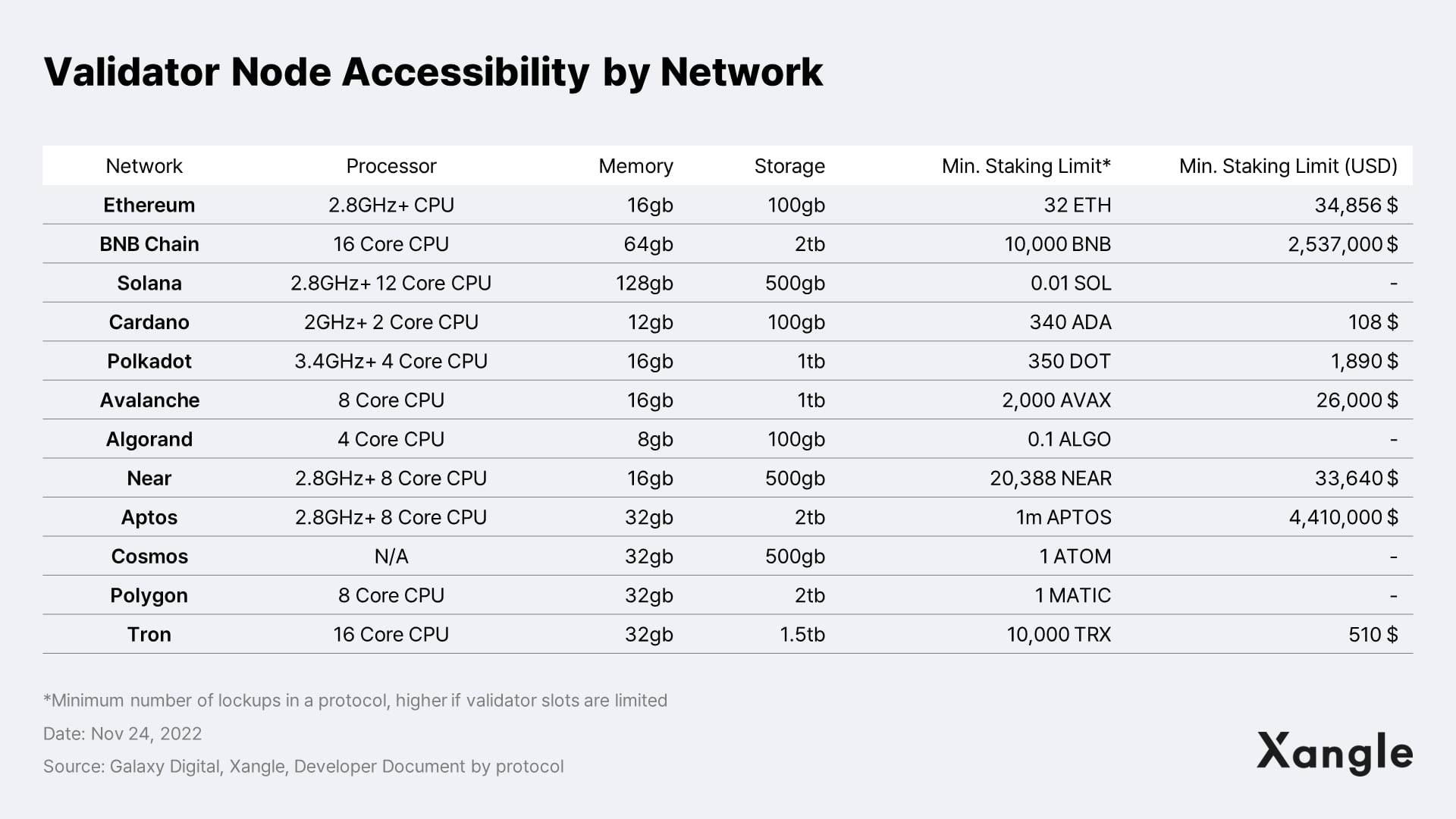
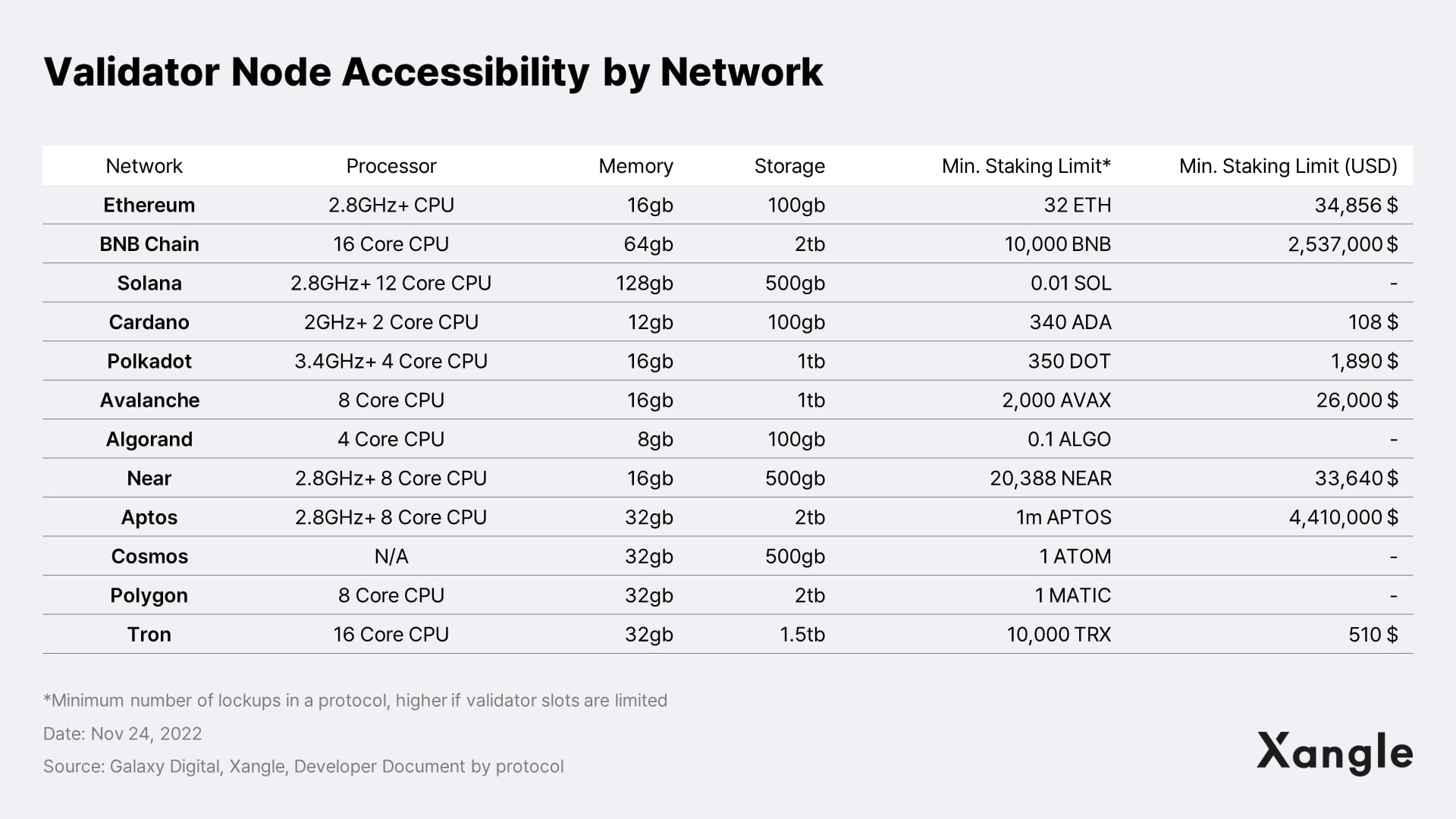
Meanwhile, a PoS chain is as secure as the number of validator nodes. The higher the number of validators and distribution of staked assets, the less susceptible the network becomes to a security breach. The requirements for running a validator node vary between different PoS chains and may significantly impact the network’s decentralization and security.
Source: Xangle
Even though the number of validators on PoS chains tends to scale linearly following the network’s launch, factors such as the minimum staking limit and hardware requirements may impede growth. Networks with minimal setup demands and substantial economic value achieve greater security and decentralization in the long term.
Pros and cons of proof-of-stake in crypto
Like other consensus mechanisms, proof-of-stake has unique advantages and disadvantages. The benefits account for its wide adoption across the crypto ecosystem, while the weaknesses reveal why established networks such as Bitcoin continue to run on PoW consensus.
Pros
- Energy efficiency: PoS chains are energy efficient because validators are chosen based on staked assets or arbitrary requirements such as reputation and stake duration. Hardware requirements are also relatively accessible compared with running a PoW mining operation.
- Fast and cheap transactions: Some proof-of-stake chains offer fast and efficient transactions, which makes them ideal for decentralized applications and other modern blockchain use cases. It is important to note that not all proof-of-stake implementations reduce fees. For example, Ethereum’s transition to PoS did not make significant changes to the model (maximum extractable value) responsible for transaction cost and speed. As a result, the network is still prone to high fees and congestion.
- Flexibility to change and evolve: Validators can easily vote to modify various PoS implementations to adapt to the network’s needs. However, such modifications are usually challenging to execute on a legacy model such as PoW because of technological limitations.
Cons
- Relative infancy: PoS and recent adaptations to the consensus mechanism are very new and thus unproven over extended periods. Fears remain that unique vulnerabilities may emerge as the model sees wider adoption.
- Inferior security: The system remains vulnerable since PoS chains tie their value to the underlying currency instead of a real-world asset. PoS networks must make extra efforts to discourage wealthy participants from buying influence. This can increase the protocol’s complexity and make it more difficult to audit for bad behavior. PoW chains require energy investments which are not correlated with the crypto asset. They are still prone to wealthy centralized forces. However, it is more difficult to manipulate the cost of energy than crypto.
- Centralization of power and governance problems: The system also tends to become more centralized as the rich perpetually increase their dominance due to having a high stake in the network. Validators with significant holdings can also have an excessive influence on transaction verification.
- Stringent exit rules: To combat the ease at which validators can exit their position, some PoS chains may require locking up staked coins for a minimum amount of time – often with no end. Such arbitrary rules may impose huge losses on validators, as they cannot react to market developments.
- Security laws enforcement: The SEC made proof-of-stake services the target of their enforcement when they charged Kraken for its staking service. Gary Gensler also hinted that the protocols themselves may be a target when he said the group of entrepreneurs and developers behind protocols with locked tokens “should seek to come into compliance.” The SEC also listed three PoS tokens — ALGO, OMG and TKN — along with DASH, NGC and IHT, as securities in a lawsuit against crypto exchange Bittrex. Their argument was more rooted in the evidence of centralizing forces behind each token and the expectation of profit from token holders. Many argue that staking yield usually constitutes an expectation of profit – an essential tenet of the Howey Test.
Read more: Will The SEC Target Crypto Validators and Protocols Next?
Proof-of-stake cryptocurrencies
Proof-of-stake is most cryptocurrencies’ preferred consensus mechanism, especially blockchains focused on hosting decentralized applications. At the time of writing, six of the top 10 cryptocurrencies implement the native PoS mechanism or a modified version. Here are the top PoS cryptocurrencies:
- Ethereum: The second-largest cryptocurrency network, Ethereum migrated to PoS in 2022 as part of broader efforts to scale its ecosystem. The network had initially operated the PoW consensus model until making the switch.
- BNB: Binance-backed BNB Chain implements a modified version of PoS called proof-of-staked-authority (PoSA). The model is considered more centralized but offers greater scalability.
- Cardano: Launched in 2017, Cardano adopts the native PoS, using its native Ouroboros protocol to determine the next block producer. Although the network’s speed pales compared to competitors, Cardano is generally considered one of the leading adopters of the PoS model.
- Solana: The Solana network uses PoS alongside other novel protocols to deliver extremely cheap and fast transactions. Notably, the network ranks high on the list of PoS cryptocurrencies despite persistent liveness issues.
- Polkadot: Polkadot is another blockchain project that adopts a modified PoS version. The network utilizes a nominated proof-of-stake (NPoS) protocol which selects validators based on past performance.
The future of proof-of-stake
PoS chains offer greater energy efficiency and scalability features that account for its wide adoption with the cryptocurrency system. But if there isn’t enough validator diversity, the protocol can suffer from censorship, security and slashing risks. These risks, though, are similar to PoW and many other consensus mechanisms.
And while PoS services and tokens have been the target of regulation by enforcement, it doesn’t mean that policy is settled. There is a strong argument for classifying many of these tokens as commodities – as long as they are properly decentralized and protocol staking risks are minimized.
The advent of the proof-of-stake consensus model has paved the way for blockchains to power multiple use cases previously unimaginable. These capabilities have already played a crucial role in onboarding mainstream audiences to the blockchain and look set to continue doing so for the foreseeable future.


