
Blockchains move billions in value every single day. But on their own, they operate in isolation. They cannot see prices, events, or outcomes outside their own network. That gap limits what smart contracts can actually do.
Chainlink exists to close this gap. It connects blockchain networks to real-world data, external systems, and other blockchains using oracles. And it has already become critical infrastructure across Web3.
What Is Chainlink (LINK)?
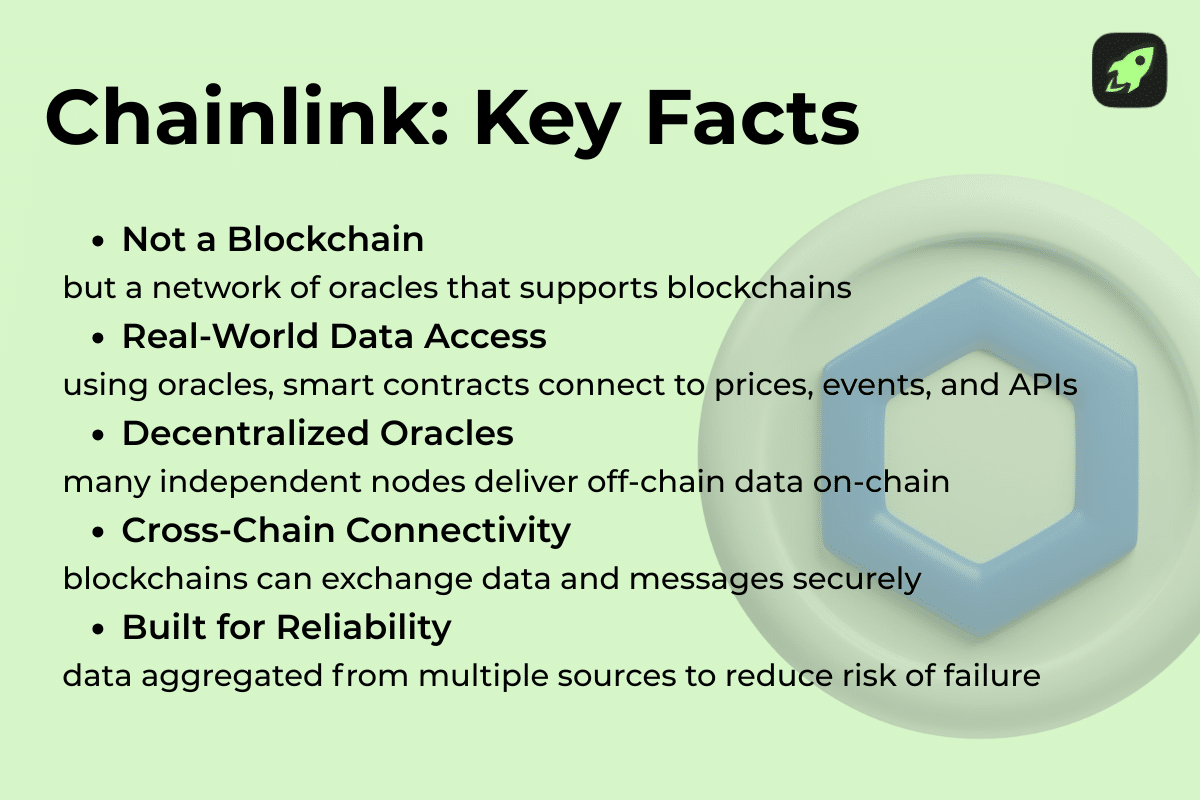
Chainlink is a decentralized oracle network (DON) that connects on-chain smart contracts to real world data, off-chain systems, and external services. Hundreds of oracle nodes retrieve, verify, and deliver data to smart contracts. These nodes operate across many blockchains, including the Ethereum network and others.
Since blockchain networks can’t access information outside their own chain, Chainlink provides a solution by acting as a secure data layer between the chain and the outside world. It doesn’t replace blockchains. It supports them instead.
The network aggregates data from multiple sources, relies on independent node operators, and reduces single points of failure. This allows smart contracts to react to real-time data under certain conditions without trusting one provider, which makes the network appealing to developers, DeFi protocols, and institutions that need dependable infrastructure.
Chainlink was proposed in 2017 and launched in 2019 by Sergey Nazarov and Steve Ellis, who set out to solve the oracle problem (more on that below) in a way that could scale beyond single applications. The project’s development is led by Chainlink Labs, a US-based company focused on blockchain infrastructure.LINK is the native cryptocurrency of the Chainlink network. It pays node operators and secures the system through staking.
What Makes Chainlink Different from Other Blockchain Networks
The first main difference is that Chainlink isn’t actually a blockchain network. It’s a decentralized oracle network, not a base layer.
Blockchains are concerned with consensus, transaction ordering, and state changes. Chainlink is focused on data. Its role is to connect blockchains to information they cannot access themselves.
Chainlink operates across many blockchains instead of competing with them. This design allows Chainlink to serve Ethereum Layer 2 networks, and other blockchains like Avalanche, Polkadot, and Cosmos all at the same time.
In short, Chainlink complements blockchain networks. It isn’t actually one itself.
Why Blockchains Need Chainlink: The Oracle Problem
Smart contracts can only use data stored on their own blockchain. They cannot verify prices, events, or outcomes outside their system. This limitation is known as the oracle problem.
However, using a single oracle to solve that problem creates a lot of risk—what’s called a single point of failure. For example, if it fails or delivers bad data, the contract still executes. That exposes users to losses and manipulation.
So instead, Chainlink offers a decentralized oracle network (DON). Instead of trusting one provider, smart contracts can rely on multiple independent nodes. These nodes retrieve data from multiple sources and reach consensus before delivering it on-chain.
How Chainlink Works: Step-by-Step Overview
Chainlink acts as a secure data layer between smart contracts and external systems. Let’s break down every step of its operations.
Core Components
- Smart contracts
Smart contracts define what data they need and how they respond. Many Chainlink-powered applications use hybrid smart contracts that combine on-chain logic with off-chain data. - External data sources
These include APIs, market data feeds, financial reports, and other off-chain services that provide real-world information. - Chainlink oracle nodes
Oracle nodes retrieve data from external sources. Independent node operators run these nodes and maintain uptime, accuracy, and security. - LINK tokens
LINK tokens pay node operators for services and secure the network through staking.
Step-by-Step Oracle Flow
- Step 1: Smart contract requests data
A contract specifies the data it needs and requests it from an oracle. - Step 2: Chainlink nodes retrieve off-chain data
Chosen oracles pull data from external sources. - Step 3: Nodes validate and sign data
Each node verifies the data independently. - Step 4: Aggregation contract combines results
An aggregation contract reconciles data from multiple sources. - Step 5: Final data is delivered on-chain
The verified result reaches the original smart contract. - Step 6: Node operators receive LINK as payment
The system pays node operators for reliable service.

How to Get Free Crypto
Simple tricks to build a profitable portfolio at zero cost

Chainlink Data Feeds: Price Oracles for DeFi
Chainlink Data Feeds deliver real-time price data to smart contracts.
These feeds aggregate data from hundreds of independent oracles and multiple premium sources. This prevents reliance on a single source and improves reliability. Plus, many of these feeds use Chainlink’s off-chain reporting (OCR) system, which reduces on-chain costs by aggregating data off-chain before final submission.
DeFi applications use data feeds to trigger liquidations, rebalance positions, and settle derivatives. Without accurate data, these systems fail.
Chainlink data feeds are the most widely used oracle service in the crypto ecosystem and already secure tens of billions in value across blockchain networks.
Chainlink VRF: Verifiable Randomness for Games and NFTs
Blockchains can’t generate fair randomness on their own. So the Chainlink Verifiable Random Function, or VRF, delivers cryptographically secure randomness that smart contracts can verify. The system proves that its results were not manipulated or predicted.
VRF uses a commit-reveal scheme to ensure integrity. P2E games, NFT mints, and lotteries rely on VRF to guarantee fair outcomes without trusting a central party.
Chainlink Proof-of-Reserve: On-Chain Reserve Verification
Proof-of-reserve verifies that on-chain assets are backed by off-chain reserves.
Chainlink pulls data from custodians, banks, and auditors. Smart contracts use this data to verify backing in real time. If reserves fall below required levels, contracts can react automatically. This system improves transparency for stablecoins and wrapped assets, as well as reducing counterparty risk.
Chainlink CCIP: Cross-Chain Interoperability Protocol
Chainlink CCIP, the Cross-Chain Interoperability Protocol, enables secure messaging and value transfer across multiple blockchains. It allows smart contracts to interact across chains using a shared standard.
CCIP relies on the same decentralized oracle network and security model as other Chainlink services. It’s already been tested through a SWIFT integration and a DTCC pilot, where the protocol was used to explore cross-chain settlement and messaging between traditional financial systems and blockchain networks.
Chainlink Automation and Chainlink Functions
Chainlink Automation allows smart contracts to execute automatically based on time or events. This removes the need for manual triggers.
Chainlink Functions let developers connect smart contracts to custom APIs and cloud services. They simplify retrieving data and running off-chain logic. Developers define these workflows through Chainlink job specifications, which tell nodes when and how to perform tasks.
Together, these tools support fully automated hybrid smart contracts.
The LINK Token: Utility, Staking and Tokenomics
LINK is the native cryptocurrency of the Chainlink network. Developers use LINK to pay node operators for retrieving data and delivering services. Node operators stake LINK to secure the system and earn rewards for good performance.
Chainlink has a maximum supply of 1 billion LINK tokens. As of 2025, around 700 million of these tokens have been issued and are in active circulation. LINK also plays a growing role in network security through Chainlink Staking v0.1 and v0.2, and further expansions planned under v0.3.
Chainlink Nodes, Node Operators and Ecosystem
The Chainlink network relies on independent node operators. These include Web3 teams, data providers, and traditional infrastructure companies. Some come from Web2 backgrounds, including telecommunications—Vodafone, for example, which has explored blockchain connectivity through its Digital Asset Broker initiative.
Chainlink uses a reputation-based rewards system to manage performance. Reliable nodes earn more work and rewards. Poor performance metrics reduce future opportunities.
Chainlink Labs leads development of the core software. Steve Ellis, one of the co-founders, helped design the original architecture. A global community operates and secures the network.
Chainlink Use Cases
Chainlink use cases show how oracle infrastructure works in practice. Let’s take a look at some examples:
DeFi
DeFi protocols rely on Chainlink for price feeds, automation, and risk management. Lending and derivatives platforms like Aave, Compound, and Synthetix use Chainlink data feeds to price assets, trigger liquidations, and settle positions using real-time data pulled from multiple sources.
NFTs and Gaming
NFT projects and games use Chainlink VRF for fair randomness. Platforms such as Axie Infinity, Loot, and various on-chain games rely on VRF to assign random traits, distribute rewards, and ensure outcomes cannot be predicted or manipulated.
Enterprise and Finance
Banks and enterprises use Chainlink to connect legacy systems to blockchain networks. Through CCIP and oracle infrastructure, organizations like SWIFT, DTCC, and ANZ Bank have tested cross-chain messaging, settlement, and asset movement between traditional financial systems and blockchains.
Public Sector and Beyond
Chainlink has delivered verified data for elections, sports outcomes, and public reporting. Oracle-powered data has been used to automate reporting for sports leagues, election result aggregators, and media organizations, with Chainlink infrastructure supporting data delivery for thousands of outlets globally.
Benefits and Risks of Chainlink and LINK
Chainlink reduces the risks of using single oracles by decentralizing their services, but it’s not entirely risk-free. Here’s a balanced comparison of its benefits and challenges.
| Benefits | Risks |
| Widely adopted oracle network | Dependence on external data quality |
| Strong decentralization and security | Competition from Band Protocol, API3, and Pyth Network |
| Broad support across many blockchains | LINK token price volatility |
How to Buy Chainlink as a Beginner
You can buy LINK on many online platforms. Start by choosing a reputable service that supports Chainlink and offers payment methods you already use.
Changelly lets you buy LINK using more than 20 local payment methods, including cards and bank transfers, and receive the tokens directly into your wallet. This approach keeps the process simple and avoids complex trading interfaces that can overwhelm beginners.
You can also find out more about the coin’s potential in our Chainlink (LINK) price prediction.
Final Thoughts
Chainlink solves a practical problem that every blockchain application faces: accessing reliable information from outside the chain.
By connecting smart contracts to real-world data, it makes many new Web3 use cases possible. Its broad adoption across DeFi, NFTs, and enterprise projects shows its role as core infrastructure rather than a speculative tool. Understanding how Chainlink works helps you evaluate its value and risks more clearly before engaging with LINK or oracle-based applications.
FAQ
Is Chainlink a blockchain or an oracle network?
Chainlink isn’t a blockchain. It’s a decentralized oracle network (DON) that supplies data and services to many blockchain networks.
How does Chainlink compare to other oracle projects?
Chainlink focuses on decentralization, security, and broad adoption, while other oracle projects use different trade-offs in data sourcing, network design, or specialization.
Can Chainlink be replaced or copied by competitors?
Competing oracle networks exist, but Chainlink’s scale, integrations, and reputation system make it difficult to replicate its success quickly.
Is Chainlink only about price feeds, or more than that?
Chainlink provides randomness, automation, proof-of-reserve, and cross-chain communication, not just pricing data.
Disclaimer: Please note that the contents of this article are not financial or investing advice. The information provided in this article is the author’s opinion only and should not be considered as offering trading or investing recommendations. We do not make any warranties about the completeness, reliability and accuracy of this information. The cryptocurrency market suffers from high volatility and occasional arbitrary movements. Any investor, trader, or regular crypto users should research multiple viewpoints and be familiar with all local regulations before committing to an investment.


