

As the crypto world grows, it’s becoming more fragmented. We have dozens of chains, each with its own rules, tokens, and user base. But most of them can’t talk to each other directly.
That’s where Layer-0 comes in. It offers a shared underlying infrastructure to route messages, move assets, and verify activity across blockchains—without creating new bottlenecks. Projects like LayerZero, Cosmos, and Polkadot are building this base layer to make all chains feel like one.
This guide explains how Layer-0 works, what makes it different from bridges, and why it could be one of the most important layers in blockchain technology.
What Exactly is Layer-0?
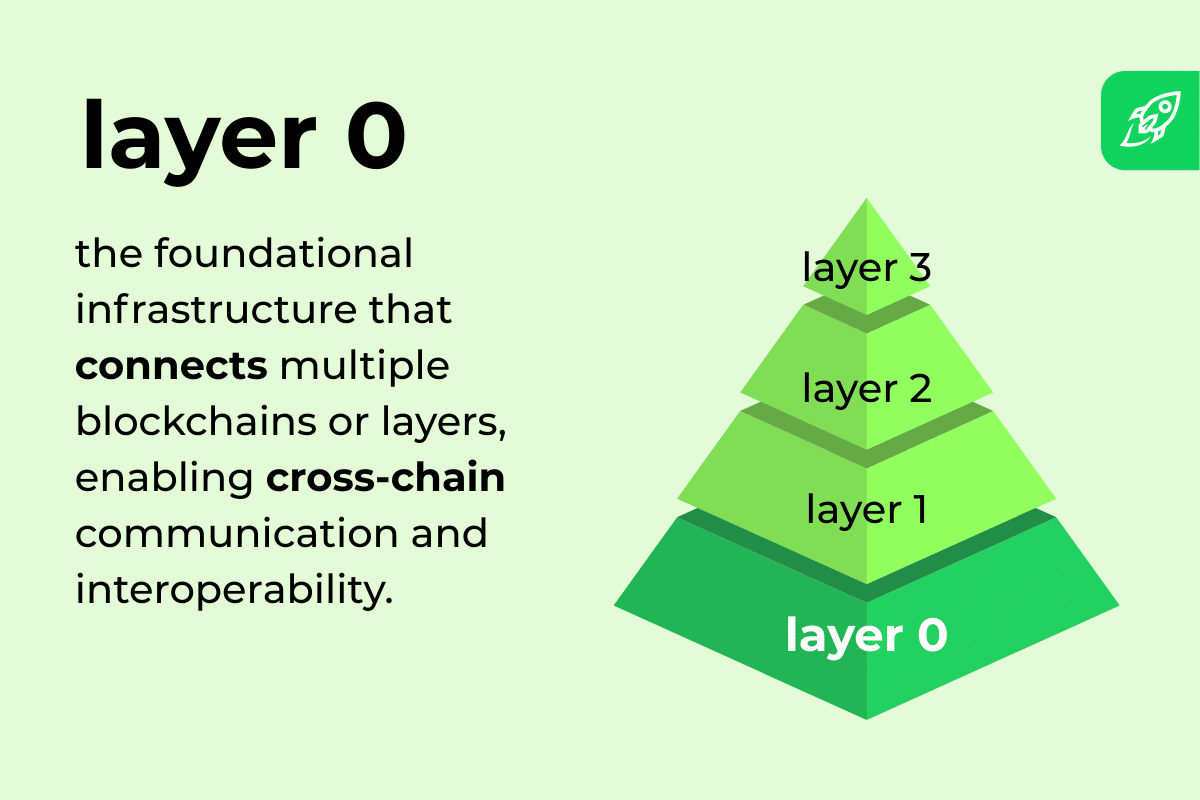
Layer-0 refers to the base-level blockchain protocols that support communication and interaction across chains. If you think of Layer-1s (like Bitcoin or Ethereum) as the operating systems of crypto, then Layer-0 is the internet cable—connecting those systems into a unified, more tightly interwoven network.
Unlike Layer-1s, Layer-0 doesn’t process smart contracts or store transactions directly. Instead, it facilitates efficient data communication between chains. It lets one smart contract on Chain A send a message to Chain B, and ensures that message is real, verifiable, and tamper-proof.
In short, Layer-0 is the flexible base infrastructure beneath the entire blockchain ecosystem—enabling cross-chain functionality and powering the next generation of decentralized applications.
The Two Meanings of “Layer-0”
When we talk about Layer-0, we’re referring to both a technology concept and specific projects that implement it in real-world applications.
- Layer-0 (technology): A general term for protocols designed to connect different blockchain layers and enable seamless data exchange. These protocols form the backbone for interoperability across chains. Well-known examples include Cosmos, Polkadot, Avalanche, and the LayerZero framework.
- LayerZero (project): A specific implementation of the Layer-0 vision. It connects blockchains through lightweight messaging instead of relying on shared consensus. LayerZero powers cross chain transfer protocols that let assets and messages move across networks with minimal friction. It’s often described as the “omnichain messaging layer” of crypto.
You’ll see both meanings of Layer-0 used throughout this article—the general class of Layer-0 protocols, and LayerZero, one of the most advanced platforms in this category.
How Layer-0 Differs from Traditional Bridges
So, as we established before, Layer-0 is the connective tissue of Web3—the foundational layer that links blockchain networks into a single, functional ecosystem. At first glance, Layer-0 sounds a bit like a bridge—both aim to move tokens and data across chains. But there are key differences.
Traditional bridges rely on centralized entities or validator networks to lock tokens on one chain and mint “wrapped” tokens on another. This setup often creates a single point of failure, which hackers have repeatedly exploited. Over $2.8B was lost to bridge hacks in 2022 alone. These bridges also introduce liquidity fragmentation and trust issues.
In contrast, Layer-0 protocols use a tightly interwoven network of smart contracts and off-chain agents to validate messages. There’s no wrapped token or custody—just secure messaging between chains. Think of it more like a TCP/IP layer for crypto, rather than an escrow service.
This structure eliminates reliance on third parties and drastically reduces attack surfaces. It also allows blockchain networks to interoperate seamlessly, even if they use different consensus mechanisms or programming languages.
How Does Layer-0 Work?
Layer-0 functions like a decentralized router. It doesn’t host apps itself—it moves data between them. To do this securely, it combines several components that ensure trustless, reliable communication across chains.
Let’s walk through the architecture.
Endpoint Nodes
An endpoint is a smart contract deployed on each participating chain. It acts as the messenger’s inbox and outbox. If a user wants to send tokens or data across chains, they interact with the local endpoint—which packages the data and prepares it for delivery.
Endpoints don’t verify messages on their own. Instead, they rely on two independent off-chain actors: the Oracle and the Relayer.
Oracle and Relayer
The Oracle retrieves the block header from the source chain. The Relayer brings the message payload and a proof that the message exists in that block. Only when both pieces arrive and match does the destination endpoint execute the message.
This two-part check makes it nearly impossible to fake a message. For example, to forge a cross-chain swap, an attacker would have to simultaneously trick both the Oracle (say, Chainlink) and the Relayer—an unlikely feat.
The beauty of this model is that it can support many setups. Developers can run their own Relayers, pick trusted oracles, or use LayerZero’s defaults. It’s modular, and it’s why LayerZero and other Layer-0 solutions don’t require their own consensus algorithms to secure the network.
Ultra Light Nodes (ULNs)
ULNs are LayerZero’s version of a light client—they only ask for what they need. Instead of downloading the entire history of a foreign chain, a ULN will request just the minimum cryptographic proof needed to verify a message.
This design dramatically improves performance. Traditional light clients are secure but heavy on transaction processing. ULNs give you the same result with less load, making Layer-0 fast and scalable.

What Problems Can Layer-0 Solve?
L0 solves some of the biggest problems holding crypto back today—and it does it in a modular, decentralized way.
Interoperability
The most obvious win is blockchain interoperability. Different blockchains operate in silos. Ethereum doesn’t speak Solana’s language. BNB Chain doesn’t talk natively to Avalanche. Moving assets or data between them often requires using centralized bridges, wrapped tokens, or clunky workarounds that compromise decentralization and security.
Layer-0 changes this. By providing a base messaging layer, it lets smart contracts across different blockchains communicate directly—without needing a third-party chain or custodial system in between. This not only simplifies UX but also unlocks a new class of decentralized applications that can operate across chains without duplicating logic or liquidity.
With LayerZero, a lending protocol on Arbitrum could let you deposit collateral on Optimism. An NFT marketplace on Ethereum could list assets from Solana. The key is direct, verifiable messaging between chains—a foundation for unified, multi-chain systems.
Scalability
Layer-0 protocols don’t directly increase transaction throughput like rollups or sharding. Instead, they improve network-level scalability by distributing workloads across chains and making those chains interoperate seamlessly. This relieves pressure from any single chain and enables developers to build horizontally.
For example, instead of scaling Ethereum by cramming more into it, a Layer-0-enabled app can run core functions on Ethereum and delegate other parts—like payments or gaming logic—to cheaper or faster chains. The logic and state are synced across chains through LayerZero’s messaging protocol.
In effect, Layer-0 is an evolved alternative to pure vertical scaling. It allows parallel processing across networks, which scales the ecosystem as a whole without depending on one chain’s capacity.
Developer Flexibility
For developers, Layer-0 unlocks plenty of new options. They’re no longer tied to a single chain or ecosystem. They can build user-defined functions that span chains, use different chains for different functions (e.g., one for smart contracts, one for data storage), or even launch parallel chain deployments to reduce costs.
LayerZero also supports different blockchain protocols and VM types. It connects EVM chains, Cosmos chains, Solana, Aptos, and more—all without asking them to change their consensus mechanisms.
This flexibility lets developers optimize network topology to fit their needs—whether they want maximum security, low fees, or both.
Real-World Use Cases of Layer-0
LayerZero has already seen massive adoption across the crypto ecosystem. It’s currently powering bridges, swaps, NFTs, games, and more across multiple blockchains. Here are a few real examples that show its impact.

Cross-Chain Decentralised Finance (DeFi)
DeFi thrives on liquidity. But when that liquidity is split across chains, it becomes inefficient. LayerZero solves this by allowing cross-chain messaging and execution.
Take Stargate Finance, a protocol built on LayerZero. It lets users transfer stablecoins like USDC and USDT between chains instantly and with finality. It’s trusted by major DeFi platforms like SushiSwap and PancakeSwap for cross-chain swaps.
Another case: Radiant Capital, a lending protocol, lets users deposit collateral on one chain and borrow from another. With LayerZero, it’s able to unify liquidity and manage loans across networks—all while maintaining robust security.
This kind of inter blockchain communication is exactly what DeFi needs to scale.
Multi-Chain Gaming Ecosystems
In gaming, speed and flexibility are key. Players don’t care about which chain their items live on—they care that the game works. LayerZero enables cross-chain game economies where assets like weapons or skins can move across networks with zero friction.
For example, a game might store high-value NFTs on Ethereum and handle gameplay on a fast Layer-2 scaling solution like Arbitrum. LayerZero can sync inventories, reward claims, and in-game marketplaces between these environments. Smart contracts on each chain send verified messages through LayerZero, creating a seamless gaming experience.
One early adopter was the Flow blockchain, known for NBA Top Shot. With LayerZero integration, Flow can now connect to chains like Ethereum and Polygon, bringing its collectibles into wider ecosystems.
NFT Marketplaces Across Different Blockchains
NFTs used to be bound to the chain they were minted on. That’s now quickly changing. Omnichain NFTs—enabled by LayerZero—can move between chains without wrapping or re-issuing. This preserves ownership and simplifies the user experience.
Ghostly Gh0sts was the first fully omnichain NFT project. Minted across seven chains, each NFT could move freely from one network to another using LayerZero. The transfer process involved burning the NFT on the source chain and minting it natively on the target chain—no wrapped assets, no custodial bridges.
This model is now used by other marketplaces like TofuNFT, where omnichain collections can trade across platforms. It unlocks interconnected value chains where one asset retains value and identity across multiple networks.
Decentralized Applications (dApps) with Cross-Chain Capabilities
Beyond DeFi and NFTs, LayerZero powers a new class of dApps: omnichain apps or “OApps”. These dApps don’t live on a single chain—they live on LayerZero’s foundational layer, using endpoints across networks to coordinate logic.
Imagine a DAO that governs funds on Ethereum but votes on Arbitrum. Or a yield aggregator that hunts for APYs across ten chains. Or a decentralized exchange that lets you swap assets between BNB Chain and Optimism in one click. All of these are live today—and they’re powered by LayerZero.
So, this isn’t just a UX upgrade. It’s a structural shift in how apps get built, enabling more flexible base infrastructure that can grow with demand.
Challenges and Criticisms of Layer-0
No protocol is perfect, and Layer 0 protocols face their share of scrutiny. While LayerZero has gained traction, several challenges remain—especially when it comes to decentralization, security assumptions, and interoperability standards.
Centralization Concerns
In early versions, LayerZero relied on a default Oracle and Relayer setup—often controlled by LayerZero Labs. While this worked well in practice, critics pointed out the risk: if both Oracle and Relayer were compromised or colluded, a message could be spoofed. That contradicts the very principles of blockchain technology.
The team responded with LayerZero V2. It introduced decentralized Oracle and Relayer networks, allowing anyone to join as a verifier or executor. It also supports custom setups, so developers can choose independent third parties or even require multiple signers per message. Still, decentralization is a spectrum here. Projects must choose wisely when configuring security.
Security Trade-Offs
LayerZero gives developers full control over who verifies cross-chain messages. This flexibility is powerful—but it also opens the door to misconfigurations.
For example, if a project uses the same entity as both Oracle and Relayer, the system’s trust assumptions weaken. That’s why it’s critical for applications to validate data properly before acting on any incoming message.
To help prevent major issues, LayerZero introduced Precrime—a feature that simulates cross-chain messages before they’re executed. If a transaction looks suspicious, such as one draining a full wallet, the system can flag and block it. While Precrime adds a valuable layer of protection, some critics argue it introduces complexity and doesn’t fully replace on-chain safeguards.
Ecosystem Fragmentation
LayerZero isn’t alone in tackling cross-chain communication. Competing protocols like Axelar, Wormhole, Chainlink CCIP, and Cosmos’s IBC all offer their own approaches to enabling interoperability. But this variety can also create a fractured landscape, with apps and users split across different ecosystems.
To reduce that fragmentation, LayerZero V2 introduced support for adapters. These connectors let a dApp combine LayerZero’s infrastructure with third-party networks—verifying messages through services like Axelar or CCIP. It’s a smart step toward greater cohesion, allowing blockchains to interoperate seamlessly, even if they use different underlying architectures. Adoption is still early, but the potential for unified cross-chain logic is there.
The Future of The Layer-0 Crypto Network
As demand for seamless communication between blockchain networks grows, LayerZero is positioning itself as the messaging layer of Web3.
The launch of LayerZero V2 marks a major upgrade. It enables full permissionless participation with Decentralized Verification Networks (DVNs) and Executors, creating a more trustless architecture. Apps can define their own network topology, blending oracles, relayers, and even third-party validators to match their security needs.
Just like TCP/IP powers the internet, LayerZero aims to become the default for cross-chain messaging in crypto—what some call the HGTP network for blockchains.
With this flexible base infrastructure, we’ll likely see an explosion of user-defined functions built across chains: think cross-chain yield aggregators, omnichain DAOs, and DeFi platforms that can pull liquidity from ten chains at once.
And this won’t be limited to EVM chains. LayerZero has already integrated with Solana, Aptos, and Flow—and plans to expand to Cosmos, Polkadot, and beyond. For example, imagine if Cosmos Hub transfers assets directly to Ethereum without needing IBC or wrapped tokens. That’s the kind of efficiency LayerZero wants to unlock.
As adoption grows, expect more smart contracts to be designed with cross-chain logic from day one. And if fee switches or ZRO staking come into play, LayerZero could evolve into one of the most widely used revenue-generating protocols in the blockchain ecosystem.
Final Words
The future of crypto won’t be about choosing the “best” chain. It will be about choosing the best combination of chains—and stitching them together with tools like LayerZero.
By focusing on secure, flexible, and customizable messaging between multiple networks, LayerZero unlocks real blockchain innovation. Whether you’re a DeFi builder, NFT creator, or someone exploring new decentralized applications, LayerZero offers the foundation to go omnichain—without compromising on security or UX.
As the crypto space continues to grow, Layer 0 may very well become the foundational infrastructure that quietly powers it all.
FAQ
What blockchains does LayerZero currently support?
As of 2025, LayerZero connects over 50 mainnets, including Ethereum, BNB Chain, Polygon, Avalanche, Arbitrum, Optimism, Solana, Aptos, Flow, and more. Its endpoint architecture allows it to scale to different blockchain layers, EVM or not.
Why is LayerZero important for regular crypto users?
Because it makes cross-chain activity seamless. Whether you’re bridging USDC, buying an NFT, or swapping tokens between chains, LayerZero powers the efficient data communication behind it—without needing users to manage any of the complexity.
How secure is LayerZero compared to other cross-chain solutions?
LayerZero uses a dual-verification model (Oracle + Relayer), meaning messages are only executed if both are in agreement. V2 improves this further by decentralizing both roles. Its design reduces the chances of single-point failures and boosts network security.
Is the LayerZero ($ZRO) token a good investment, and how can investors acquire it?
$ZRO launched in 2024 with a supply of 1 billion. It governs the LayerZero protocol, including the fee switch and possibly rewards in V2. You can get it on Changelly and other major exchanges, but always research before investing—like any asset, it’s tied to network usage and governance.
Where can I start using LayerZero, and what apps are popular right now?
Start with Stargate Finance for bridging, or try cross-chain swaps on Sushi or PancakeSwap. If you’re into NFTs, look up Ghostly Gh0sts—one of the first omnichain collections. These apps showcase what LayerZero can do under the hood, without you even noticing.
Disclaimer: Please note that the contents of this article are not financial or investing advice. The information provided in this article is the author’s opinion only and should not be considered as offering trading or investing recommendations. We do not make any warranties about the completeness, reliability and accuracy of this information. The cryptocurrency market suffers from high volatility and occasional arbitrary movements. Any investor, trader, or regular crypto users should research multiple viewpoints and be familiar with all local regulations before committing to an investment.


