

Let’s be clear: “BTC going to zero” doesn’t mean all the coins vanishing into thin air. It means a total Bitcoin crash—a complete collapse of the BTC price—from today’s value to nothing. In this scenario, we’ll walk through the fallout in detail. How will Bitcoin miners, crypto exchanges, ETF regulators, and even your own wallet react?
You’ll learn what would actually happen, including the effects on proof-of-work mining, hash rates, difficulty adjustments, potential withdrawal suspensions, and possible government actions.
If you’ve ever wondered what happens if Bitcoin crashes to zero, this article is your answer.
Table of Contents
Could Bitcoin Really Fall to Zero?
It’s possible, but extremely unlikely. A total collapse is theoretically possible, but several structural factors make it improbable in practice.
In market terms, a complete collapse would mean buyers disappear, bids thin out, and Bitcoin’s price crashes toward nothing. In that kind of scenario, price would stall near zero, and cryptocurrency markets might freeze trading entirely.
But remember that a Bitcoin crash is not the same as the shutting down of the Bitcoin network. The network can still process blocks, settle and validate transactions—even if each coin has no market value. You’ll still control your private keys. Ownership of coins remains on the blockchain, though that ownership may not have practical value.
This difference helps explain why some experts remain skeptical about Bitcoin investment long-term. Even if the network endures, the token itself could still become worthless.
Read more: Can My Crypto Go Negative?
Why Experts Like Eugene Fama Believe It Could Happen
Nobel laureate Eugene Fama, known for the efficient-markets theory, views Bitcoin differently than many crypto investors. He argues that Bitcoin has no intrinsic value: no interest, no dividends, and no backing. Fama says it is a speculative “bubble” asset. In his view, in an efficient market where Bitcoin’s price reflects all available information, it should eventually converge to zero.
Some secondary reports claim Fama believes this could happen within a decade. If enough investors review the same data and conclude that Bitcoin is worthless, the crash to zero could happen very quickly. While Fama’s argument is rooted in financial theory, critics argue it overlooks Bitcoin’s technical significance and role in global finance. Whether or not the crypto market agrees, his logic shows why a zero-value outcome—while extreme—is not simply theoretical.
Why Many Say It’s Extremely Unlikely
As some argue, some argue Bitcoin could plausibly fall to zero. But there’s another side to this story. Many more believe this outcome is highly unlikely because of several structural market conditions, institutional support, and its decentralized nature. Let’s break them down in more detail:
- Deep global liquidity and 24/7 trading on major crypto exchanges mean a complete collapse of BTC would require a synchronized failure of all financial markets. With millions of holders worldwide, a sudden drive to zero would imply near-universal capitulation, which is historically extremely rare.
- Financial institutions, balance sheets, and ETF (exchange-traded funds) infrastructure now underpin ongoing demand, making a value of zero much less likely. Large asset managers and institutional investors now hold Bitcoin on their balance sheets, adding structural support. However, these components may introduce interconnected risks if confidence collapses.
- Because Bitcoin ownership is highly fragmented and no central entity controls a majority, decentralization acts as a buffer against coordinated liquidations or market manipulation that could otherwise force Bitcoin’s price to hit zero.
- Bitcoin’s proof-of-work consensus ensures network security, and the difficulty adjustment mechanism allows mining operations to continue, providing some long-term stability even if Bitcoin prices fluctuate.
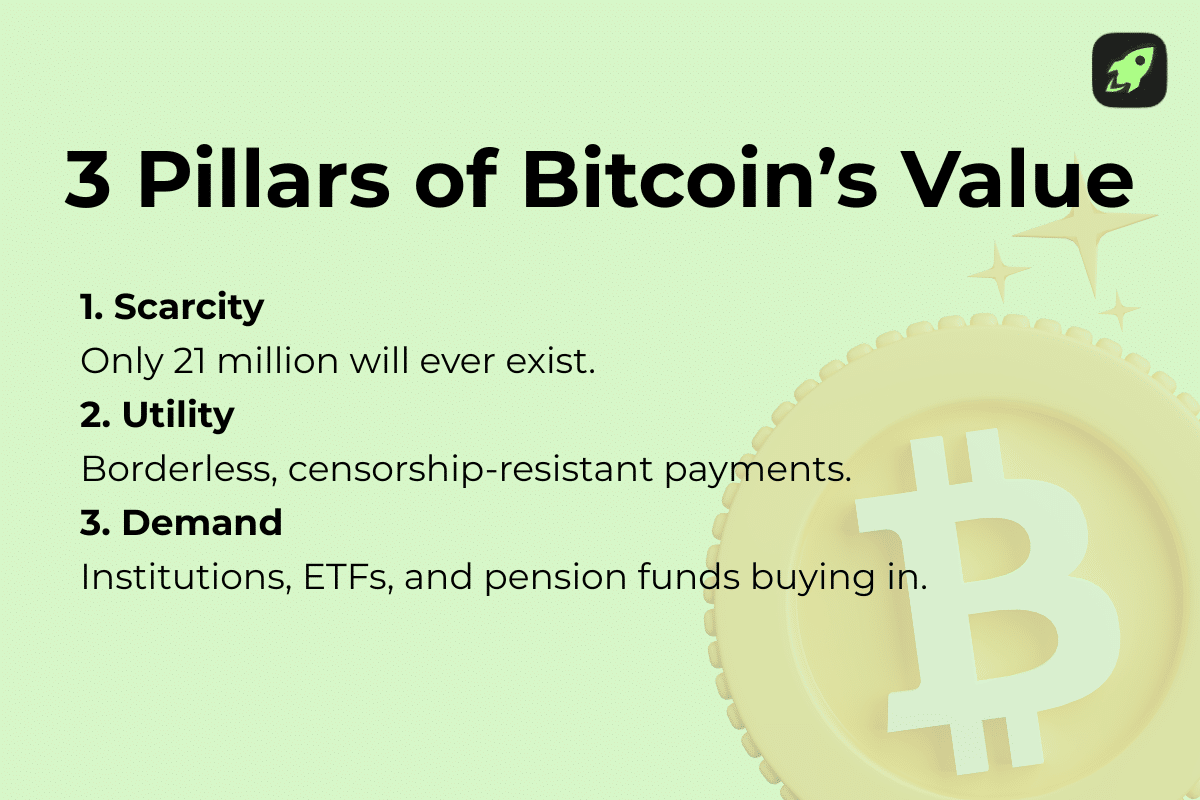
What Gives Bitcoin Value (Scarcity, Utility, Demand)
Bitcoin’s price may not come from intrinsic value cash flows, but it has other forms of value—most notably digital scarcity, utility, and demand.
- Digital scarcity drives much of Bitcoin’s appeal. Its fixed supply of 21 million creates rarity that many see as “digital gold”, especially after they learn about Bitcoin halvings.
- As an open network without a central authority, Bitcoin allows censorship-resistant transactions and fast cross-border settlement, with everything recorded on blockchain technology. Small block size preserves decentralization and incentivizes higher-priority transactions with competitive fees.
- The store-of-value narrative, combined with institutional adoption via regulated custodians and spot Bitcoin ETFs, sustains persistent ongoing demand from pension funds, asset managers, and family offices—not just retail market speculation.
Read more: Why Does Bitcoin Have Value?
Five Plausible Routes to Zero
Even though a total Bitcoin crash remains unlikely, Bitcoin could lose all market capitalization through major shocks like loss of trust, technological failure, legal suppression, infrastructure breakdown, or miner-driven collapse.
- Loss of public trust and confidence collapse
Bitcoin’s collapse may start with a loss of confidence. Reflexivity—a cycle where Bitcoin falls and causes more selling and thinner liquidity, which fuels panic selling—can quickly make downturns self-reinforcing. When faith in the financial system evaporates, even robust technical setups cannot prevent collapse. - Catastrophic protocol failure or quantum-hack scenario
A catastrophic protocol failure means a fundamental break in the rules that govern the Bitcoin blockchain technology’s consensus, leading the network to lose synchronization or security. A future quantum attack may also compromise Bitcoin’s signature scheme, enabling unauthorized spending across the entire network. A full cryptographic break could result in massive coin thefts and security breaches—the kind of systemic loss of trust that could send Bitcoin’s price to zero with no clear path to recovery. - Global regulatory ban or severe government crackdown
Regulatory crackdowns such as restricting banking access, imposing punitive tax policies, or banning Bitcoin mining outright can choke liquidity and adoption simultaneously across the cryptocurrency market, removing the institutional and retail demand that underpins Bitcoin’s price. - Exchange and infrastructure meltdown
During a Bitcoin crash, exchanges might suspend withdrawals to prevent liquidity vanishing. In extreme liquidity crunches like this, the price of Bitcoin could briefly print near zero on some exchanges before rebounding—locking in permanent losses for trapped users. The key lesson: not your keys, not your coins.
Learn more about safely storing your coins: Exchange vs. Wallet: Key Differences
- Mining economics collapse
Bitcoin mining profitability is measured by hashprice. If the crypto market collapses and this metric drops too quickly, miner capitulation follows—Bitcoin miners shut off rigs, the hash rate drops, and network security weakens. A severely weakened network accelerates the loss of confidence, potentially turning a crash into Bitcoin’s total collapse.

How to Get Free Crypto
Simple tricks to build a profitable portfolio at zero cost

What Happens Step-by-Step When Bitcoin Collapses
A complete collapse of Bitcoin will likely unfold in these five overlapping phases. They may play out differently on distinct platforms or in different regions.
Phase 1: Price Plunges, Order Books Widen, Stablecoins Wobble
Bitcoin’s collapse begins with severe price crashes and thinner order books. When the spread between the highest bid and lowest ask widens, even small trades can cause big swings in the market price.
Next, stablecoins may lose their peg, like what happened with USDT in 2022, which dipped to $0.92 before recovering—showing even widely used digital currencies are not immune to Bitcoin’s volatility.
Finally, leverage accelerates the crash: as Bitcoin’s price drops, margin calls and forced liquidations will trigger panic selling and push prices even lower, feeding a negative feedback loop.
Phase 2: Withdrawal Suspensions, Custody Freeze, Panic Spreads
As liquidity vanishes and panic selling rises, centralized crypto exchanges (CEXs) may halt withdrawals. Users will then be forced to wait indefinitely, unable to access their funds.
Asset managers, brokers, and lenders may also freeze crypto assets voluntarily or by court order. Those holding funds on exchanges are most affected. In these moments, self-custody (using a cold wallet) gives users full control regardless of market conditions.
Read more: What is Self-Custody? A Beginner’s Guide
Relying on third-party intermediaries (such as exchanges) exposes users to counterparty risks. The best practice is to store coins in private wallets, not exchange accounts.
Phase 3: Network Congestion, Fees Explode, Confirmations Slow
With so many people trying to move Bitcoin at once, transactions pile up in the mempool and fee markets become highly competitive. Only a limited number of transactions can be added to each block, so users bid higher fees—sometimes escalating from cents to $50 or more. Confirmations slow as the mempool grows, making both costs and wait times unpredictable across the entire cryptocurrency ecosystem.
Phase 4: Miners Turn Off Rigs, Hash-Rate Drops, Difficulty Retarget Kicks In
Bitcoin miners begin to shut down rigs to cut losses, shrinking the hash rate—the total computing power securing Bitcoin. Difficulty adjusts every 2,016 blocks, roughly every two weeks, so widespread shutdowns will slow block times significantly until the adjustment event resets mining difficulty.
A weakened hash rate will open the door to 51% attacks, giving malicious actors the ability to rewrite recent transactions or double-spend coins—a form of market manipulation—further eroding trust in the Bitcoin network.
Phase 5: TradFi/ETF Plumbing Stress Shows Up (Creation/Redemption Strains)
A full Bitcoin crash now affects traditional finance. Spot Bitcoin ETFs, which let investors gain exposure without holding private keys, rely on a process called creation/redemption to keep prices in sync. A Bitcoin crash could disrupt these flows, causing ETF shares to trade at steeper discounts or premiums and, in extreme cases, prompt trading halts—straining the broader financial system.
Large asset managers offering exchange-traded funds and futures trading instruments tied to Bitcoin could face severe market sentiment swings, affecting retirement accounts and financial products that now carry Bitcoin exposure.
This liquidity mismatch shows how Bitcoin’s collapse could ripple into global finance as well as crypto wallets—and potentially affect the entire economy if institutional adoption has run deep enough.
Final Thoughts
A Bitcoin crash wouldn’t just hit your portfolio, but test every layer of the system at once. The good news is that most of the risk is manageable with basic habits: know where your coins are, don’t leave more on exchanges than you can afford to lose, and keep your seed phrase somewhere safe. None of this is complicated. The people who fare best in a crisis are usually the ones who prepared before it started.
FAQ
If Bitcoin hits zero, do I lose my coins?
Not automatically—if you hold your own private keys, you still own your BTC, it just may have no tradable value. Centralized platforms may freeze funds, so custody will determine access.
How long until blocks normalize after a Bitcoin crash?
Difficulty adjusts every 2,016 blocks (roughly every two weeks), but only if blocks keep being found at a normal rate—so normalization depends on mining activity, not just time passing.
Could an ETF collapse make things worse?
Yes, an ETF unwind may trigger panic selling and strain the creation/redemption process, though it doesn’t affect the Bitcoin network itself.
What might regulators do if crypto crashes?
Expect stricter KYC, increased tax monitoring, and more disclosure rules. Regulatory crackdowns could extend to decentralized finance platforms too.
Disclaimer: Please note that the contents of this article are not financial or investing advice. The information provided in this article is the author’s opinion only and should not be considered as offering trading or investing recommendations. We do not make any warranties about the completeness, reliability and accuracy of this information. The cryptocurrency market suffers from high volatility and occasional arbitrary movements. Any investor, trader, or regular crypto users should research multiple viewpoints and be familiar with all local regulations before committing to an investment.


