

Crypto derivatives clocked $85.7 trillion in global trading volume in 2025. No, that’s not a typo. But a lot of traders can’t actually explain what a perpetual swap is, or why funding rates are quietly eating their returns. If crypto derivatives feel like a black box to you, you’ve come to the right place. We’ll figure out what crypto derivatives are in this deep dive.
What Are Crypto Derivatives?
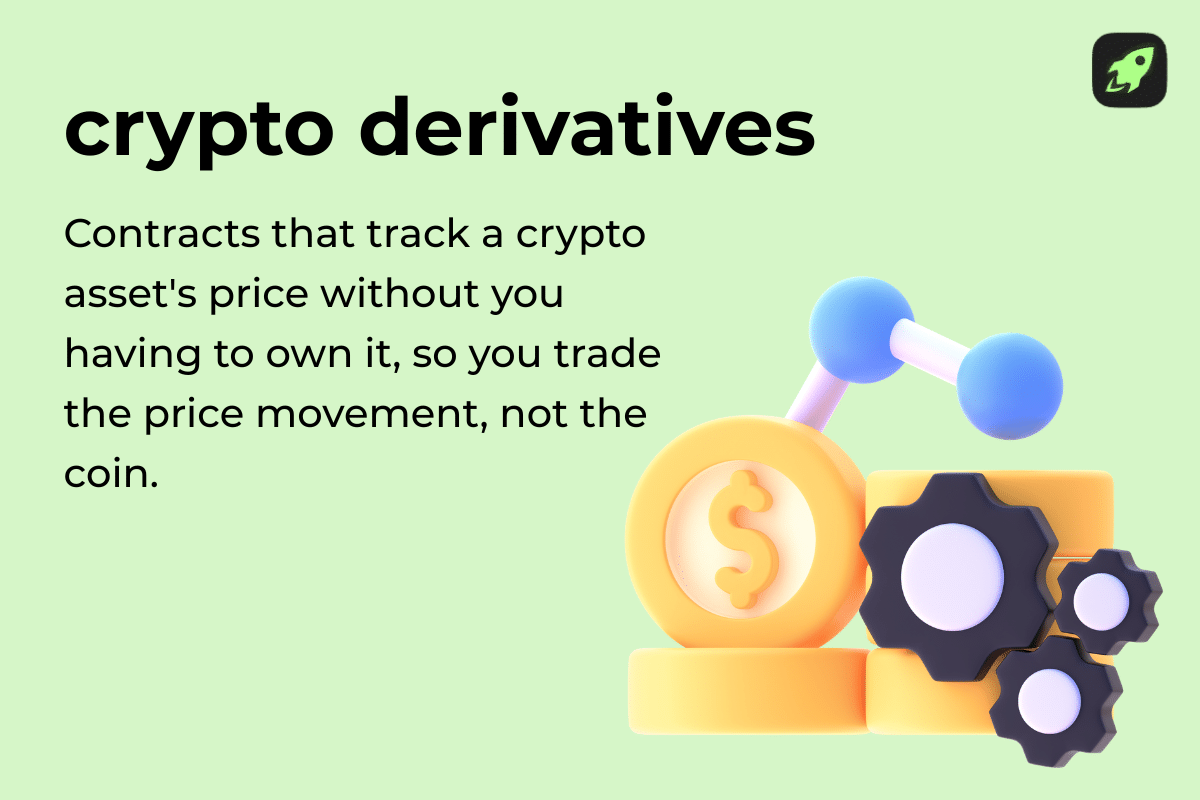
In simple terms, a crypto derivative is a financial contract that tracks the price of an underlying asset like Bitcoin or Ethereum without you ever touching the actual coin. So you’re not actually buying crypto, but making an agreement about where its price is going in the future.
That’s the core idea, but from there, it opens up into many possibilities. You can use crypto derivatives to bet on price movements going up or down, protect a position you’re already holding, or get leveraged exposure without tying up a ton of capital. Same market, more ways to play it.
Institutions use the crypto derivatives market to manage risk at scale. Retail traders use it to speculate, hedge, or both. Whatever the goal, the mechanics are the same—and once you understand them, everything else clicks into place.
Why Traders Use Derivatives: Hedge, Short, Leverage
Traders come to crypto derivatives for different reasons, but it usually comes down to three things.
- Hedging. You’re holding ETH and you’re nervous about a price drop. Instead of selling, you short a derivatives contract. If the price falls, your contract profits offset your losses. It’s not perfect protection, but it takes the edge off adverse price movements.
- Shorting. Spot trading only lets you profit when prices go up. Derivatives let you take a short position and profit when prices fall. If you think the market’s heading down, you can act on that view directly.
- Leverage. This is the big one. Derivatives let you control larger positions with less capital. Post margin, and you get exposure to the full value. With a $2,000 deposit, you can control a $20,000 trade. That amplifies your gains—and your losses, too. Leverage trading is powerful, but it demands respect. It can be very risky.
Put it all together and you’ve got a toolkit that spot trading simply can’t match. Manage risk, express a view, or do both at once. That’s why professional traders rely on derivatives—and why understanding them is worth your time.
Spot vs. Derivative: Key Differences
Spot trading is straightforward: you buy the asset and you own it. With derivatives, though, you’re trading a contract that tracks the price, not the asset itself. This difference cascades into many other elements—how you’re exposed, what it all costs, and how fast you can lose money. Here’s how these two types of trading stack up:
| Feature | Spot | Derivatives |
| Ownership | You hold the actual crypto | You hold a contract. No asset custody |
| Leverage | Rarely | Standard, often 20x–100x |
| Liquidation Risk | Low | High, small moves can force closure |
| Expiry | None | Varies, futures expire, perps don’t |
| Fees | One-time trading fee | Ongoing: funding rates, premiums, margin |
| Best For | Holding, investing, payments | Hedging, shorting, leveraging, speculation |
| Regulatory Risk | Lower | Higher |
Types of Crypto Derivatives
The crypto derivatives market offers several distinct instrument types—each with different mechanics, risks, and use cases. Here’s what you need to know.
Futures Contracts
A futures contract is a binding agreement to buy or sell an underlying asset at a predetermined price on a specific expiration date. Both sides are obligated to settle—and there’s no backing out.
Simple example: Bitcoin is at $30,000. You take a long position on one BTC futures contract, putting up $3,000 as margin—that’s 10x leverage. If BTC climbs to $35,000 by expiration, you pocket $5,000. But if it drops to $25,000, you’re down $5,000, and you may get liquidated before you even reach expiry.
Settlement is either cash (you receive or pay the price difference, no crypto changes hands) or physical delivery (the buyer actually receives the asset). Most crypto venues default to cash settlement, though. Each contract also has a defined contract size—say, 1 BTC—which sets its notional value and your total exposure.
Perpetual Swaps
Perpetual swaps—or just “perps”—work like futures but with no expiration date. You can hold a long or short position indefinitely, as long as you maintain sufficient margin. They’re the most liquid crypto derivatives on the market, with volumes hitting $61.8 trillion in 2025.
Without an expiry to force convergence, perps use a funding rate to stay anchored to the spot price. This is a periodic payment that’s exchanged between traders on opposite sides of the market. When the perp trades above spot, longs pay shorts, pushing the price back down. When it trades below, shorts pay longs, pushing it back up. For example, a 0.01% funding rate on $10,000 works out to $1 per interval. Rates adjust dynamically. Funding fees can quietly erode your returns over time—or add to them. So don’t ignore them.
For liquidations and unrealized PnL, perps use a mark price—derived from the index price plus an expected funding component—rather than the last trade price. This prevents manipulated price wicks from triggering unfair liquidations.
Options Basics
An options contract gives the buyer the right—but not the obligation—to buy or sell an underlying asset at a specific strike price at expiration. You pay a premium upfront for that right.
There are two types: a call option gives you the right to buy (you use it when you think price is going up), and a put option gives you the right to sell (useful when you expect the price to drop). If the market price never crosses the strike price, the option expires worthless.
The risk profile is asymmetric. As a buyer, your maximum loss is the premium paid, and nothing more. As a seller, you collect the premium but take on potentially much larger losses.
Most crypto options are European-style, meaning you can only exercise at expiry—but you can still trade the option itself before the expiration date.
Forwards and Swaps
A forward contract works like a futures contract but trades over-the-counter (OTC), which means privately, between two parties, without a public exchange. Both sides agree on a future price and settle at expiry via cash settlement or physical delivery.
A swap involves exchanging cash flows or price exposure—not buying or selling the asset outright. In crypto, this might mean swapping fixed-rate returns for variable ones, or exchanging stablecoin yield for Bitcoin price performance.
Both types carry counterparty risk. There’s no clearinghouse between you and the other party, so if they default, you’re exposed.

How to Get Free Crypto
Simple tricks to build a profitable portfolio at zero cost

Mechanics: Margin, Leverage & Liquidation
Derivatives trading also means putting up margin—collateral that lets you control a larger position than your capital alone would allow. That’s the appeal. But it also means you can lose that collateral faster. Here’s how the mechanics work:
- Initial and Maintenance Margin
Every leveraged position starts with an initial margin, which is the minimum deposit required to open the trade. For example, at 10x leverage on a $20,000 BTC position, that’s $2,000 upfront. As the market moves, your position is constantly marked against current prices. If your balance drops toward the maintenance margin threshold—say, $1,200 on that same trade—the exchange issues a margin call or closes your position outright. The gap between the two is your buffer. The tighter it is, the less room you have before a small price move ends your trade. - Leverage
Leverage lets you control larger positions with less capital. $2,000 can open a $10,000 trade at 5x, or a $40,000 trade at 20x. The math works both ways though, so a 1% price drop on a 20x leveraged position wipes out 20% of your margin. At 5x, that same move costs you 5%. Higher leverage means a smaller buffer between your entry and liquidation price. You set the position size, and the exchange enforces the consequences. - Liquidation
Liquidation happens when your margin falls below the maintenance threshold. The exchange closes your position to protect itself. Importantly, liquidations are triggered by the mark price, not the last trade price, because the mark price averages data from major exchanges plus a basis rate, smoothing out short-term volatility and preventing wick-driven wipeouts. So monitor your margin levels actively, add collateral before you approach the threshold, and use stop-loss orders to exit on your terms. - Insurance Funds and Auto-Deleveraging
When a liquidated position closes below the bankruptcy price, the exchange’s insurance fund absorbs the shortfall. But funds have limits. During extreme volatility, if the fund runs dry, exchanges trigger auto-deleveraging (ADL)—automatically reducing profitable traders’ positions to cover the gap. Your winning trade can get cut without warning, so make sure to track your exchange’s insurance fund health, since it tells you a lot about platform risk. - Cross Margin vs. Isolated Margin
How you allocate margin matters as much as how much you post. Isolated margin caps your loss to one specific position, so one bad trade can’t drain your whole account. Cross margin pools collateral across your entire portfolio, which is more capital-efficient but riskier. That’s because one losing trade can cascade across your entire balance. For most traders, isolated margin is the safer default.
Contract Types: Linear vs. Inverse
There are a number of different crypto derivatives contract types. The margin currency—what you post as collateral and what your PnL is settled in—changes your exposure in ways that aren’t obvious until you’re already in a trade. Here’s how the two types compare:
| Feature | Linear (USDT/USDC-Margined) | Inverse (Coin-Margined) |
| Margin Currency | Stablecoins like USDT or USDC | The underlying crypto, such as BTC |
| Settlement & PnL | Stablecoins | The underlying asset |
| Who Prefers It | Short-term traders, beginners | Long-term holders, miners |
| Hedging | Cleaner, easier accounting | Exposed to asset volatility |
| Reporting | Easier tax and reporting | More complex |
| Exchange Support | Widely available | Major coins only |
Read more: What Is Crypto PnL (Profit and Loss)?
Pricing and Valuation Basics
Crypto derivatives don’t just mirror spot prices—and the gap between what you see and what the exchange uses matters more than you’d think. Here’s what shapes derivatives prices, and what you can use to measure them:
- Contango/Backwardation: futures above spot means contango; below spot means backwardation.
- Implied Volatility (IV): drives options premiums as much as price direction—high IV means expensive options, low IV means cheaper ones.
- The Greeks: delta, gamma, vega, and theta measure how sensitive an option’s price is to changes in the underlying asset, volatility, and time.
- Black-Scholes: the standard options pricing framework, though it has real limits in crypto.
- Put-Call Parity: ties call and put prices together—big deviations signal potential arbitrage opportunities.
- Open Interest: tracks total active contracts, not just volume. Rising open interest with rising prices means capital is flowing in, while rising open interest with falling prices suggests aggressive shorting or longs holding underwater.
Risks Traders Are Facing
Leverage offers more ways to profit—but also more ways to lose. Here’s what you’re actually exposed to, and what you can do about it.
| Risk | What It Means |
| Leverage and Liquidation | Positions can reverse fast. If your margin drops below the maintenance threshold, the exchange closes your trade. |
| Funding Rate Drag | Funding fees on perpetual contracts quietly accumulate. Being on the wrong side consistently will eat into your returns. |
| Volatility Spikes and Gaps | Crypto runs 24/7 with no circuit breakers. Sudden price movements can blow past stop-losses and trigger liquidations before you react. |
| Basis Risk in Hedges | Your derivative and spot position don’t always move in perfect lockstep. Unexpected price movements can leave you underhedged. |
| Regulatory and Platform Risk | Exchange shutdowns, rule changes, and restrictions can affect even well-placed trades. Counterparty risk is a real threat. |
Practical Strategies and Use Cases
Crypto derivatives aren’t just for leverage junkies. Here are four practical ways any trader can actually use them, and the benefits and risks.
Hedging Spot Positions
If you’re holding BTC or ETH and want protection against a price drop, derivatives are your best tool. Short a futures contract or buy a put option against your spot position. If the price falls, your derivative profits offset your spot losses. It’s not perfect—you’ll need to maintain margin and potentially re-enter if liquidated—but it’s a direct way to reduce exposure without selling your holdings. It’s the core of any serious risk management strategy.
Directional Speculation
You don’t need to own an asset to have a view on its price. Perpetual swaps let you go long or short with leverage, making them the go-to for traders who want direct exposure to price movements. Options add another dimension—if you think BTC is heading up but want to cap your downside, buying a call option limits your loss to the premium paid while keeping your upside open. If a trader believes the market will move, derivatives let them act on that belief efficiently.
Arbitrage and Basis Trades
When the futures contract price diverges from the spot price, there’s a potential arbitrage opportunity. Buy spot, short the future, and lock in the price difference as the basis converges at expiration. Crypto arbitrage sounds simple but requires fast execution, sufficient capital for margin, and careful attention to fees and funding rates—all of which can compress or eliminate profit.
Calendar Spreads and Term Structure
A calendar spread involves buying one expiry and selling another on the same underlying asset. You’re not betting on direction—you’re betting on how the price difference between two contract expirations will change over time. Profit depends on volatility shifts and term structure movements between the two contracts. Risks include illiquidity in longer-dated contracts, rapid price changes, and unpredictable implied volatility swings.
Where to Trade: CEX vs. DeFi
CEXs offer speed, deep liquidity, and straightforward onboarding. DeFi gives you self-custody and transparency but comes with smart contract risk and oracle dependencies. Neither is universally better—know what you’re trading off before you pick a platform.
| Feature | Centralized Exchange (CEX) | Decentralized Derivatives Exchange (DeFi) |
| Custody | A platform holds your funds | You hold your own funds |
| KYC | Identity checks required | No registration—wallet only |
| Liquidity | Tighter spreads, deeper markets | Thinner in smaller markets |
| Fees | Exchange/volume-based fees | Lower base fees, but higher gas and slippage are possible |
| Transparency | System logic is private | Smart contract code is auditable |
| Clearing Model | Centralized clearinghouse | Peer-to-peer settlement |
| Smart Contract Risk | Lower | Higher |
| Oracle Risk | Internal/aggregated pricing | Relies on external price feeds |
Regulatory Landscape
Crypto derivatives regulation is a patchwork—and where you live often determines what you can trade.
In the US, crypto futures fall under CFTC jurisdiction. Kraken, for example, routes US clients through a registered CFTC affiliate for fixed-term futures trading. Non-US users typically get access to a wider range of contract types and higher leverage limits. Some major exchanges operate offshore deliberately, offering more flexibility but also less investor protection.
The practical takeaway: Your access to certain instruments, leverage caps, and contract types may depend on where you signed up, not just where you live. Before trading, check what’s actually available to you—and what rules apply.
Final Thoughts
Crypto derivatives are powerful—and that power cuts both ways. Used well, they let you hedge, speculate, and manage risk in ways spot trading simply can’t match. Used carelessly, leverage and liquidation will do the thinking for you.
Start with the basics. Understand how each instrument works before you trade it. Know your liquidation price, watch your funding rates, and never risk more than you can afford to lose. The market rewards preparation.
FAQ
Can I start trading with a small amount of money?
Yes—some platforms offer micro contracts, but check minimum trade sizes first. Fees and funding costs can eat into small positions fast, so use low leverage and stay aware of your liquidation risk.
Do I actually own the crypto in a derivative trade?
No. You own a contract that tracks the price—not the asset itself. Most crypto derivatives are cash-settled, meaning that typically, no coins ever change hands.
Why use options instead of just buying the coin?
Options let you cap your downside to the premium paid while keeping upside exposure. They’re better for hedging, volatility plays, and risk management than outright ownership.
Are crypto derivatives different from stock ones?
Yes. Stock derivatives clear through central clearinghouses and trade set hours. Crypto derivatives run 24/7, often settle via smart contracts, and carry different risk structures.
Are perps only for BTC and ETH, or for other coins too?
Perps are available for many assets including altcoins—but altcoin perpetual contracts carry higher volatility, wider spreads, and thinner liquidity. Use tighter risk management with smaller assets.
Disclaimer: Please note that the contents of this article are not financial or investing advice. The information provided in this article is the author’s opinion only and should not be considered as offering trading or investing recommendations. We do not make any warranties about the completeness, reliability and accuracy of this information. The cryptocurrency market suffers from high volatility and occasional arbitrary movements. Any investor, trader, or regular crypto users should research multiple viewpoints and be familiar with all local regulations before committing to an investment.


