


The US crypto space is in disarray. In March, its foreshadowing was already in full view when the prestigious law firm, Cooper & Kirk, released the paper Operation Choke Point 2.0: The Federal Bank Regulators Come For Crypto.
Did the US market become so hostile to necessitate a crypto exodus? If so, which other jurisdictions are poised to attract innovators, builders, and entrepreneurs in the FinTech and crypto space?
First, let’s take a look at the current crypto landscape.
Systemic Uncertainty Unfolding
Even before Operation Chokepoint 2.0 sharpened into focus, it was rather telling that the SEC refused to approve even a single spot-traded Bitcoin ETF. As market liquidity cornerstones go, that would be it.
Instead, regulators opted to drain liquidity. Crypto-friendly banks were the first to fall – Silvergate and Signature – albeit under suspicious circumstances, which Cooper & Kirk lawyers found indicative of “regulatory overreach against the crypto industry”.
In the meantime, the Securities and Commission Exchange (SEC) has been on a rampage throughout 2023. The watchdog agency issued complaints against Bittrex, Kraken, Gemini and Paxos, with the finishing moves against Binance.US and Coinbase.
Charging Coinbase as an unregistered securities exchange appears to have opened the legal uncertainty floodgates. The SEC approved the exchange’s underlying business model, a prerequisite to go public under ticker COIN in April 2021. However, as Coinbase expanded its crypto offering, the SEC views a portion of its offering as “crypto asset securities”: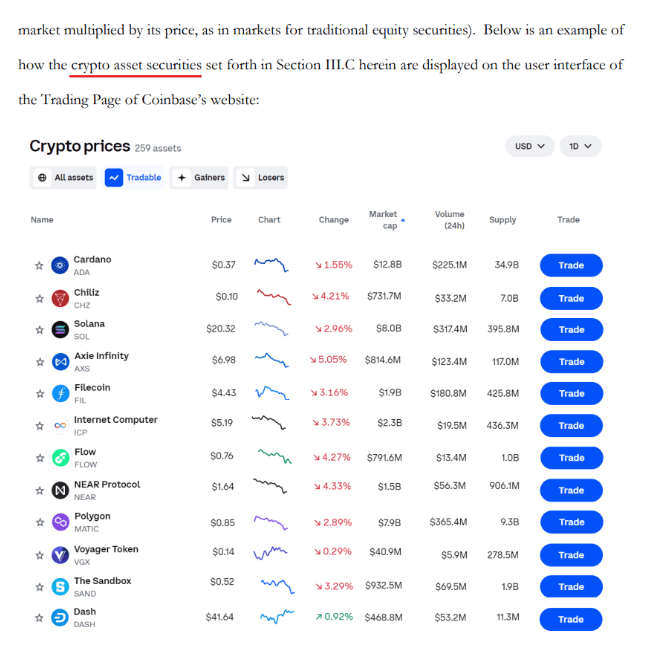 Simultaneously, the SEC failed to give clarity when previously prompted. This appears to be the agency’s gambit to establish rules from enforcement, taking advantage of the present legislative void. While Coinbase is bringing the SEC to court to clarify securities, the damage is already underway.
Robinhood will delist major cryptocurrencies Cardano (ADA), Solana (SOL), and Polygon (MATIC) on June 27, with more likely to follow according to the SEC’s interpretation. Binance.US halted all USD deposits, while Crypto.com is shutting down its institutional exchange.
The legal uncertainty then triggered a torrent of liquidity pouring out, shrinking the total crypto market cap by $55 billion since Friday. As the FUD in the US crypto space cement, which crypto-friendly regions are likely to benefit the most?
European Union (EU)
Although having officially entered a recession, the Eurozone is the first major region to deliver a comprehensive legal framework on digital assets. According to Eurostat, this market accounts for around 14% of the world’s trade, alongside China and the US as the top three.
The EU’s Market in Crypto-Asset (MiCA) regulations will go into effect from June to December 2024. Thanks to this clarity, Ripple CEO, Brad Garlinghouse, picked Europe as a “significant beneficiary of the confusion that has existed in the U.S.” in a recent CNBC interview.
Likewise, Coinbase’s chief legal officer, Paul Grewal, sees the US crypto crackdown as an “incredible opportunity” for Ireland and Europe, speaking to the Irish Independent.
Years in the making, MiCA adopted a balanced, proactive approach to crypto regulation. On one hand innovations are encouraged, while financial stability and consumer protection are considered. Here are some of the key MiCA highlights to consider:
- Digital assets exist on a spectrum, from e-money tokens (EMT) and asset-referenced tokens (ART) to crypto-assets and utility tokens.
- Based on their market capitalization, requirements differ. For instance, smaller-cap and utility tokens are exempt from supplying a whitepaper (liability, tech, marketing).
- However, suppose an ART (stablecoin) or EMT exceeds certain thresholds, such as €5 billion market cap, 10 million holders, or 2.5 million daily transactions exceeding €500 million volume. In that case, they become “significant” gatekeepers to be regulated under the Digital Markets Act (DMA).
- All crypto companies are licensed as CASPs (crypto-asset service providers), maintaining a minimum of €125k liquidity threshold for custodians and exchanges and €150k for trading platforms.
To maintain their licenses with the European Securities and Markets Authority (ESMA), CASPs have to report user transactions. This includes transfers between CASPs and self-custodial wallets if they exceed €1,000. But regardless of transaction size, CASPs must record senders/recipients for hosted wallets under the so-called “Travel Rule”.
While all this tracking is not ideal, it is a big step in legitimizing the industry. At least, in contrast with the US, in which the SEC Chair Gary Gensler recently blanket-named crypto investors as “hucksters, fraudsters, scam artists”.
It also bears noticing that Switzerland remains a sandbox innovation zone but also interfaces with the Eurozone. This is why there are so many prominent foundations in Switzerland, such as Tezos and Ethereum.
In the EU itself, many crypto companies have already become global.
Notably, the popular options trading platform Deribit in the Netherlands, LocalBitcoins in Finland, DappRadar in Lithuania, and Ledger, the hardware wallet provider in France.
Hong Kong
China’s semi-autonomous proxy region, Hong Kong, is back on the crypto menu. Although mainland China banned cryptocurrencies to not interfere with the digital yuan, Hong Kong was greenlighted for retail crypto trading on June 1st.
Of course, this means that Virtual Asset Service Providers (VASPs) in Hong Kong must block retail traders from mainland China. Each token they list must have high liquidity, be included in two major indices, and have one year of trading. In addition to these basic requirements, VASPs must segregate customer assets, set exposure limits, follow cybersecurity standards, and avoid conflicts of interest.
The DeFi space can also thrive under the Securities and Futures Ordinance (Type 7 license), with their tokens designated as either futures or securities. Following the new regime, many exchanges rushed to acquire new HK VASP licenses: CoinEx, Huobi, OKX, Gate.io, and BitMEX, to name a few.
Interestingly, ZA Bank, the subsidiary of Chinese state-owned Greenland as the largest HK digital bank, has also entered Hong Kong’s e-HKD Pilot Programme initiative. This showcases that China fully greenlights Hong Kong’s embrace of digital assets for the long haul.
Hong Kong is also extremely generous in the crypto tax arena. While capital gains tax is voided for taxpayers, businesses are under the progressive tax regime of a maximum of 17%.
Singapore
Another highly developed city-state, Singapore, has been the crypto hub since early, boosting crypto adoption for the entire Asia-Pacific region. And for a good reason. There is no capital gains tax, making it irrelevant if one is selling or trading cryptocurrencies.
Moreover, because the Monetary Authority of Singapore (MAS) classifies them as “intangible property”, cryptocurrencies can be used for payment for goods and services, which is then viewed as barter trade. Incidentally, this is very easy to accomplish thanks to Singapore-native Alchemy Pay.
With that said, the zero-tax regime doesn’t apply to businesses. They are subject to a flat corporate tax rate of 17%. But to one-up Hong Kong, Singapore has a three-year tax exemption for start-up firms, which is particularly helpful for newer businesses which need help building credit,and therefore have limited funding opportunities.
With its financial and social stability, Singapore has served as quite the crypto magnet. For instance, California-based OKCoin opened shop in 2020. Of course, Coinbase and Binance also have Singapore offices, including Crypto.com.
While Crypto.com is hurrying to shut down its institutional exchange in the US, citing the “current market landscape”, the aptly-named exchange had no trouble getting Major Payment Institution (MPI) license from the MAS.
This makes Crypto.com no longer subject to thresholds for its Digital Payment Token (DPT) services. Given the SEC’s hostile attitude towards these exchanges, it is safe to say their fallback position is sound in Singapore.
Lastly, Singapore has held a friendly approach to integrating machine learning and artificial intelligence technology for several years. The Ministry of Education has already developed AI-powered learning and educational systems for students. From how AI is predicted to boost business operations from communication to training and beyond, Singapore has demonstrated a proactive approach to using game-changing technology.
With how AI is predicted to integrate with and even help the crypto industry, Singapore may become a hotspot for new crypto projects.
Shane Neagle is the EIC of The Tokenist. Check out The Tokenist’s free newsletter, Five Minute Finance, for weekly analysis of the biggest trends in finance and artificial intelligence.


