


Jennifer and Kevin McCoy need little introduction. Ten years ago, the acclaimed artists introduced the world to Quantum, the first art NFT ever created. Quantum found its home on the Namecoin blockchain in 2014, when Kevin McCoy decided to mint it as an NFT to establish the provenance of the digital image.
The Web3 world might see minting an NFT for such a reason as a banality these days, but in 2014, the idea was revolutionary. Provenance documents for digital art didn’t exist at the time, and Quantum showed the world that blockchain technology could solve the problem of ownership in the digital age.
Its landmark million-dollar sale at a Sotheby’s auction in 2021 brought it the recognition it finally deserved.
Having created only a handful of NFT artworks since then, the McCoys are now releasing their first NFT collection, Land Sea and Sky. The project, which launches on Artwrld on April 5, is a collection of 310 collages that combine elements of AI-generated landscapes. nft now caught up with Jennifer and Kevin to talk about their upcoming release, how the NFT ecosystem has evolved since 2014, and the ethical quandaries that come with using AI art tools.
Web3 since the time of Quantum
Given their position in the annals of Web3, Jennifer and Kevin are uniquely positioned to offer a bird’s-eye view of how the crypto and NFT space has evolved since they minted Quantum.
Calling back to comments he made alongside Anil Dash during a 2014 conference, in which the two argued that blockchain-based tech had far more interesting things to offer the world of culture than it did to finance, Kevin recounted a particularly poignant observation he had during the 2021 bull run.
“It’s culture versus money. And culture wins out every time.”
Kevin Mccoy
“I had this experience walking around Manhattan, looking out and [thinking], everybody here has heard of NFTs, and how weird that was,” Kevin recalled. “In a very real sense, NFTs became [bigger] in the popular imagination than the money aspect of cryptocurrencies. And I think that that’s because NFTs are about media, they’re about ideas in a direct way. It’s culture versus money. And culture wins out every time.”
Web3 trends tend to be cyclical. The recent ASCII art meta that the Owls NFT project kicked off at the beginning of March put this fact on full display. The project’s text-based aesthetic reignited interest in some of the earliest NFTs on the blockchain, many of which were just simple characters associated with a domain on Namecoin. They may not have been the first art-intentional NFTs Web3 witnessed — that would come with 2014’s Quantum — but they nonetheless form an integral part of the space’s history.
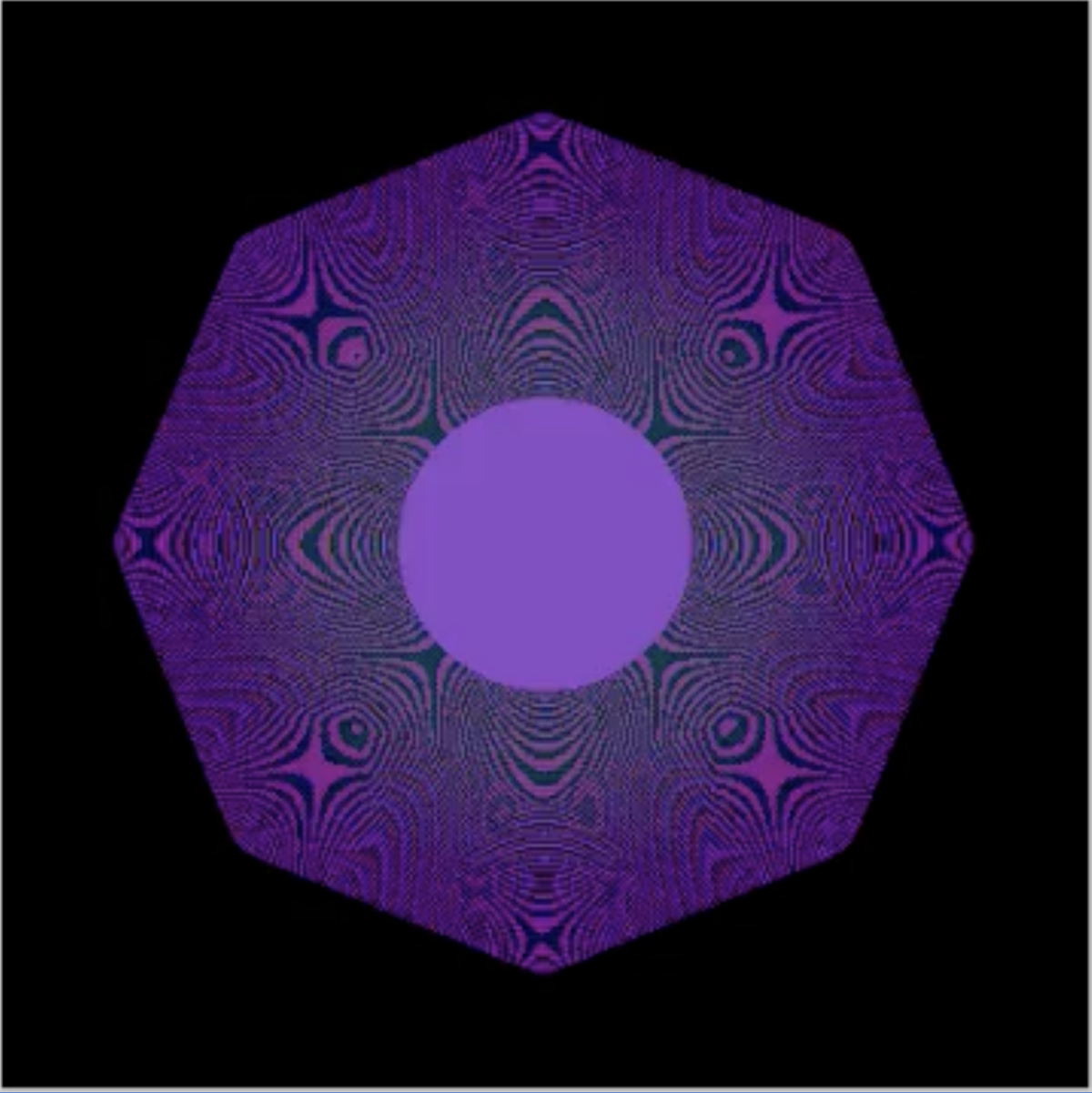
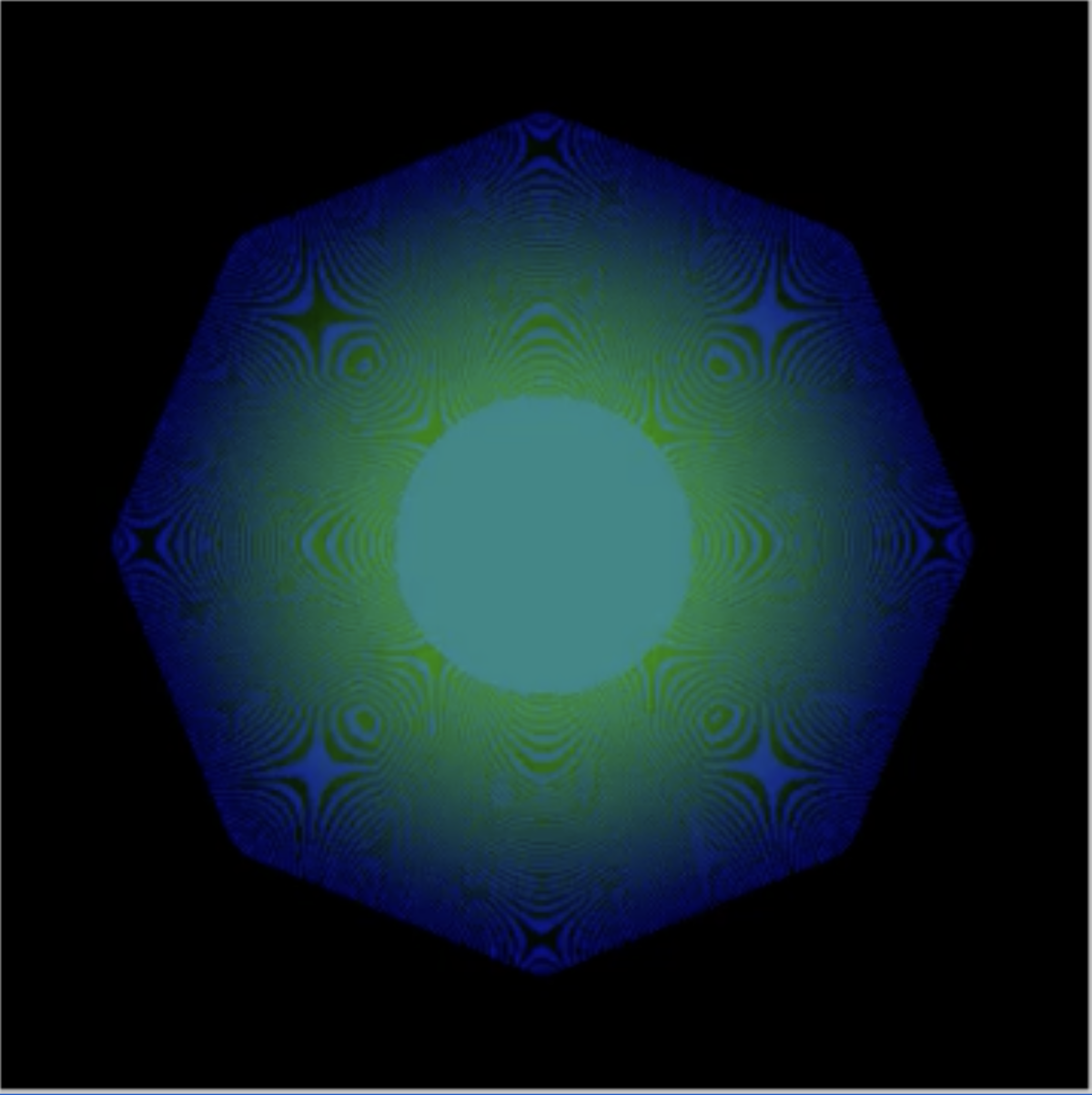
As individuals who have been creating art for decades, the McCoys unquestionably advocate for people to learn and honor the value of historical developments in art and technology. But they also lament that they’ve seen history forgotten time and again. The pair even go so far as to say that “history slows down the market.” When a new development occurs, few people are interested in shining a light on the things that came before it.
This is one of the reasons Quantum’s 2021 Sotheby’s auction was such an important moment for both the McCoys and the broader Web3 community — a vital piece of NFTs history finally received its due.
Can’t stop, won’t stop
Web3’s future is as unpredictable as ever, and the McCoys note that the dynamic of decentralization is largely culpable. Pointing to traditional art institutions’ role in guiding conversations and cultural movements, Jennifer noted that, while admittedly centralized, such organizations provided some clarity in separating the signal from the noise.
“Everyone is excited about peer-to-peer disintermediation, the idea of direct connection,” she explained. “And yet, in the absence of institutions to gather us together and point towards an ongoing conversation, it becomes really overwhelming and kind of frightening to have to sort through everything. And I think that’s what good institutions can do.”
However, the two remain big believers in Web3’s egalitarian potential. Kevin was quick to point out the recent resurgence of discussion surrounding faith in cryptocurrency and Defi to free people from the disastrous mismanagement of the financial sector.
“The idea of digital scarcity, uniqueness, and property isn’t going to go away.”
Kevin Mccoy
“The fraud in [the NFT space in] 2022 was pretty intense,” Kevin said, “And it rocked a lot of people. But then, out of the blue, we have a banking crisis, and, all of a sudden, the core argument for crypto dating back to Satoshi is once again brought up. So, you never know what’s going to happen. We are believers in this technology [and] decentralization. The idea of digital scarcity, uniqueness, and property isn’t going to go away.”
While that’s basically a guarantee at this point in Web3’s history, it doesn’t hurt to hear it from one of the people who helped ignite the digital revolution in the first place. And nothing speaks to their belief in the importance of digital scarcity and uniqueness more than their new work.
Land Sea and Sky
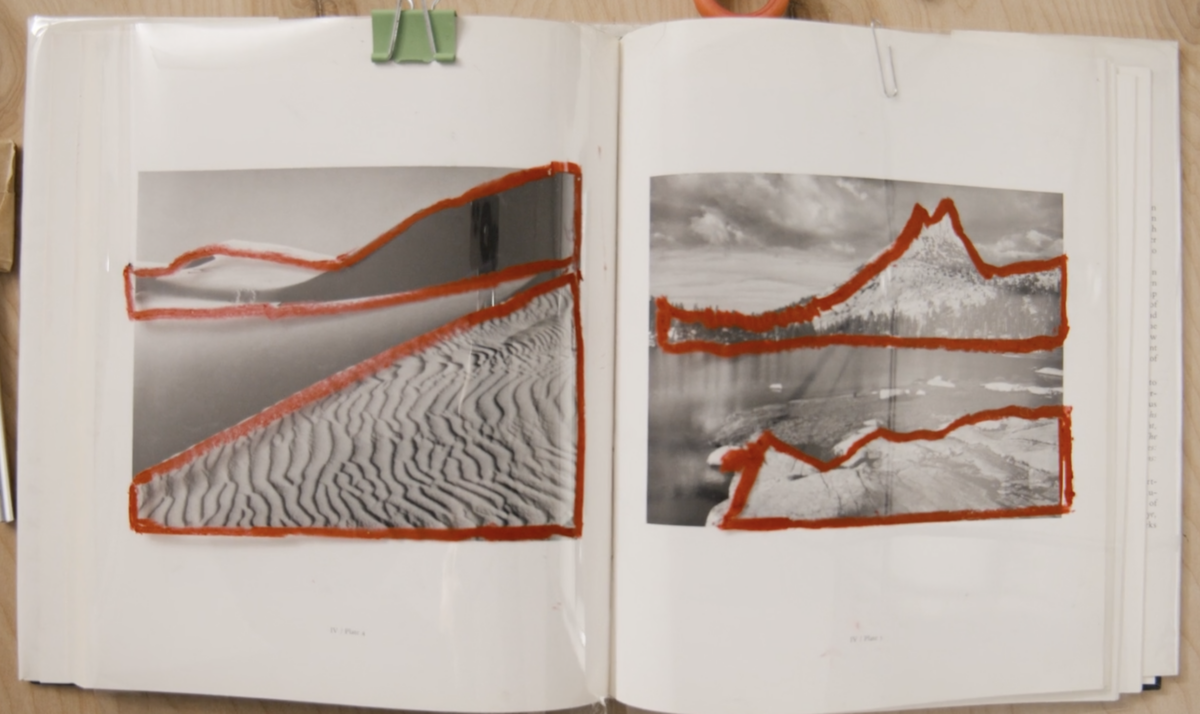
Collage work has long appealed to the McCoys, who deeply appreciate the idea of combining disparate visual and cultural elements into something new. To create the collages for Land Sea and Sky, the duo analyzed Ansel Adams’ body of work, highlighting certain landscape sections of his photographs that caught their eye.
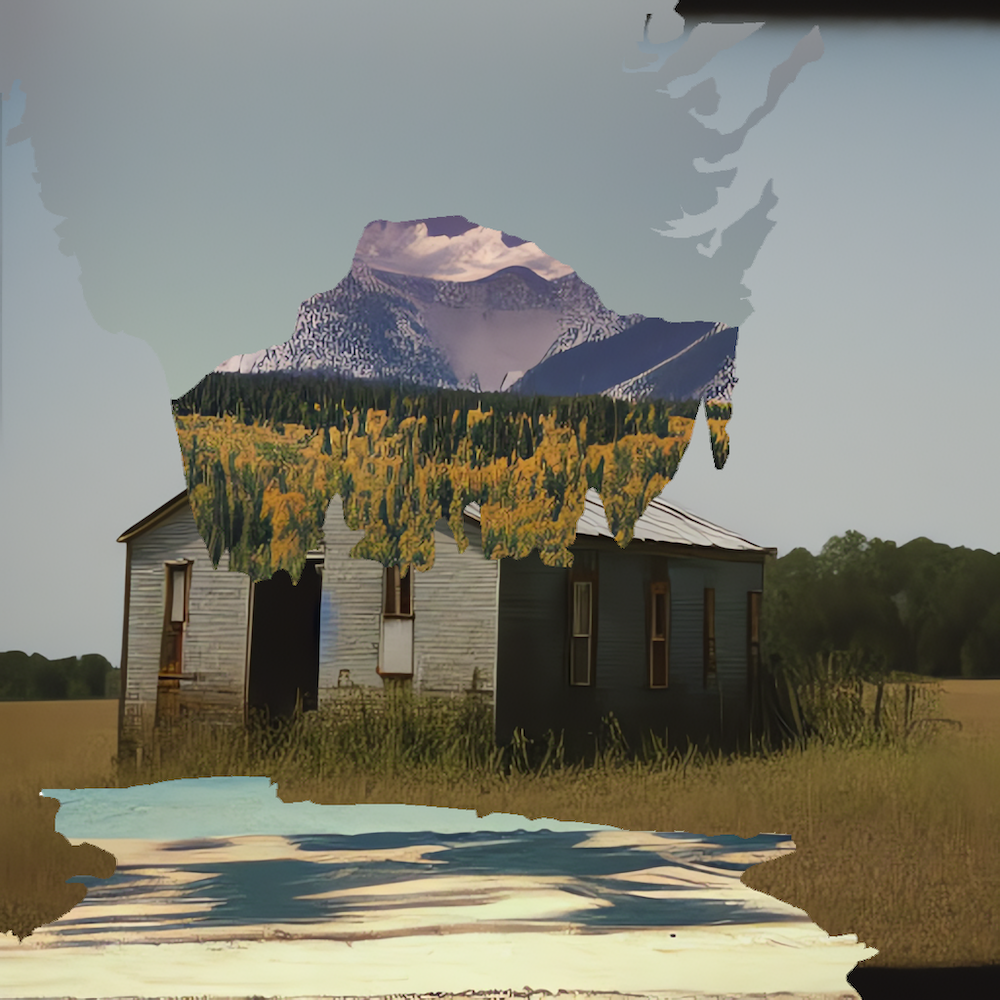
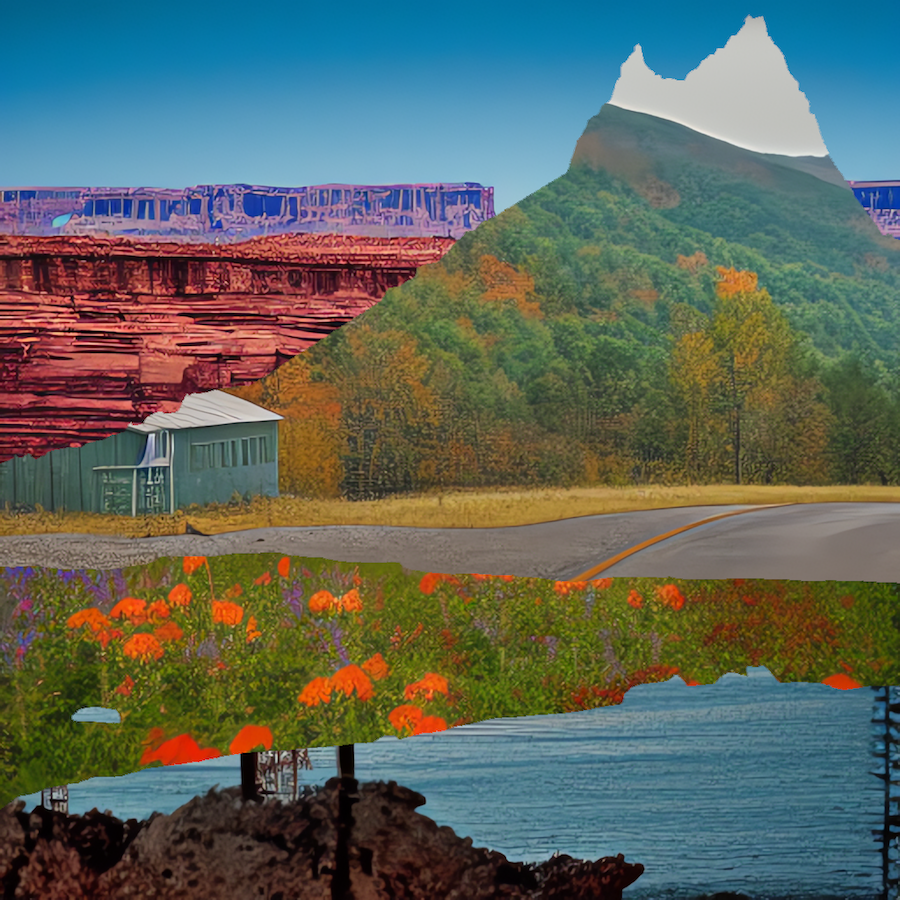
Taking those outlines and using them as a basis with which to structure each hand-made piece, the pair then used the AI art tool Stable Diffusion to generate hundreds of landscape images. They then sorted the images into five descriptive databases: land, sea, mountains, trees, and sky. Custom scripts then searched these databases to produce recombinant landscapes, and the areas in each collage that come from shapes taken from Ansel Adams’ photographs were then filled in with one of the five types of generated AI landscapes that the McCoys produced.
The result is a fusion of 20th-century landscapes as filtered through 21st-century technology.
“We knew it would be a landscape project,” Jennifer McCoy said of Land Sea and Sky’s origins. “We had done experiments with jagged cutouts and juxtaposing ill-fitting kind of elements of landscape before, but with Stable Diffusion and AI gaining ground, we [thought] this might be a really interesting way to go straight from imagination to landscape without intervening photographic sources, which was really exciting.”
“We’re kind of driving the American East through the American West.”
Jennifer Mccoy
And while tools like Stable Diffusion are at the center of a heated debate about the ethical use and existential implications of ever-more capable AI systems, the McCoys were curious to explore how they could use them in their artistic practice. They explained that one of the most appealing aspects of these tools is how they evoke the idea of a visual statistical average.
Elaborating on what appeals to them about AI’s summative nature, the pair pointed to Russian duo Vitaly Komar and Aleksandr Melamid’s 1994 work, The People’s Choice, as a parallel. Komar and Melamid were Russian emigres who were fascinated by the idea of “the American people” and how they would express their collective preferences for art and culture.
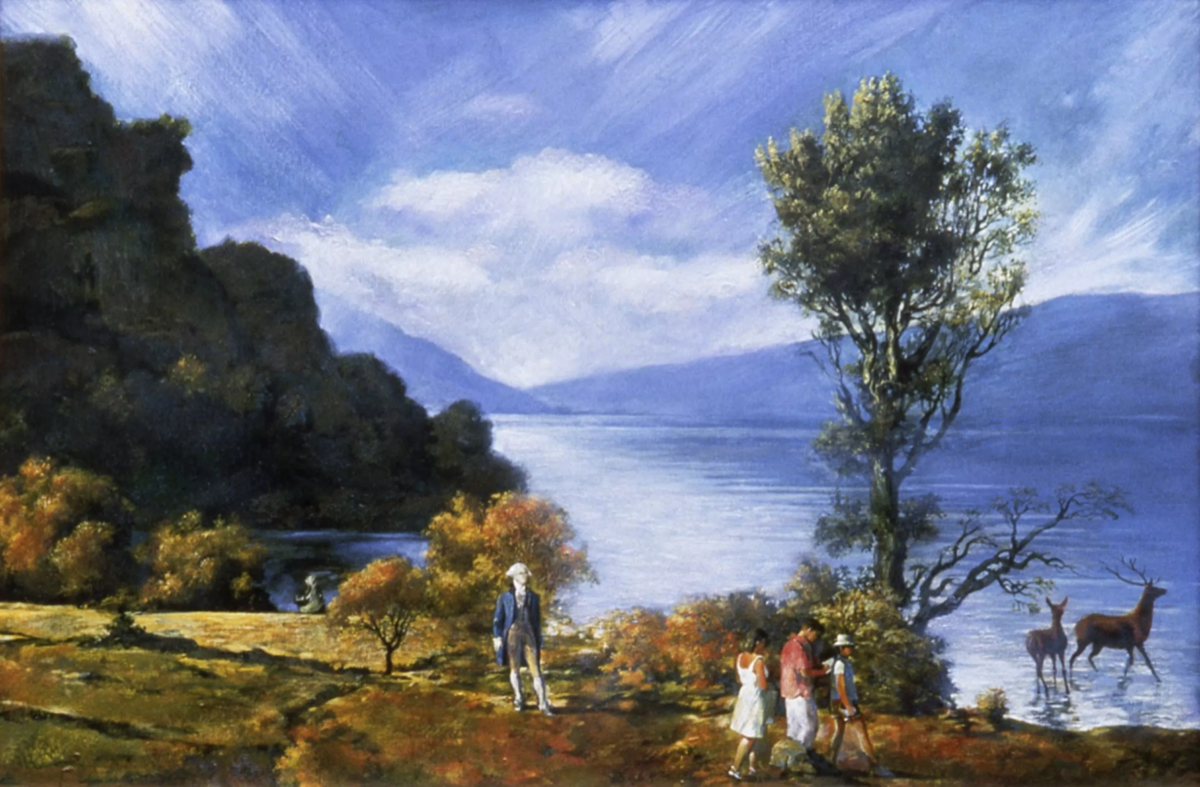
Komar and Aleksandr commissioned a public-research polling firm to survey U.S. citizens accordingly; the survey included questions on lines and curves, colors, size and shape, content, and even what figures they liked to see depicted. Komar and Melamid then created paintings featuring the most and least popular elements, forming a damning satire of both creation-by-committee and the idea that artistic expression is an elitist endeavor.
“What is the idea of a California coast? 110 ideas of a California coast? What is 40 images of Vermont trees? These were the kinds of questions we were looking at,” Jennifer offered as a perspective on how the pair approached Land Sea and Sky. “And the scripting that we did was essentially combining those into specific formats based on Adams’ [work] from the Sierra and Yosemite. We’re kind of driving the American East through the American West.”
The collages include AI-generated depictions of all 50 U.S. states. The couple was interested in depicting various environments through Adams’ lens, especially scenes that are entirely disparate from the photographer’s rugged depiction of grand-scaled nature in the west of the country.
“The impacts are unknown, and I think that people are right to be nervous.”
Kevin Mccoy
An artist’s job, Kevin emphasized, is to look out at the world and report back what they see, and landscape is one of the primary genres where that happens. Only now, the landscape is a digital one, an “algorithmic landscape” that, thanks to new AI technologies, can be used to report back in an entirely new way.
The concerns that prompt-based AI art tools have given rise to are nonetheless not lost on the couple. Kevin believes that critics who point to their social aspect — the fact that these programs are trained on the works of others — are absolutely right to ask who benefits from these tools’ use and who is owed what as a result.
“These tools are going to be pretty weird,” Kevin acknowledged. “The impacts are unknown, and I think that people are right to be nervous.”
Nostalgia and memory, synthesized
Land Sea and Sky is imbued with a deep sense of nostalgia. The project’s Artwrld page notes that the AI-generated images in the collection are meant to evoke something closer to memory than fantasy, with hints of “cross-country road trips, Ektachrome film, and the strange, hazy yellow-green tint of […] childhood snapshots” spread throughout.
But that sense of memory, Kevin says, stems not from the McCoy’s own childhoods but from their interpretation of the anxiety people feel toward the real world as they are increasingly thrown into the virtual one.
“There’s this kind of question and desire for, or remembrance of, that physical world. Nostalgia for the real,” he explained.
While speaking to nft now about the project, Artwrld’s Artistic Director and founding partner Nato Thompson drew attention to the unique dynamic the McCoys have in being a couple that produces art together.
“They often work with these kinds of juxtaposing technologies,” Thompson explained. “They’re thinking about both cinema and landscape, but they’re also a couple, so they inevitably are almost a collage themselves. There’s a certain kind of pushing up against things that’s in that work, that I think perhaps is the result also of two people making work together.”
The 310 pieces in Land Sea and Sky are split into two parts: 300 short-form collages and 10 longer-form pieces accompanied by audio. And while there’s nothing particularly unique about landing on 310 as a supply for the collection, the McCoys observed that utilizing NFTs allows them to maintain “serial uniqueness” at a scale that might otherwise be impossible in more traditional art forms.
The McCoys have chosen the non-profit Rhizome, a “born digital” art platform, to receive a portion of the proceeds from primary and secondary sales. Those looking to gain priority access to the drop can do so by minting an NFT from one of Artwrld’s previous collections by March 31. Minting for Land Sea and Sky for the general public goes live on April 6.


