

NFT
Wash trading on nonfungible token (NFT) marketplaces is back in the spotlight after critics claimed the fast-growing NFT marketplace Blur has incentivized the practice with its trading rewards scheme.
10% of Blur’s total token supply was distributed to users based on their trading activity in its second token reward scheme from Feb. 14. The platform has seen a surge in trading volume in comparison to other leading NFT marketplaces.
Skeptics claim that wash trading played a significant role, with CryptoSlam reporting around $577 million worth of NFTs have been wash traded back and forth in recent months and that 80% of trades on the platform are “inorganic.” However, opinions vary.
A new Dune Analytics deep-dive by Hildobby argues that the vast majority of the platform’s trading volume is actually above board due to the way it has structured the rewards. But the analysis is far from a clean bill of health for the sector, with the same methodology suggesting that LooksRare and X2Y2, have 98% and 85%, respectively, of volume currently flagged as suspicious.
NFT marketplaces have accounted for a reported $73.8 billion worth of trading volume to date. However, Dune Analytics data suggests that more than 42% of the volume is fake, with $31.2 billion attributed to wash trading.
I made an open-source wash trading filter available for all to use on Dune v2 and managed to flag $30B of NFT wash trades – that’s ~44% of volume traded 🤯
🧵 pic.twitter.com/b7WUKCFnrh
— hildobby (@hildobby_) December 16, 2022
The effects are wide-ranging. Inflated prices and manufactured popularity of certain collections have left inexperienced digital collectors as collateral damage. And in some cases, criminals have been using NFTs as a means of money laundering.
There is some good news for more educated collectors, however, in that most wash trading surrounds the type of NFT collections favored by inexperienced or low-information collectors.
“Sure, in absolute terms, there is a lot of wash trading, but it mostly is happening to NFT collections with a poor reputation anyways.”
What is NFT wash trading?
Wash trading itself is not a new phenomenon. The term has its origins in the early 1900s, where the practice of “wash sales” in the United States was carried out by selling a security prior to the end of the tax year to claim a loss and then buying them back straight after.
Artists impression of typical wash trading scenario. (Pexels)
Wash trading in crypto is an offshoot of those early practices, whereby individuals or colluding parties buy and sell a particular financial asset among themselves to create the perception of higher trading volumes or liquidity. Exchanges and projects do it mainly to make themselves look more popular.
It’s important to note that wash trading is illegal in a number of jurisdictions around the world and is prohibited by major regulatory institutions. Considered a form of market manipulation, the practice is harmful to investors and is a threat to the integrity of financial markets.
Given that the cryptocurrency space is still fairly nascent, regulators are still coming to grips with the ins and outs. This leaves crypto and NFT wash trading in a gray area where the practice is unchecked and ungoverned. However, President Joe Biden has proposed closing the loophole that made the practice not illegal for crypto assets in the U.S. in the upcoming budget.
Research carried out by analysts and insights provided by industry experts to Cointelegraph Magazine suggests wash trading is ongoing across a number of NFT marketplaces.
NFT wash trading and money laundering
Hildebert Moulié is one such expert, whose in-depth research brought NFT wash trading into the spotlight in late 2022. By day, Moulié is a data scientist working for cryptocurrency investment firm Dragonfly. In his spare time, Moulié built a data dashboard that has lifted the veil on wash trading in the NFT space.
His popular post on Dune late last year found that around 80% of the total NFT trading volume in January 2022 resulted from wash trading, and that figure averaged around 58% for the totality of 2022. Moulié’s method for routing out wash trading made use of four specific filters.
Firstly, addresses that were both the buyer and seller of a specific NFT were flagged. The second filter identified back-and-forth trades between two different wallets. If an address had purchased the same NFT three or more times, it was also identified as potential wash trading. The final filter was used to identify addresses or trades that sidestep the above-mentioned methods by checking if the buyer and seller addresses were funded by the same wallet.
After applying all these filters, Moulié’s data reveals that 42% of NFT trading volume is currently driven by wash trading across 29 major NFT marketplaces operating today.
Blockchain analytics firm Chainalysis also delved into NFT wash trading in two separate reports in 2022. A key takeaway from its research highlighted 110 profitable wash traders netting $8.9 million in profits last year. The company tells Magazine that government agencies have shown interest in learning about NFT wash trading while declining to provide any specifics.
Chainalysis also keeps tabs on illicit funds moving through the cryptocurrency ecosystem. Its tools identified a rise in funds sent from illicit addresses toward the end of 2021, with around $2.4 million flowing to NFT marketplaces in the final two quarters of the year.
The report concludes that the amount of illicit funds sent to NFT marketplaces associated with money laundering paled in comparison to the $8.6 billion worth of cryptocurrency-based money laundering that Chainalysis monitored in 2021. Nevertheless, the practice is an option for cybercriminals.
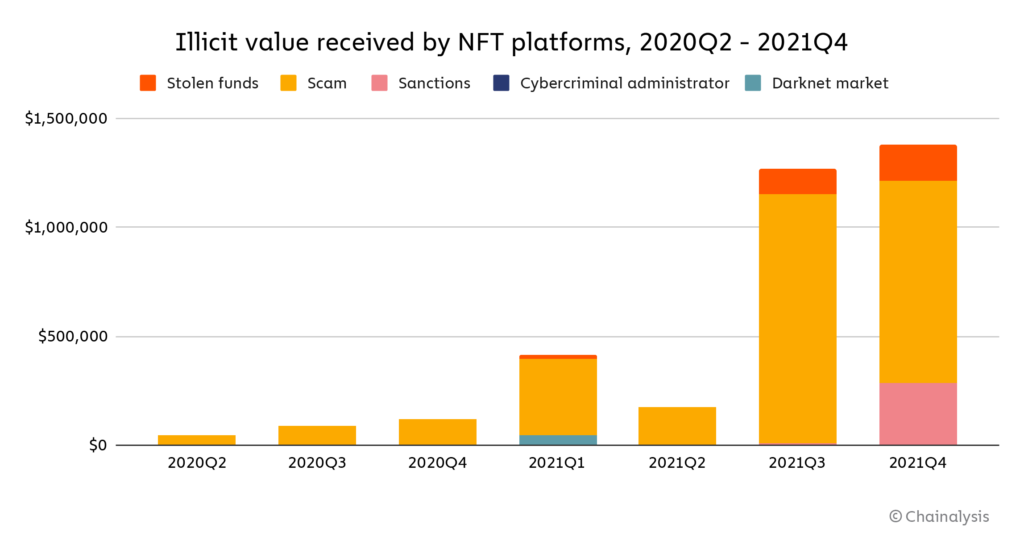
Money laundering via NFT wash trading is only a very small slice of the issue (Chainalysis))
What NFT marketplace has the least wash trading?
Moulié’s research highlights LooksRare and X2Y2 as the two worst offenders, with 94.7% of LooksRare’s trading volume and 85% of X2Y2’s trading volume allegedly attributed to wash trading. This is significant, given that the two platforms have processed $27.6 billion and $4.2 billion in total trading volume, respectively.
OpenSea still ranks as the largest NFT marketplace by volume, but it has a cleaner track record, with just 2.35% of the total $33.1 billion of trading volume attributed to the practice.
Blur (14%), Sudoswap (11%), Skillet (17%) and BitKeep (12.8%) all have wash trading percentages in the mid-teens, while NFT aggregator Element has the third-highest wash trading percentage, with 63% of its $94.3 million trading volume flagged as wash trading.
DappRadar shares data with Cointelegraph that corroborates Moulié’s insights. LooksRare had 20,743 NFTs flagged as likely wash trade sales from January 2022 to March 2023, while X2Y2 had 11,289.
OpenSea had a total of 4,357 NFTs flagged as possible wash trade sales, while Blur has produced 2,285 over the past four months.
DappRadar’s data shows that the ratio of likely wash trading volume to total volume on LooksRare was 3,361.96%, while X2Y2’s ratio was 210.99%.
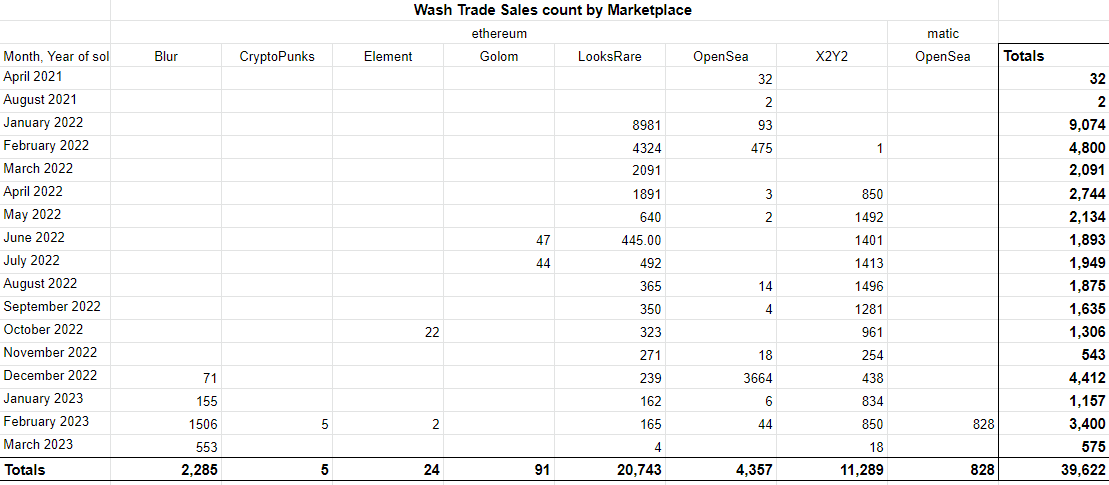
Data from DappRadar supplied to Magazine breaks down NFT wash trade sales numbers by marketplace. (DappRadar)
NFT wash trading, explained
Moulié tells Magazine that NFT wash trading occurs when a particular NFT is traded between two addresses owned by the same individual, with the goal of it blending into organic trading activity.
There are two primary reasons for this kind of activity. Firstly, trading platforms like LooksRare and X2YX incentivize trading with token rewards. If carried out correctly, traders wash trade NFTs to make a profit by acquiring these token rewards to offset fees.
The second reason is more subversive, as a trader looks to drive up the appearance of high trading volumes of a particular NFT collection in order to attract attention and higher bids from other traders.
“If undetected, wash trading could help increase the perceived value of an NFT collection to other traders, which may make them buy/trade it.”
However, Moulié believes it is not possible to sustainably simulate organic trading over a long period of time and notes that any collection that is revealed to be heavily wash traded will end up being unattractive to potential collectors.
Zhong Yang Chan, head of research at CoinGecko, agrees the intention is to manipulate trading volumes and NFT prices while adding that tax loss harvesting is another driver of the practice.
He says that NFT wash trading has diminished some trust and credibility in the market and also played a part in fueling the NFT bubble of 2021 by enabling projects and participants to play the “numbers only go up” game.
Chan believes that wash trading undermines the ability to verify NFT ownership history, which is meant to contribute to their value and differentiate collections from other physical and virtual collectibles. The result is collections that experience price distortions and wild fluctuations:
“While this does not affect NFT authenticity, it may impact the perceived value and create doubt for an NFT collection that is trying to build a strong community.”
Andrew Thurman, an analyst at blockchain analytics platform Nansen, echoes the sentiments of Moulié and highlights the scams connected to wash trading and the negative impact on real users.
Wash trading low-volume collections could potentially help scammers defraud users in a variety of ways. Thurman points to research from Nansen that uncovered instances of scammers creating and wash trading collections to coax users into minting new NFTs.
The scammers either change the mint price mid-mint or lead users to trade against themselves in order to generate trading fees or sell the worthless NFTs.
“These NFTs would have no organic value and are briefly made to appear as if they do.”
Thurman also notes wash trading also has a detrimental impact on real users of NFT marketplaces or platforms, as it lowers the number of rewards an organic user would earn.
How to prevent NFT wash trading
So, how can the industry combat wash trading?
Moulié notes that different NFT marketplaces already have varying approaches to reducing wash trading, with fees being a prominent point. Fees hinder wash traders’ ability to maximize profits by creating an additional cost to trading.
Marketplace fees and creator royalties are two fee mechanisms that take a share of a trader’s profits, with Moulié highlighting OpenSea as an example. The platform enforced royalty fees, which other marketplaces have emulated as a result.
Cutting out the type of rewards that incentivize trading is another means of curbing the practice according to Moulié:
“While platforms airdropping tokens to users such as LooksRare and X2Y2 see plenty of wash trading, Blur found a new solution, rewarding listings and not trading.”
The lack of regulation or perceived enforcement around NFT marketplaces is another point to consider according to Chan. Market manipulation and tax loss harvesting are illegal for traditional financial assets, and this looks set to be enforced by regulators in the future as Biden’s budget proposals suggest. However, applying the existing standards to the nascent Web3 and NFT space might not be so clear-cut.
DappRadar head of research Pedro Herrera notes that NFT wash trading is a growing concern for regulators and law enforcement around the world, but they have bigger fish to fry right now.
“The regulatory focus is in crypto adoption, DeFi and security tokens,” he says. “There is a major need to first establish the rules for the Web3-based financial layer.”
Thurman tells Magazine that platforms, including OpenSea and Blur, have introduced trading throttles as a preventative measure. This inhibits an NFT from being listed if it recently changed addresses but does not completely combat the prevalence of the practice.
“Aside from that, preventing wash trading on platforms like LooksRare and Blur is difficult – it’s a subset of the sybil problem,” he says.
Sybil attacks pose a particular threat to blockchain and decentralized networks. An attacker looks to gain control or influence of a system by creating and controlling a large number of pseudonymous wallets, addresses or identities.
As Thurman suggests, sybil attacks in the case of NFT marketplaces would allow an attacker to create fake trading volumes of various NFTs by trading using a number of different addresses that they anonymously control.
NFT data providers exclude wash trading
Apart from the obvious impacts of artificially inflating prices or astroturfing popularity, wash trading also distorts the ability to analyze and monitor cryptocurrency markets. Moulié says when he set out to provide in-depth insights about NFT trading, he first needed to remove the wash trading activity to work out what was actually going on.
“Any good analyst will tell you that when you want to start studying a data set, the first step is to clean it up,” he says, adding that many NFT data providers now filter for wash trading activity.
“Many of the major analytics platforms have wash trading filters, and the way they’re constructed is often industry secret,” he says.
Thurman shares Nansen’s NFT Trends and Indexes section by way of example, with the wash trading filter both on and off. The first image shows marketplace NFT trading volumes with wash trading removed:
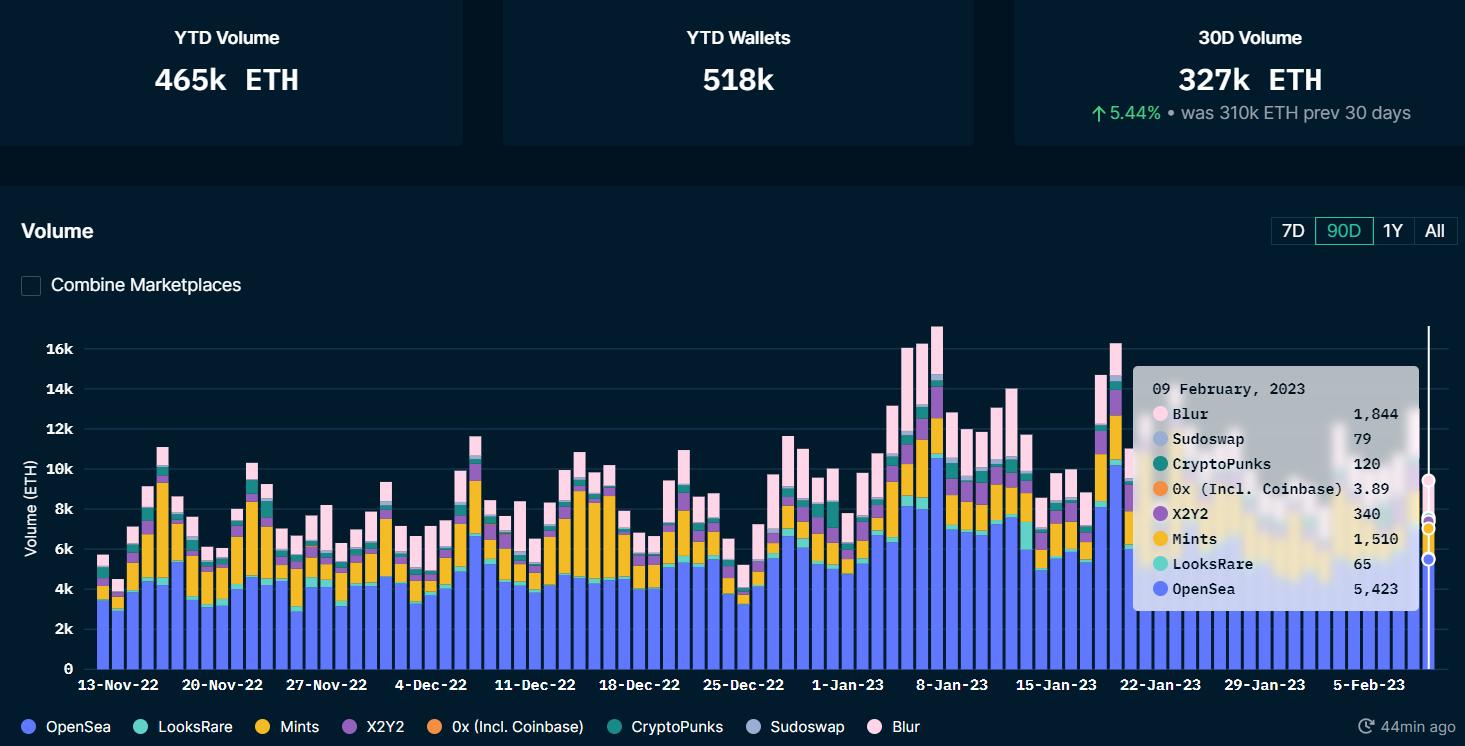
Nansen data with wash trading removed (Nansen)
The second screenshot includes wash trading and highlights the market distortions created by platforms rewarding trading volume. The likes of LooksRare and Blur have between 10 and 20 times the volume with the wash trading filter turned off:
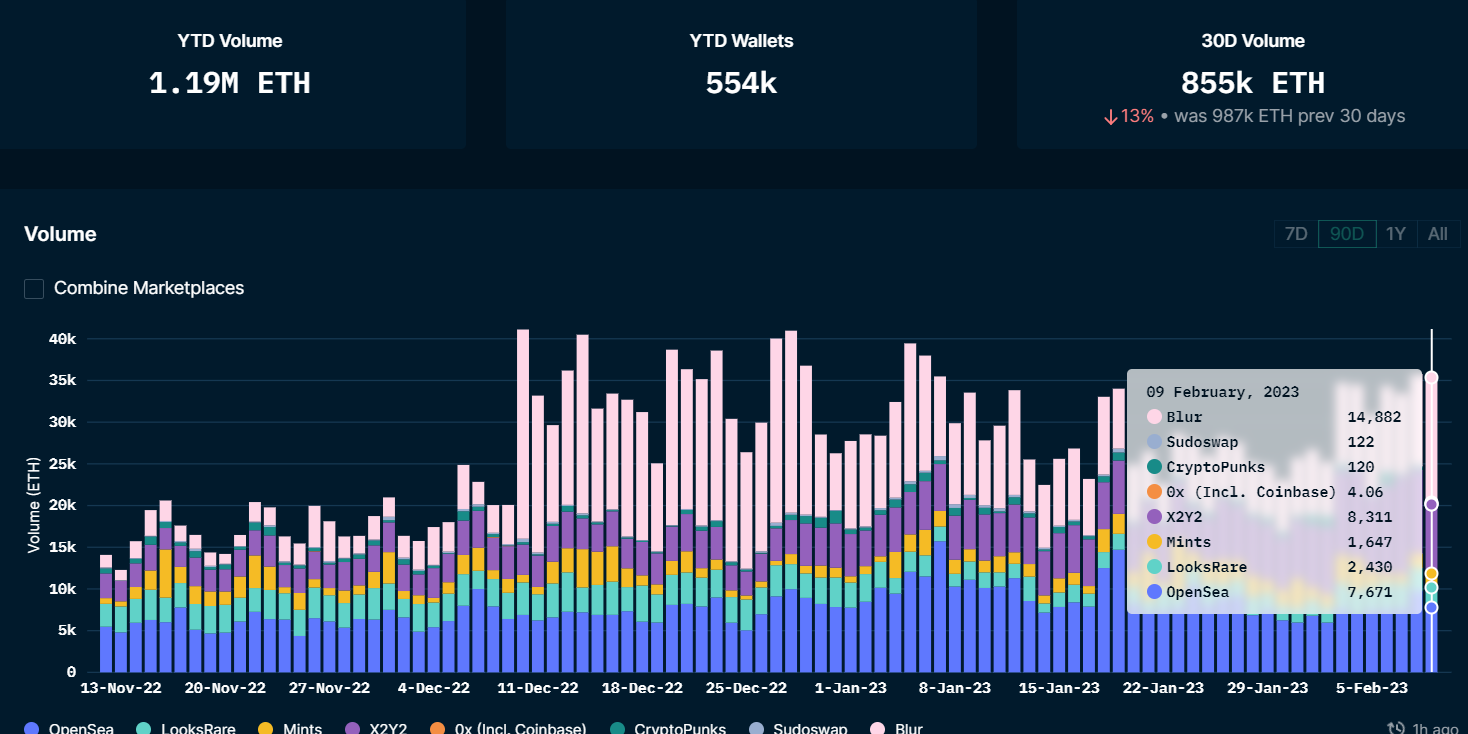
Nansen data with wash trading pumping up the volume (Nansen)
Chan says analytics platforms are getting better at identifying and filtering out wash trading. The activity shows up as specific transaction patterns, allowing algorithms to detect and filter disingenuous trades from genuine transactions:
“While wash traders are becoming more sophisticated, analytics platforms are also improving their algorithms to detect new wash trading patterns.”
Despite their best efforts, Thurman agrees that wash trading invariably still distorts analytical insights to some extent.
How to identify NFT wash trading
A key takeaway is that collectors and NFT traders need to be aware of wash trading and its effect on prices and trading volumes of collections and collectibles. As Thurman says:“Actual collectors, meanwhile, simply need to be wary of classic scam vectors.”
Vlad Hategan, a cryptocurrency expert at dappGambl, highlights useful tips to spot potential NFT wash trading.
The first port of call is research. Look up an artist or artwork and inspect market demand. Sudden spikes in trading volume or price are potential red flags. Patterns that seem out of the ordinary, including spikes or consistently low trading volumes over an extended period, bear the hallmarks of manipulative trading action. There are a variety of wash trading dashboards on Dune that may help.
Stick to reputable marketplaces that enforce robust vetting processes for sellers and listings and avoid platforms that allow anonymous or unverified users to trade NFTs.
Low or discounted prices are another potential sign of a wash trading scheme to lure in unwitting traders.
Lastly, ask for help if you’re in doubt. Financial advisers and traders who are well-acquainted with NFT markets can provide good guidance to identify dodgy-looking NFTs or trading data.


