


Overcoming identity challenges in defi is crucial for institutional investment. Explore solutions to unlock this trillion-dollar bottleneck.
Decentralized finance (defi) is rapidly transforming the financial landscape, offering unprecedented opportunities for innovation and democratization of financial services.
However, despite the buzz and potential, institutional investment in defi remains surprisingly low. According to analysts, this gap is not due to a lack of interest but rather significant compliance challenges that traditional financial (tradfi) institutions face when considering defi investments.
Institutional investors are accustomed to a well-regulated environment where compliance with know-your-customer (KYC) and know-your-business (KYB) regulations is mandatory.
These regulations are designed to prevent fraud, money laundering, and other illicit activities by ensuring that entities engaging in financial transactions are verified and legitimate.
However, the decentralized nature of defi presents unique challenges to meeting these regulatory requirements. Let’s explore the complexities and potential solutions for these identity challenges and their implications for the future of decentralized finance.
Table of Contents
The institutional investment bottleneck in defi
In an interview with crypto.news, Piers Ridyard, CEO of RDX Works, stated that compliance concerns are the primary obstacle hindering institutional investment in the defi space.
Ridyard further emphasized the pivotal need for institutional blockchain compliance frameworks that mirror the features and functionality of permissionless defi, enabling institutions to leverage the full potential of decentralized finance.
Additionally, he underscored the urgency of developing innovative identity solutions capable of applying intricate identity rule sets to marketplaces without impeding the liquidity of underlying assets.
He pointed out that without such solutions, institutional investors’ participation is limited, and the flow of assets and the activity in markets that attract these investors are also hindered.
To unlock the power of DeFi for institutions requires the creation of a new set of identity tools that allow complex identity rule sets to be applied to marketplaces without preventing the underlying liquidity of those instruments to be affected. Without identity solutions that do not hamstring the secondary liquidity of assets and marketplaces that institutional investors are interested in, the DeFi space will be mainly locked out for institutions.
Piers Ridyard, CEO of RDX Works
He contends that without viable identity solutions safeguarding secondary liquidity, defi remains largely inaccessible to institutions, stymieing its evolution into a mainstream financial ecosystem.
Major compliance challenges in defi
Data privacy
While pseudonymity is a feature of many cryptocurrencies, it often brings privacy concerns and challenges with data protection regulations. To align with the law, financial platforms must balance maintaining user privacy and meeting regulatory compliance, especially for users holding significant assets.
Token classification and securities laws
Another compliance challenge facing the decentralized space is whether a cryptocurrency or token qualifies as a security and falls under securities legislation.
For traditional financial institutions to get involved with decentralized finance, regulators must clarify the legal status of the many different tokens used in DeFi protocols. Compliance with securities laws can be complex and has significant legal consequences.
Uncertain regulatory environment
Continuing the point mentioned above, the constantly evolving landscape of digital currency regulations across various jurisdictions also presents significant difficulties for tradfi.
The lack of clarity on how cryptocurrencies should be classified, taxed, and regulated has created uncertainty for businesses and users in the decentralized finance space.
Emerging technologies
While the defi space has kept innovating with new technologies such as decentralized identities (DIDs) and decentralized autonomous organizations (DAOs), these advancements bring additional compliance challenges.
As a result, regulatory agencies often struggle to understand and adapt to these advancements and are constantly left having to play catch-up as the industry progresses.
Cross-border transactions
As much as cryptocurrency facilitates borderless transactions, differing regulations across countries can complicate international transfers. It means that defi platforms and defi users must navigate varying regulatory standards to maintain compliance with global activities.
Rapid user growth
According to the latest data from Statista, more than 5.2 million unique addresses had either bought or sold defi assets by the end of April 2024.
Although it was a considerable dip from the March 2024 figure of 6.8 million unique users, the latest number still represents a 41% increase year over year.
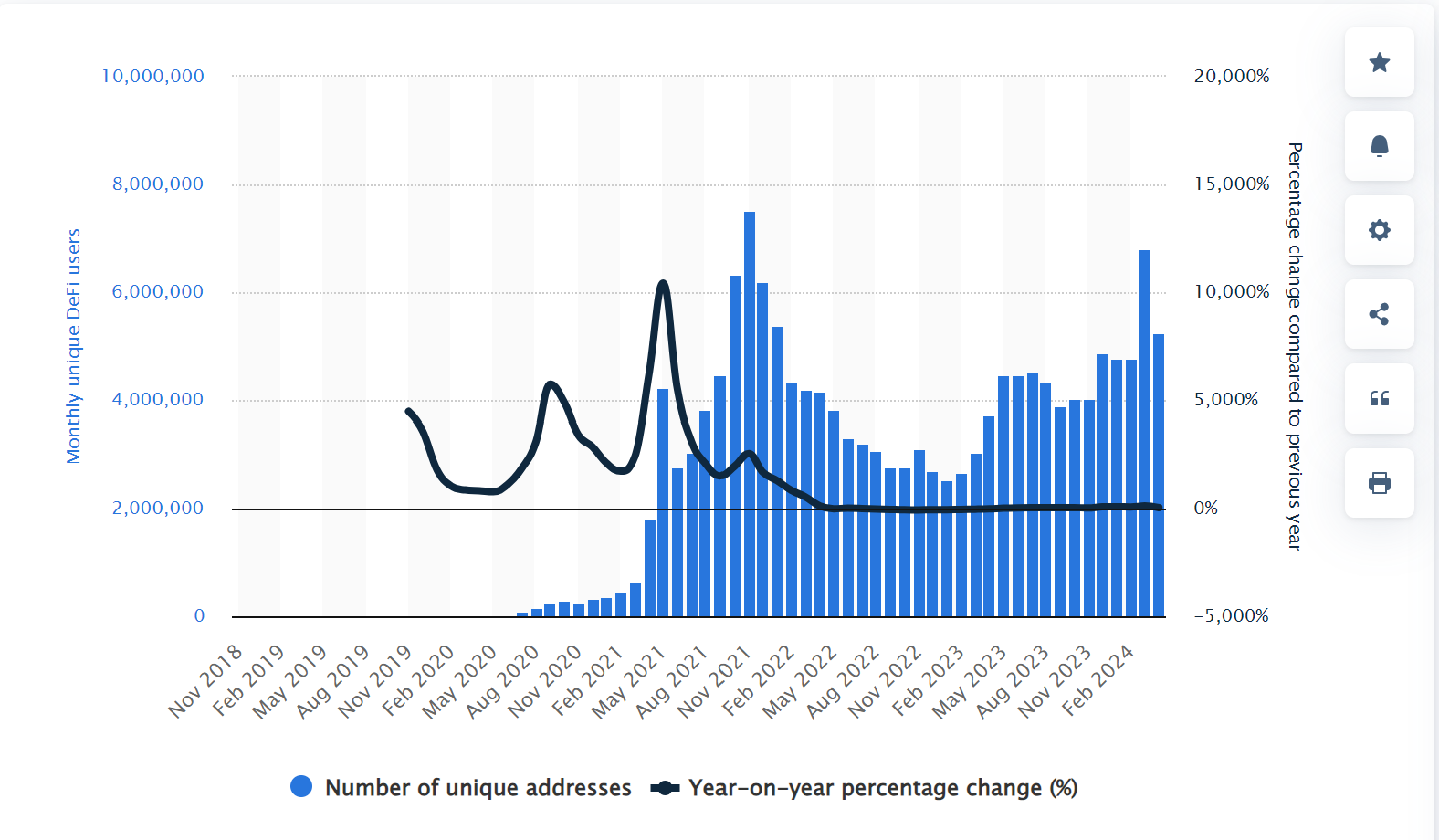
Number of unique addresses buying and selling defi assets globally | Source: Statista
Per the data, the number of unique defi users has increased by nearly 700% over two years.
This rapid increase presents numerous challenges, including compliance and scalability issues for defi platforms. It has made it difficult for defi protocols to maintain robust compliance processes and procedures as user numbers surge.
You might also like: Are CBDCs the ultimate weapon against money laundering?
The identity challenge in defi
Apart from the challenges mentioned above, a recent study by London-based hedge fund managers Nickel Digital Asset Management identified compliance with KYC and anti-money laundering (AML) regulations as major hurdles keeping tradfi institutions away from defi.
Nearly half of the participants (47%) expressed concerns about the complexities associated with KYC and AML compliance in the defi sector.
Returning to Ridyard, the RDX Works CEO emphasized that overcoming compliance barriers such as KYC and KYB requirements in defi necessitates fundamentally reevaluating how identity is conceptualized, managed, and processed within decentralized finance ecosystems.
Limitations of current layer-1 networks
Layer-1 (L1) networks like Ethereum (ETH), which form the backbone of many defi applications, face significant limitations in integrating identity with asset control. On these networks, identities and assets are often tied to a single private key.
This approach is inherently flawed for several reasons:
- Security vulnerabilities: A single point of failure means that if the private key is compromised, all associated assets could be at risk.
- Lack of flexibility: Binding identity and assets to one key may limit the ability to manage identities and assets separately.
- Inefficiency: Some analysts feel this approach is not scalable and may not accommodate the nuanced requirements of institutional investors who need robust identity management systems.
In his submission, Ridyard highlighted the conventional assumption prevalent on L1s that users are synonymous with their accounts and validate their identity solely through a single private key. In his opinion, this falls short of meeting compliance standards.
Moreover, Ridyard underscored the inadequacy of identity solutions mandating the inclusion of all user identity information onto the blockchain, regardless of encryption.
Instead, he outlined that emerging independent L1 protocols tackle this challenge by integrating identity solutions directly into the blockchain architecture.
According to him, these solutions aim to balance privacy protection with facilitating selective disclosures required for compliance adherence.
Risks associated with a one-size-fits-all approach
The current one-size-fits-all approach to identity and asset management in defi can create multiple risks, including the following:
- Security vulnerabilities: A compromised private key can lead to the theft of all associated assets.
- Lack of flexibility: Institutions require the ability to manage multiple identities and roles within their organizations, which is not feasible with a single private key.
- Inefficiency: The current system does not allow for efficient management of assets and identities, leading to operational bottlenecks.
Potential solutions
Separation of identity and assets
One promising solution to the problems highlighted above is the separation of identity and assets. This approach allows defi users to manage their identities separately from their assets, enhancing security and control.
Additionally, by decoupling these elements, defi platforms can offer a more flexible and secure experience, aligning more closely with the needs of institutional investors.
Touching on this potential solution, the RDX Works CEO said, “When we log in to an application, we want to be able to separate who we are from what we own. To control our accounts and assets, we don’t want a single easily-lost-or-stolen key that we can’t change,”
Multi-factor authentication
Introducing multi-factor authentication (MFA) into defi platforms can also provide a bank-like security experience.
MFA requires multiple forms of personal proof, such as something you know (password), something you have (hardware token), and something you are (biometric verification).
This layered security approach can significantly reduce the risk of unauthorized access and asset theft.
Application-specific identities
Another solution being developed by companies like Radix DLT is the use of application-specific identities. It allows users to create distinct identities for different decentralized applications (dapps), ensuring privacy and security.
By compartmentalizing identities, users can mitigate the risk of a single point of failure and maintain greater control over their personal information.
Credential verification on the network
Facilitating compliance through credential verification on the network is crucial. It involves allowing verified credentials to be shared securely without exposing private information. Such a system can enable defi platforms to meet regulatory requirements while preserving user privacy and decentralization.
“Radix provides these primitives by separating the concept of the account from the concept of identity,” Ridyard explained. “Many accounts can be bound to a single identity, separating ‘actor’ and ‘assets’ in a manner similar to traditional compliance structures.”
The Implications for institutional investors
Meeting compliance needs
Defi platforms that integrate robust identity solutions can meet the compliance needs of institutional investors. By providing a secure, flexible, and compliant environment, these platforms can attract significant institutional capital. It will not only enhance the credibility of defi but also drive its mainstream adoption.
Unlocking $100 trillion in capital
The potential for unlocking an estimated $100 trillion in institutional capital cannot be overstated. This influx of investment can bring unprecedented liquidity to defi markets, facilitating more efficient and scalable financial services.
Furthermore, institutional involvement can also spur innovation as new products and services are developed to meet the needs of these large investors.
Sharing his view on the potential implication on the broader defi ecosystem of unblocked institutional capital, Ridyard remarked, “Institutional capital entering defi has the potential to be a transformative force. It is likely the catalyst needed to bring defi mainstream and to the masses.”
Broader impact on the defi ecosystem
Increased institutional participation can also have a ripple effect across the defi ecosystem. Experts like Ridyard believe enhanced liquidity can lead to more stable and efficient markets, while the influx of capital could drive innovation and development.
Additionally, integrating robust identity solutions can enhance the overall security and trustworthiness of defi platforms, benefiting all users.
Conclusion
The transformative potential of defi lies in its ability to democratize finance and provide open access to financial services. However, to fully realize this potential, addressing the identity challenges that hinder institutional investment is crucial.
By developing solutions such as the separation of identity and assets, multi-factor authentication, application-specific identities, and credential verification on the network, defi platforms can bridge the gap between decentralized finance and traditional financial institutions.
Read more: What is zero knowledge proof and how does it protect your data?


