


NFT
Bitcoin nonfungible tokens (NFTs) have captured the crypto world’s attention fast, opening new opportunities for the oldest blockchain and digital art enthusiasts. Since their explosion in 2020, NFTs have been typically minted and traded on Ethereum-based platforms, besides other blockchains, such as Cardano and Solana.
However, a new protocol known as Ordinals was launched in January 2023 by former Bitcoin Core contributor Casey Rodarmor, who exploited the 2021 Bitcoin Taproot upgrade to expand the cryptocurrency capability and enable on-chain Bitcoin-native NFTs.
Taproot offered a way to expand the base layer’s block capability by condensing the size of transactions requiring less data usage and encouraging the use of smart contracts on Bitcoin. The upgrade considerably increases the types of transactions possible on Bitcoin, including decentralized finance (DeFi) and NFT applications.
By February 2023, the world’s largest issuer of NFTs, Yuga Labs, had already announced the creation of TwelveFold, a new NFT collection issued on Bitcoin, thereby endorsing Bitcoin NFTs and avouching their success.
Here’s what you need to know about Bitcoin NFTs, how they differ from the most popular Ethereum-based alternative, and how to create and sell them.
What are Ordinals?
Ordinals are serial numbers imprinted in a single, unique satoshi (sat), the smallest unit of Bitcoin (BTC), through the ordinal theory that assigns them in the order in which they are mined. The first satoshi in the first block has the ordinal number 0, the second has the ordinal number 1, and the last satoshi of the first block has the ordinal number 4,999,999,999.
Colored coins were the first representation of such a concept back in 2012, being crypto assets repurposed to represent something of value by adding metadata information. Counterparty is another attempt to embed data into regular Bitcoin transactions. However, it has its own XCP token, required for some functionality, making it officially like an altcoin and not an extension or second layer for Bitcoin.
The ordinal theory rewards satoshis with numismatic value, allowing them to be collected and traded as rarities. Satoshis are given individual identities to be tracked, transferred and ingrained with meaningful arbitrary data, such as pictures, text or videos, through a Bitcoin transaction that remains permanently part of the blockchain. Such data can be viewed in Ordinals-compatible wallets, such as the Sparrow wallet, and online explorers.
Inscriptions
The process of assigning assets to individual satoshis is called inscription. Inscriptions are digital artifacts native to the Bitcoin blockchain, the digital equivalent of physical artifacts.
They are fully on-chain, do not require a sidechain or a separate token, and use the Ordinals protocol to inscribe sats with content on ord, an index, an explorer and a wallet that relies on Bitcoin Core for private key management and transaction signing.
Ord allows tracking the location of specific satoshis and their ordinal numbers and can be viewed with the Ordinals explorer. In contrast with traditional NFTs that rely on off-chain content stored on the interplanetary file system (IPFS), inscriptions are gifted with Bitcoin’s immutability and security. They are permissionless and uncensorable digital artifacts since they can be sold without a royalty.
How to create Bitcoin NFTs
The Ordinals ecosystem is in full development, but its accessibility is still restricted to two primary ways to mint an ordinal NFT.
The first method to inscribe Bitcoin Ordinals requires some technical skills, running a full Bitcoin node and then installing Ord on this node to inscribe satoshis into an Ordinals wallet and make Bitcoin Ordinals NFTs. Two types of Bitcoin wallets can process Ordinals; they both must be Taproot-compatible and have a “coin control” capability to avoid spending Ordinal satoshis as network fees or sending them accidentally in another transaction.
- The Sparrow wallet is only recommended for receiving Ordinals to avoid sending Ordinals sats inadvertently. However, using it does not require running a full node. Here’s how to set up a Sparrow wallet.
- An Ord wallet requires running a full node on 500GB capacity. Unlike the Sparrow wallet, an Ord wallet allows you to create inscriptions and freeze the inscribed sats to prevent accidental spending. Here’s how to set up an Ord wallet.
Regardless of the wallet you’re using, make sure to have some Bitcoin available to pay for the transaction fee.
The second method is more straightforward and involves using a no-code tool, such as Gamma or Ordinalsbot.com, to inscribe your ordinal NFT. Here’s how to mint your Ordinal on Gamma:
- Select the type of file you’d like to use to mint your Bitcoin NFT.
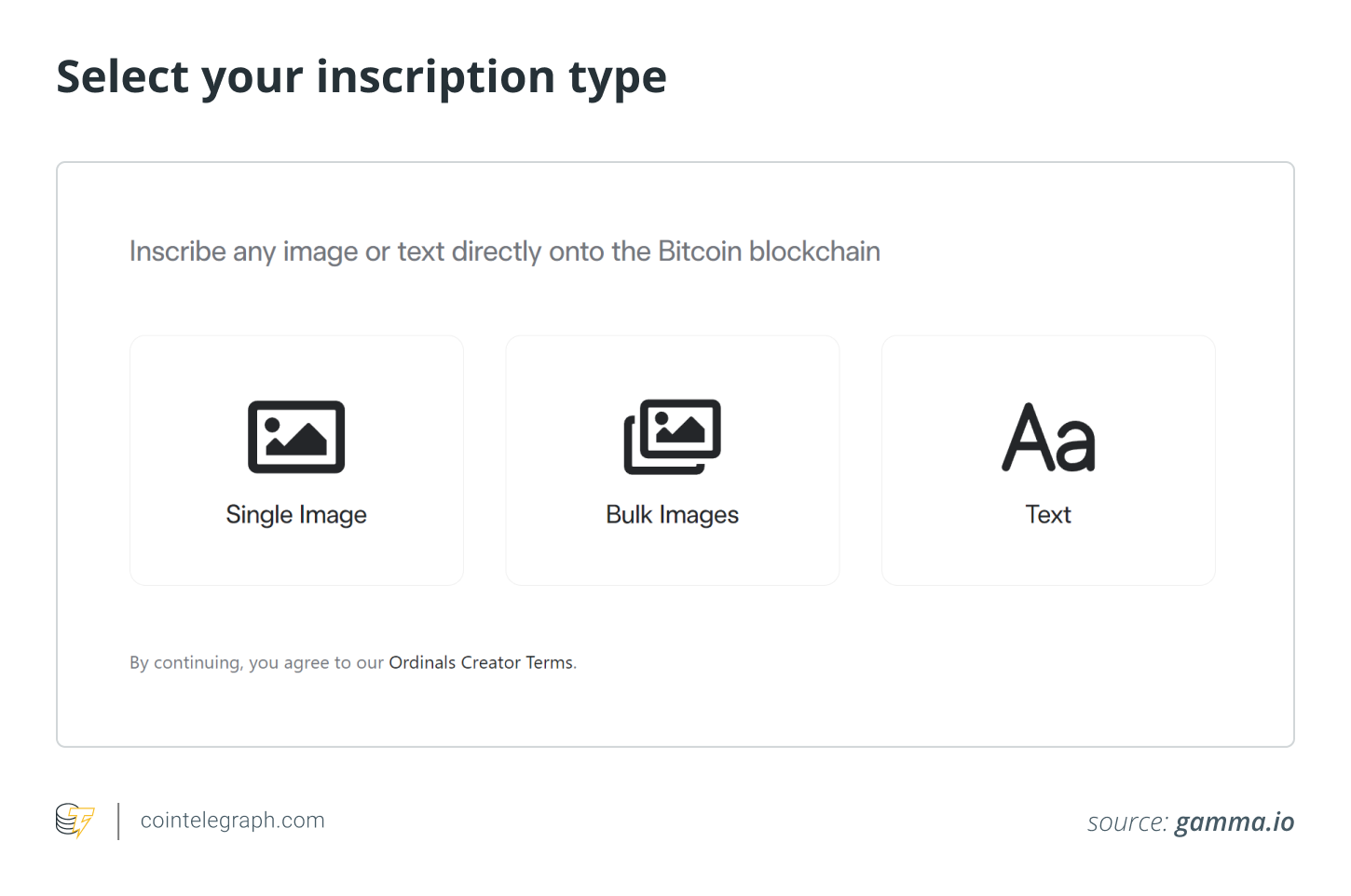
- Upload the necessary file from your computer.
- Set up the transaction fee depending on how long you’d like to wait for your Ordinal to be minted.
- Copy and paste the Bitcoin address where to send the digital artifact, which needs to be an Ordinal-compatible address or a Taproot address.
- Wait for the NFT to be minted. Such a wait depends on the fee you paid for the process to be completed and may be hours or even days. You’ll be able to track the minting status through a link you’ll receive by email.
- View your minted Ordinal on OrdinalsViewer.
How to trade Ordinals
While proper infrastructure and marketplaces to trade Bitcoin Ordinals are being built, the digital artifacts are traded peer-to-peer over-the-counter (OTC) in dedicated Discord servers, with escrows as intermediaries and tracked on Google sheets.
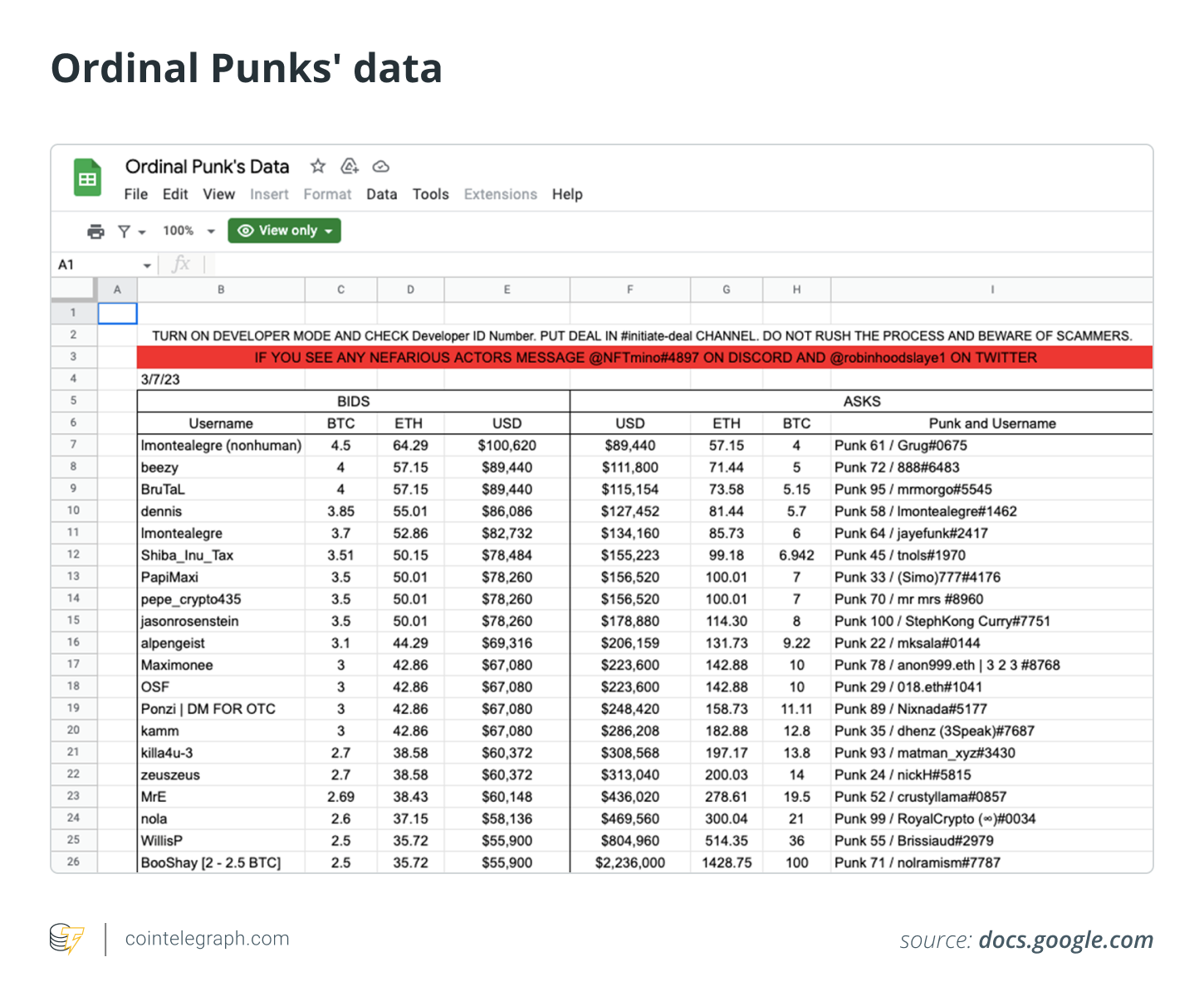
Compared to the more popular NFTs traded via Ethereum and other blockchains, Bitcoin Ordinals trading appears to be an obsolete method. Yet this hasn’t contained people’s interest in Bitcoin NFTs, with hundreds of thousands of newly minted digital artifacts emerging within only a few weeks from launch.
The Ordinals market is entirely trustless, using the secure, partially signed Bitcoin transactions (PSBT) technology, which allows users to easily sign transactions in cold storage, and atomic swaps with no intermediary and a market fee of 2.7%. A system to verify creators is being developed to include creator royalties of 4.2%.
How to buy Bitcoin NFTs
Taproot-compatible wallets must be used to buy Bitcoin Ordinals, such as the Ordinals wallet, the Xverse and Hiro wallets. The Ordinals wallet is very straightforward to use, and the others are also similar:
- Create an account, secure your seed phrase, and deposit funds into the wallet.
- Select the Ordinals you wish to purchase and click “Buy Now.”
- Once the transaction has been executed, the Ordinals will be added to your wallet.
How to sell Bitcoin NFTs
Similar to buying a Bitcoin NFT, you’ll need to pick a Bitcoin Taproot-compatible wallet and download it.
- Create an account, secure your seed phrase, and upload your inscription. The fee will depend on the file size and how fast you’d like the transaction completed.
- Once your file has been inscribed onto the blockchain, you can view it on the Ordinals.com inscriptions page.
- You can freeze the Ordinals to make sure you do not spend them.
- You’ll need to use a peer-to-peer OTC market, usually, the Bitcoin Ordinals Discord server, to sell your inscription.
It is recommended that particular attention is placed on these trades. Being in an unregulated peer-to-peer OTC market, platforms are full of scammers trying to catch the latest Bitcoin NFT craze.
Ordinals vs. traditional NFTs
A few differences distance Ethereum-based traditional NFTs from Bitcoin Ordinals, although they both tend to be grouped under the same umbrella of digital art. The creator of Bitcoin Ordinals, Casey Rodarmor, defines Bitcoin NFTs as authentic digital artifacts because they are on-chain and enjoy all of the good properties Bitcoin holds. Here are the main differences:
- Bitcoin inscriptions are always immutable, while Ethereum-based NFTs can technically be changed or deleted by the contract owner. Traditional NFTs must be audited to become immutable, which requires deep knowledge of the Ethereum Virtual Machine (EVM) and Solidity.
- Bitcoin inscriptions always have on-chain content, making it impossible to be lost. It is durable and scarcer because inscription creators must pay fees proportional to the size of the content. In contrast, Ethereum NFT content can be off-chain and stored on platforms such as IPFS and could be lost.
- Bitcoin inscriptions are more secure because the blockchain is the most secure. Inscriptions can be sold with PSBT without needing a third party, such as an exchange or marketplace, to transfer them on the user’s behalf. On the other hand, Ethereum NFTs tend to grant intermediary platforms unlimited permission over a user’s NFT, and the use of complex smart contracts may be challenging to interact with for the regular non-techie who wants to trade digital art.
Unlike NFTs, which are minted as completely new tokens, Ordinals have the raw file data inscribed directly onto the sats on the Bitcoin blockchain.
Bitcoin NFTs controversy
The new Ordinals protocol has raised an important question and sparked a heated debate among the NFT community. Should Bitcoin just be money, or should it expand its functionality to other use cases? Is the Ordinals protocol an attack on the Bitcoin network?
The Bitcoin blockchain has traditionally been used only for payment transactions due to its limited block size and network architecture. Such infrastructure favors solutions built on top of the blockchain as additional layers to increase the network’s programmability and scalability.
The latest Ordinals craze has raised many eyebrows among the BTC community. Some are concerned it could distract from Bitcoin’s primary use case as a medium of exchange and whether Ordinals make good use of block space. Ordinals can be images, audio clips or even games inevitably requiring space that is subtracted from the financial data, significantly slowing down on-chain confirmation times.
Bitcoin’s fungibility
Bitcoin’s fungibility — one of the main properties of money — is also challenged by Ordinals. This is because inscriptions are imprinted in one satoshi, making it a rare unit, just like numismatic coins are rare physical objects used for collections.
Ordinal satoshis become individual identities that can be tracked, transferred and imbued with meaningful information, such as text or an image, making the sat unique and turning it into a de facto NFT. On the other hand, the traditional stance views all satoshis as equal, or they begin to lose a significant trait of money.
Full node costs
A few weeks after the project was launched, a record-breaking-sized block of 4MB was created, raising concerns among the community about the future efficiency and costs of the blockchain and its full nodes. The average size of a Bitcoin block had never exceeded 1.5MB until the launch of Ordinal NFTs.
Inscription contrarians fear that increasing the Bitcoin blockchain size due to the big transactions and blocks would raise the requirements and costs for devices running a full node. The counterargument is that for the Bitcoin blockchain to be securer, its blocks must be full, which would justify users paying a higher fee.
The debate will unfold in the future as the Ordinals market takes a more robust shape and new opportunities arise. Ultimately, Bitcoin’s true spirit and value reside in its resilience to guide the market in the direction the people want.


