

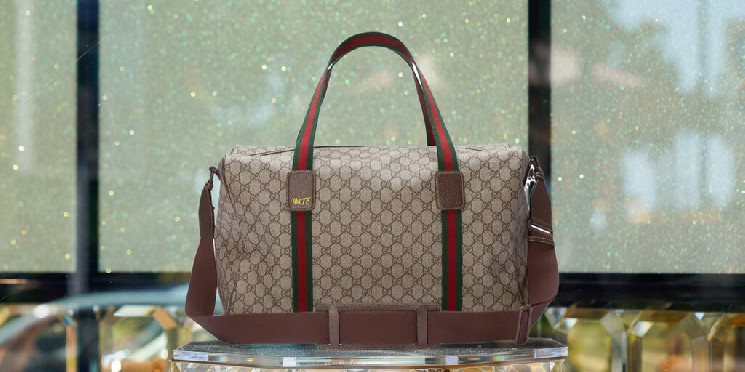
Holders of the Gucci Material NFTs can now exchange the tokens for a Gucci bifold wallet or a Gucci x 10KTF co-branded duffle bag. The reveal follows months of speculation about the planned utility behind the 2,896 NFTs minted in March.
The Kering owned brand went live this week with a redeem facility on partner platform 10KTF.shop. One Gucci Vault Material NFT can be redeemed for the wallet, while you need three tokens to redeem the duffle.
The copywriting team provided a tongue-in-cheek write-up where the duffle is dubbed “baggage you’ll want to carry,” and the wallet described as one that does not require a seed phrase.
A quick calculation shows that the bag that might be considered the better deal for Gucci fans and collectors. An identical looking wallet on the Gucci e-commerce site costs $460 while a similar version of the bag—albeit minus the 10KTF logo— retails for $1790.
On Opensea, the Material NFT is going for 0.22ETH the equivalent of around $412. Since the bag is also co-branded with 10KFT, it’s also got that ‘money can’t buy’ rarity value.
The Gucci Vault Material NFT was a reward for participating in a 10KTF mission in Battle Town. You needed a Gucci Grail NFT to enter, and participants were then airdropped the NFT.
“Just holding a Gucci Grail didn’t reward you, but ‘engagement’ did,” Matt Maher, founder of technology consultancy M7 Innovations, told Decrypt. Maher has just redeemed his token for the Gucci wallet. People can “expect to see this ‘play-to-earn’ or ‘engage-to-earn’ model a lot more in the future,” he added.
According to Maher,”the strategy here was smart because it bridges the digital divide and rewards holders with a physical product.”
“For Gucci loyalists, it’s another luxury product in their repertoire, one that was essentially free,” he said. “For Web3 degens, it acts as a ‘trial product’ to introduce them to the world of Gucci and create a gravitational pull towards the brand.”
“Rewarding a community is never a bad idea,” he continued. “In this bearish NFT market, holders may bicker over the value and/or utility of a reward, but it’s a reward nonetheless.”
There are strategic differences between the way different luxury brands operate their Web3 fidelity programs and the way they reward token holders.
Take Louis Vuitton and its VIA program. Although the 100 odd purchasers of its genesis $41,600 Treasure Trunk NFT received a limited edition Louis Vuitton trunk, to date, subsequent perks have involved just an option to purchase a limited edition “bitcoin orange” Speedy 40 bag by creative director Pharrell Williams. This comes with a price tag of around $9,000.
In the case of Dior, holders of the digital twin collectible that came with its 470 limited edition B33 sneakers will also receive an early access option to purchase an exclusive drop from Kim Jones’ Dior Men’s spring ’24 collection.
While it wasn’t a free drop, 3,333 Gucci KodaPendant NFTs—a collaboration with Yuga Labs Otherside metaverse game—also came with redeemable physical co-branded pendant necklaces in 925 sliver.
Most recently, Gucci teamed up with auction house Christie’s on an NFT sale showcasing the work of leading digital talents in the digital art space, including Iskra Velitchkova who created a generative algorithm inspired by the handle of Gucci’s Bamboo 1947 bag.
Web3 native brands and peddlers of more traditional physical luxury enjoy a symbiotic relationship, says Maher, because they fill out each other’s shortcomings. One has “all the digital lore with no credibility in physical products” while the other has “all the actual history and physical lore, but no credibility in NFT-first digital goods.”
Collaborations like Gucci’s with 10KTF parent Yuga Labs—alongside Tiffany & Co with CryptoPunks and Rimowa with RTFKT—represent a way to redress the balance and bridge the gap capitalizing on shared tropes of exclusivity, scarcity, and rarity.


