

The World Wide Web, as its name implies, is borderless, and so is crypto. The internet and cryptocurrency’s common ethos is wide-open communication and exchange, unimpeded by national boundaries. On the ground, however, as crypto has become a more significant player in the financial system, nations have begun to consider issues of sovereignty and regulation. While many countries have so far remained open to crypto, others have restricted its use or outright banned it. The same reason that some have advocated for crypto and blockchain technology — as a means of revolutionizing the international financial system — has alarmed plenty of world leaders.
For example, Hillary Clinton, calling attention to the risks of crypto and the need for regulation, said at a Bloomberg conference in Singapore in 2021, “One more area that I hope nation-states start paying greater attention to is the rise of cryptocurrency because [it] has the potential for undermining currencies, for undermining the role of the dollar as the reserve currency, for destabilizing nations, perhaps starting with small ones but going much larger.” These are strong words, and governments have begun to take claims like these seriously. Despite crypto’s decentralization, regulation appears inevitable and could profoundly alter its development and adoption worldwide.
The regulatory environment
In general, financial regulations supervise the world of finance, setting up restrictions, requirements, and guidelines for its institutions, with the goal of keeping financial systems stable and establishing and maintaining their integrity. For traditional financial institutions across the world, these rules have been evolving for decades. The cryptocurrency market, as a comparably new area of finance, does not have this larger history, and given its rapid growth and maturity, it now faces the prospect of regulation.
As the crypto market has grown, governments and international organizations, such as the International Monetary Fund, have taken notice of its potential to disrupt the established economic systems — in both the forward-looking, tech-world sense of the word and the more troublesome sense of creating problems, such as those associated with the collapse of the crypto exchange FTX in November 2022. In other words, the cryptocurrency industry is now extensive enough that financial analysts worry that it may have adverse macroeconomic consequences if not properly regulated, even if it also has potentially positive effects. The increased risk has led to a call for more regulation. The World Economic Forum, for instance, has said regarding cryptocurrency regulation that — as with other financial regulations — the aim is to “support financial stability, transparency, protection for consumers and investors, and a level playing field for different market participants.”
Related: Gary Gensler’s SEC is playing a game, but not the one you think
So far, most regulatory activity in this space has been on a national level. But cryptocurrency use is not restricted, or meant to be restricted, to national borders, making international regulatory cooperation something of an ideal — and one whose realization still seems far off. But regulatory agencies have reason to pursue it: As of this writing, one in five Americans claims to have already been involved in cryptocurrency trading on some level. In Singapore, those numbers are even higher. And as the market grows, everyone will be eager to avoid a repeat of the 2008 financial meltdown. In general, the larger the market, the more likely it is to be regulated; this is based on the assumption that as the market grows, it is more likely to affect the common good.
On the other hand, crypto advocates point to the possibility that crypto itself is attempting to avoid a 2008-style meltdown by its very nature. It constitutes an alternate financial structure not dominated by major financial institutions that more urgently need to be checked by regulations. There is a definite tension between crypto’s underlying independent ethos and the nature of regulation. Will this be a creative tension or a destructive one? It may be too early even to speculate, but whatever the case, governments have begun to assert their authority.
Regulating cryptocurrency in the U.S.
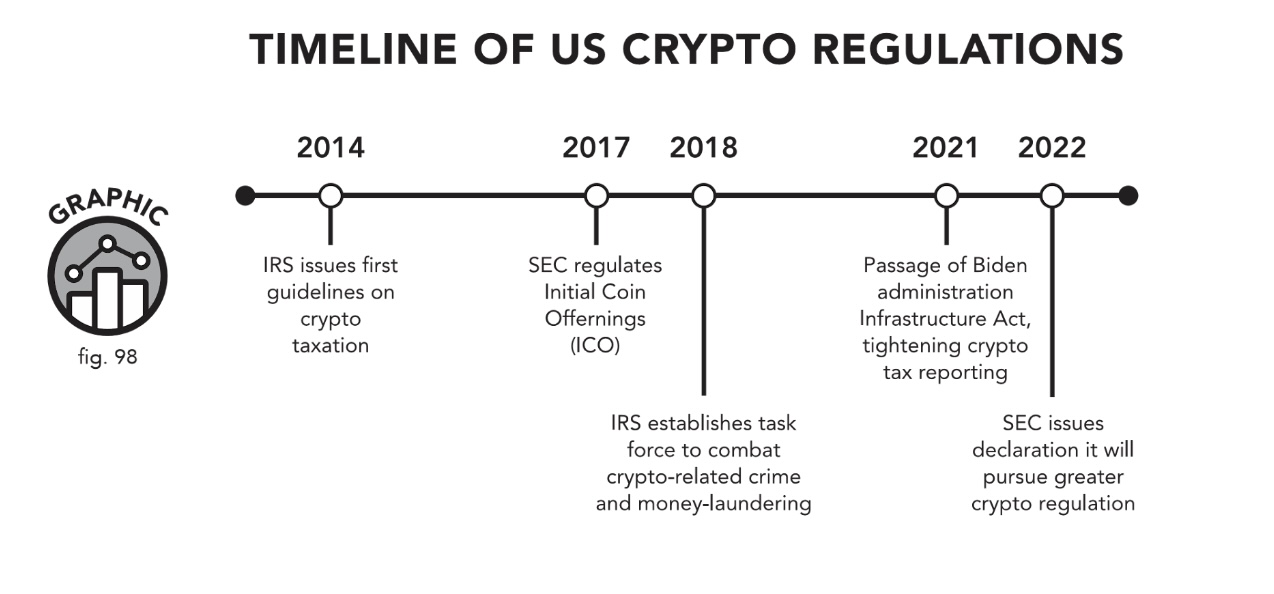
The history of cryptocurrency regulation in the United States reflects that of most Western nations. Early on, the U.S. government’s perspective was that Bitcoin (BTC) and other cryptocurrencies were fascinating innovations but required little attention from federal agencies. This frictionless system may have exhilarated early adopters, but the more skeptical felt crypto was doomed to failure.
However, to many people’s surprise, crypto not only didn’t go away but continued to grow in both value and popularity. Still, U.S. regulatory agencies such as the Securities and Exchange Commission, whose function is to supervise markets and protect investors, held on to a wait-and-see attitude for some time. Eventually, the crypto market became too prominent to ignore: Problems with initial coin offerings prompted their regulation in 2017. Additional regulation seems inevitable, for instance, in the wake of the collapse of Sam Bankman-Fried’s FTX in November 2022. The question, then, becomes which regulations will be put in place, and what areas they’ll address.

Government concern actually first centered on fraud and the use of cryptocurrencies for illegal activities on the dark web, but existing laws cover such cases. Until Congress passes additional laws directly related to crypto, the SEC’s approach will continue to be what’s called “regulation by enforcement” of existing statutes. Current regulations include provisions against money laundering and financing terrorism — these could apply to crypto-related cases but are not regulations written with crypto in mind.
The future of crypto regulation
What should be obvious is that the crypto regulatory landscape is tumultuous. There are so many different approaches that shift so frequently — sometimes 180 degrees — that it’s hard to determine what an individual government’s stance is going to be from year to year, or even from month to month.
Predictions are always risky, particularly so in situations as volatile as that in which cryptocurrency finds itself. You can probably expect increasingly louder calls for regulatory clarity and cross-border consistency, along with little chance of governments’ being able to heed such calls in a timely manner.
Related: The SEC shook Kraken down for $30M, but it doesn’t mean it had a case
Such lack of clear direction may inhibit some crypto trading in the short and medium terms from those who feel such trading is too risky. But one thing that’s virtually certain is that crypto and other digital currencies, and the blockchain technology that underpins them, are going to continue to be a force that governments will have to reckon with.
Crypto and, by extension, blockchain are part of the much larger technologically-driven global movement known as the Fourth Industrial Revolution. Within this revolution, the world is undergoing a digital transformation, and digital currency simply makes sense as every aspect of our lives evolves from analog to digital. How important is the digitalization of money and its underlying distributed ledger in this revolution? Klaus Schwab, founder of the World Economic Forum — best known for its annual conference in Davos, Switzerland — has said, “Blockchains are at the heart of the Fourth Industrial Revolution.”
Just as fears about the possible repercussions of artificial intelligence and genetic engineering are managed with some level of regulation, rather than stopping those advances entirely, national concerns about the potentially destabilizing impact of cryptocurrency are unlikely to halt its growing usage. Regulation, if properly applied, might bring some desirable order into the often chaotic proliferation of cryptocurrencies, but it’s finding the right approach to regulating this emerging phenomenon that’s proving challenging.
This column is an excerpt adapted from the Cryptocurrency QuickStart Guide, scheduled for release on Feb. 27.
This article is for general information purposes and is not intended to be and should not be taken as legal or investment advice. The views, thoughts and opinions expressed here are the author’s alone and do not necessarily reflect or represent the views and opinions of Cointelegraph.


