

Staking pools are how regular people like you can tap into crypto’s proof-of-stake networks without running heavy hardware or locking up huge amounts of coins. Together with other pool participants, you share the work, and share the staking rewards when it’s done, of course. It’s the easy way to turn crypto assets into steady passive income while helping secure the network.
Here, we cover all the essentials you need to know before diving into staking pools yourself.
What Is a Staking Pool?
A staking pool is a group of crypto holders who all combine their coins to participate in a proof-of-stake (PoS) network. Instead of staking alone, all the delegators add their staked assets into a single pool, managed by a pool operator, who runs the validator with the necessary validator keys. This pool functions as one large validator, securing the chain and earning rewards in the network’s native token.
But why is operating together better than going solo? Well, solo staking requires the chain’s full minimum stake (for example, at least 32 ETH is needed to stake on Ethereum), as well as technical skills, and nonstop validator uptime. But in crypto staking pools, participants share resources, boost their collective staking power, and improve their odds of validating transactions by working together. That means even small holders can potentially earn rewards which are otherwise reserved for large operators.
How Staking Pools Work
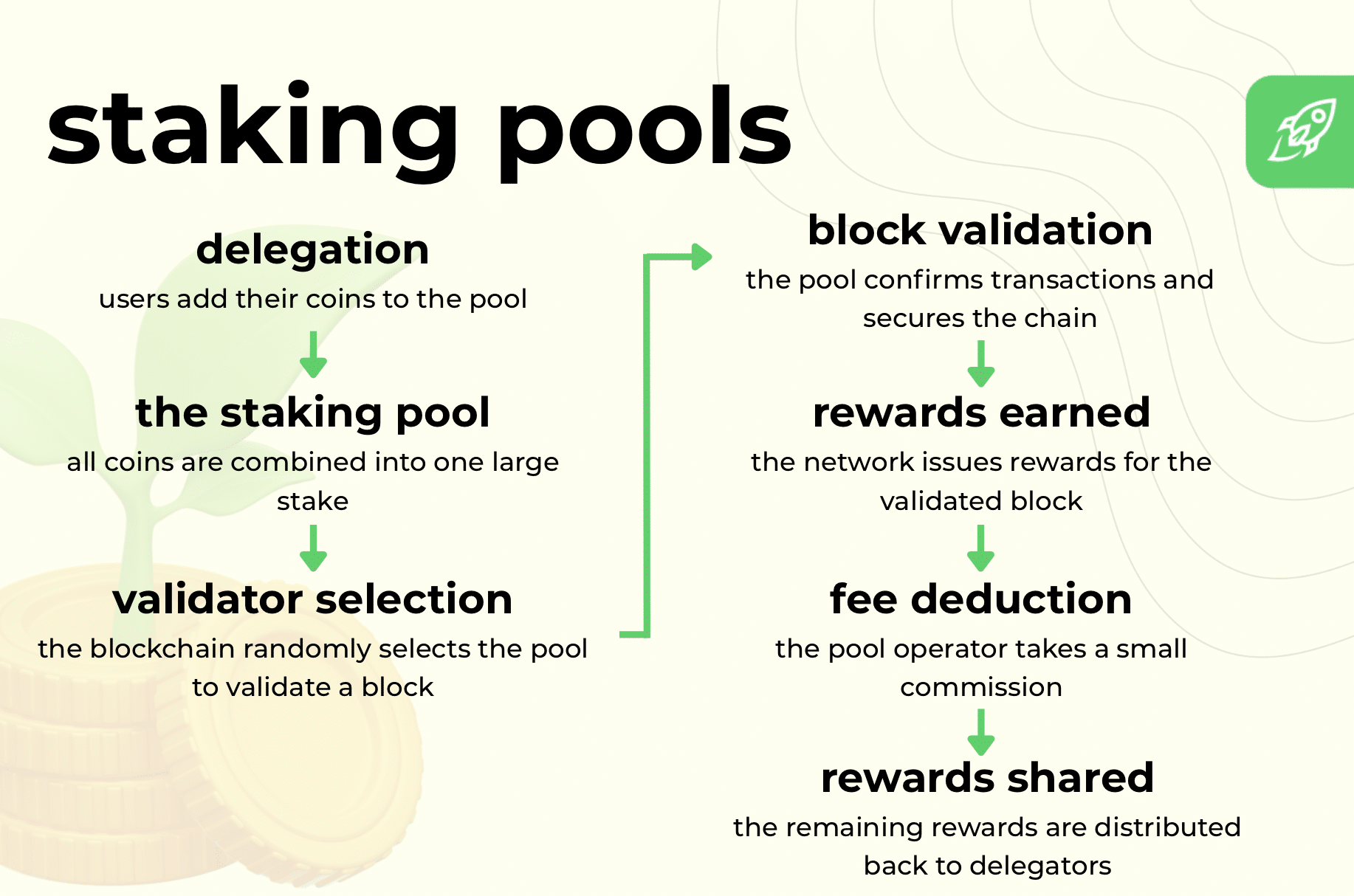
Staking pools turn a tough solo job into a shared project. They follow the same rules as any proof-of-stake network but break the process into smaller parts so that more people can join in. Let’s break down exactly how the staking process functions.
Consensus Mechanism
Everything starts with the consensus mechanism. In PoS blockchains, validators secure the chain by pool staking coins and confirming new blocks. Other blockchains use delegated proof-of-stake (DPoS), where token holders vote for validators instead of running them directly.
You can find out exactly how proof-of-stake consensus works in our dedicated article: What Is Proof-of-Stake (PoS)? A Beginner’s Guide
Either way, the network needs validators to keep it honest. But the barrier to entry is too high for most, and being a validator requires constant uptime. That’s where pools come in: they use delegation to bring smaller holders into the process. Users pool resources, and can play an active role in chain security.
Pooling Resources
Instead of staking alone, users combine their own funds into a shared pool. The blockchain then sees that entire pool as one large stake. This gives everyone inside better odds of being selected to help produce new blocks. Think of it like stacking lottery tickets: the bigger the stack, the higher the chance to win. Pooling makes the system accessible, but size only matters if the network actually chooses the validator. How does that process work?
Validator Selection
After all resources are combined, the blockchain must pick a validator. Selection is random but weighted by stake size. Bigger pool size means a higher probability of being chosen to confirm the next block. Once chosen, the validator performs its duties, validating transactions and adding new blocks. Selection determines who gets the rewards—the main concern of every delegator.
Earning Rewards
When a pool’s validator is chosen, it earns staking rewards in the chain’s native token. Rewards typically come from network inflation and transaction fees. The pool then runs a rewards distribution process to divide earnings among delegators. Your share matches your stake relative to the pool’s total. For example, staking 1% of a pool’s balance means you’ll receive 1% of each payout. On Ethereum, annual yields have ranged from 20% back in 2020 to about 5% in 2024, as more ETH joins pools. Rewards are the main reason delegators join, but before any payouts can reach your wallet, the pool deducts fees.
Stay Safe in the Crypto World
Learn how to spot scams and protect your crypto with our free checklist.

Pool Fees
Every staking pool charges fees to cover costs and pay the pool operator. This commission fee is usually a percentage of rewards, though some networks add fixed amounts. For instance, on Ethereum, most pools charge around 10%. Lower fees mean more rewards for delegators, but a reliable operator is often worth the cost. Fees are the final piece of the process: they come after rewards are earned, and before payouts are sent to your withdrawal address.
Types of Staking Pools
There are many different types of staking pools out there. The way they’re set up changes how safe, flexible, and open they are. You’ll run into three main splits: custodial vs. non-custodial, public vs. private, and centralized vs. decentralized.
Custodial and Non-Custodial Pools
A custodial staking pool takes custody of your coins. You deposit them with a service provider—usually an exchange—and they handle the validator. The upside is convenience. The downside is custodial risk: you give up your private keys and rely on the provider’s honesty and compliance with KYC/AML requirements.
A non-custodial staking pool works differently. You delegate without giving up ownership. Your coins stay in your wallet, or in a smart contract that only you can withdraw from. This avoids custodial risk and keeps funds safer. Cardano’s 3,000+ independent pools are a classic non-custodial model.
Public and Private Pools
Public staking pools welcome anyone. They lower barriers, spread staking resources, and give all pool participants access to staking rewards. They’re the standard in networks like Ethereum and Solana.
Private pools, on the other hand, restrict entry. They might be run by a company or a single entity with their own capital. Sometimes, operators demand a pool pledge or minimum that keeps out small holders. Private pools can mean better control, but they reduce community access.
Centralized and Decentralized Pools
A centralized staking pool is controlled by one group or platform. They often handle huge amounts of staked funds—Lido, for instance, controls around 24% of all staked ETH. But the risk is obvious: Too much power in one place can threaten network security.
Decentralized pools spread control across many operators. They rely on code, open participation, and sometimes, DAOs. This model reduces reliance on one operator but increases smart contract risk and liquidity risk if tokens trade poorly.
Staking Pool Returns
Returns in a staking pool hinge on three things: how much you stake, how long you stay, and the network’s rules. Pools make rewards steady, but not fixed.
Rewards come from two sources: network inflation (new coins issued) and transaction fees. A pool then runs a rewards distribution system. Your slice depends on your share of the pool size. Put in 2% of the pool’s staked funds, and you’ll receive about 2% of each payout.
The reward rate (APR/APY) in staking pools changes over time. Ethereum stakers saw 20% APR early on, but by mid-2024, as the number of total ETH staked grew to 28%, the APR dropped to ~4%. Today, Cardano averages around 4.5%, Polkadot ~9%, and Solana ~6%.
Compounding can increase these returns. It’s the process of reinvesting your rewards so they generate even more income. Some pools also offer restaking, where tokens are locked on more than one chain at once for extra yield.
Both compounding and restaking can grow your potential passive income, but they may also add extra fees and complexity.
Benefits of Joining a Staking Pool
Staking pools offer expanded access, they spread risk, and help you earn more passive income through steady staking rewards, without any of the massive upfront costs. Let’s take a look at each of those benefits in more detail.
Increased Chances of Rewards
On your own, validating a block can feel more like winning the lottery than generating passive income. A staking pool increases those odds, because participants are able to combine their stakes. The pool’s larger balance boosts its chance of being chosen to validate. When it wins, you get a cut through the rewards-distribution system. That means you’re consistently earning rewards, not just occasional payouts.
Lower Minimum Staking Requirements
Solo staking often demands high minimums. Ethereum requires 32 ETH to run your own validator, which is around $140,000 as of August 2025. That’s out of reach for most individuals. Pools remove this barrier by letting you stake any minimum amount. Some let you start with as little as a few dollars’ worth of tokens. Staking pools allow you to join with less and still gain rewards. This is why they’ve become the default choice for smaller holders.
Reduced Risk
Running a validator yourself means hardware costs, uptime demands, and the chance of slashing penalties if you make mistakes. In a pool, you offload these concerns to the operator. You still face potential risks (like counterparty risk if you use a custodial pool) but many headaches can be avoided by being in a staking pool.
Pools also smooth out income. Instead of big wins or nothing, you earn smaller but steady rewards. That balance helps you manage overall risk while still growing your stake.
Democratized Access
Perhaps the biggest benefit of staking pools is access. Staking pools offer a way for anyone to participate in securing digital assets, not just whales with massive stakes. They spread resources and strengthen security by including more participants in PoS systems. Expanding the amount of staked crypto assets keeps blockchains fair and community-driven, and pool staking ensures it isn’t just a game reserved for elites.
Potential Drawbacks
Staking pools solve many problems, but anything that good comes with its own potential risks. From fees to operator behavior, token price swings and waiting times, there are risks you should weigh before committing any funds.
Pool Operator Fees
Every pool charges fees. Pool operators handle hardware, uptime, and security, and they take a commission fee for doing so. In Cardano, that’s at least 340 ADA per epoch plus a margin. On Ethereum, exchange-run pools often take 10%. These pool fees cut into your final payout. Though low fees boost your net rewards, quality service sometimes costs more. Always balance fee size against reliability.
Misconduct by Pool Operators
All staking pools require some level of trust, since you’re delegating your assets, and this is especially true in custodial staking pools. An operator can act against your interests by going offline, hiding fees, or mishandling your stake. This introduces custodial risk and the chance a service provider loses or withholds funds. Pick operators with clean records, clear terms, and transparency.
Price Volatility
Rewards don’t matter if the token’s price crashes overnight. Staking protects against network inflation but not market swings. Even with attractive rewards, token values can fall faster than you earn. Polkadot’s ~9% APR sounds great, but a sharp price drop could wipe it all out. This isn’t investment advice, just a reminder that market risk is real. Pools can create a source of passive income, but they can’t shield you from crypto’s volatility.
Read more: What Is Volatility in Crypto?
Unbonding Period
If you want to leave a pool, the process isn’t always fast. Many chains impose an unbonding period or lock-up periods before you can withdraw. Cosmos requires ~21 days, Polkadot ~28, and Ethereum has an exit queue. During that time, you stop earning and can’t sell. If markets swing, you’re stuck. Some liquid staking options solve this with tradable liquid staking tokens, but that brings slashing penalties and liquidity risk of their own. Always check withdrawal rules before pool staking.

Popular Cryptocurrencies That Support Staking Pools
Let’s highlight four major PoS blockchains that let you stake via pools, with statistics as of August 2025.
- Ethereum (ETH)
Ethereum shows strength in stakes. Around 29.6% of all eligible ETH is currently staked, all of which locks in security and gives delegators consistent rewards. This size shows how much staking pools matter to Ethereum’s ecosystem. - Cardano (ADA)
Cardano shines with mass participation. Around 60% of all ADA is currently staked, totaling 21.2 billion ADA tokens committed to secure the network. - Polkadot (DOT)
Polkadot shows strong engagement too. Roughly 49% of its DOT supply is staked via nomination and pooling, reinforcing both the security and governance of the network. - Solana (SOL)
Solana’s staking level is high, with about 66% of circulating SOL staked. The network uses automatic validator rebalancing to keep stake spread evenly across the network. This shows both strong user trust and the popularity of crypto staking pools on this fast-growing blockchain.
How to Choose the Right Staking Pool
Not every staking pool is worth your coins. The right choice balances costs, size, and reliability. Here are the key factors to check before delegating your staked funds.
- Staking pool fees
Every pool takes a cut. Look at the commission fee, usually 5–10%, and any fixed charges. Lower fees mean more rewards, but a solid operator is usually worth paying for. - Minimum stake requirement
Some pools set a minimum amount you need to join. On Ethereum, solo staking requires tens of thousands in ETH, but most staking pools allow you to start with much less. Check the entry bar before committing. - Pool size
A bigger pool size means more chances of validating blocks. That said, oversized pools can reduced payouts or strengthen centralization. Middle-sized pools often give the best balance of returns and decentralization. - Pool pledge
Some blockchains use a pool pledge, where the operator’s own stake is locked into the pool. A higher pledge shows skin in the game, aligning the operator’s interests with yours. - Live stake
The live stake is how much is actively staked in a pool right now. It helps you gauge activity and whether a pool is approaching saturation (the point where rewards start shrinking). - Pool ranking
Many networks publish a pool ranking based on performance and rewards. Use it to compare options, but don’t just chase the top, because diversifying across pools can spread risk.
Final Thoughts
With crypto staking pools, you don’t need a server farm or a mountain of money to stake, just coins, a wallet, and common sense. Staking pools increase both security and accessibility across PoS networks, helping you earn a little in the process, too. They let everyone, not just the whales, take part in building the future of the blockchain.
FAQ
What is the purpose of a staking pool?
A staking pool lets many users combine their coins to act as one validator. This boosts the chances of validating blocks, earning staking rewards, and lowers the barrier to entry for small holders.
How do staking pools make money?
They make money by charging commission fees. Each time a block reward is won, the operator keeps a cut, and the rest is shared among pool participants.
What is better, a staking or liquidity pool?
Each serves a different purpose. Staking pools generate rewards by securing a blockchain, while liquidity pools earn trading fees in DeFi markets. Your choice depends on whether you want steady yield or exposure to trading risk.
Read more: What Are Liquidity Pools?
Can I lose my crypto by joining a staking pool?
Yes, though risks vary. Bad pool operators can trigger slashing penalties, and custodial pools carry counterparty risk. On top of that, token price swings can wipe out gains.
How much crypto do I need to join a staking pool?
It depends on the network. Solo staking usually requires significant upfront cost, but staking pools allow entry with much smaller amounts, sometimes just a few dollars’ worth.
Can I unstake my crypto anytime?
Not always. Some blockchains enforce an unbonding period (ranging from days to weeks), while others, like Cardano, allow flexible exits. Always check lock-up rules before you stake anything.
Disclaimer: Please note that the contents of this article are not financial or investing advice. The information provided in this article is the author’s opinion only and should not be considered as offering trading or investing recommendations. We do not make any warranties about the completeness, reliability and accuracy of this information. The cryptocurrency market suffers from high volatility and occasional arbitrary movements. Any investor, trader, or regular crypto users should research multiple viewpoints and be familiar with all local regulations before committing to an investment.


