

So you bought a cold wallet to protect your crypto. Great, you’re ahead of the curve. But here’s the problem: even hardware wallets can’t protect you from yourself.
Security failures with cold wallets don’t usually happen because the device is flawed. They happen because people make simple, preventable mistakes. I’ve spent years reading through forums, Reddit threads, and hack reports, and I keep seeing the same errors repeated over and over again.
If you want to truly protect your assets, avoid these common traps. Here’s a breakdown of the most frequent cold wallet mistakes and how you can stay one step ahead.
Mistake #1: Not Backing Up Your Seed Phrase Properly
Yes, yes, I know, everyone knows about this one. And yet, people still make this mistake all the time, losing millions in the process. Your seed phrase (a string of 12 or 24 words shown to you during wallet setup) is the single most important part of your cold wallet. If you lose your device, it will be the only way to recover your funds.
Read more: Top Cold Wallets That Will Keep Your Crypto Safe
Many users forget to write it down. Others try to memorize it. Some only write it down once and never check if it’s accurate. That’s a serious risk. If the phrase is wrong or never saved, your crypto will be gone forever.
I’ve seen countless posts from users who skipped the backup and paid the price. One infamous example: a man who lost access to nearly $30,000 in Bitcoin because he forgot his PIN and couldn’t recover the wallet without a proper seed phrase backup.
How to avoid this mistake:
- Write down your full seed phrase during setup.
- Don’t rely on memory or a single piece of paper.
- Recheck the spelling and word order. Just one error can lock you out forever.
Mistake #2: Storing Your Recovery Phrase Insecurely (Online or Unprotected)
Some people do back up their seed phrase, but then ruin everything by storing it in the worst way possible.
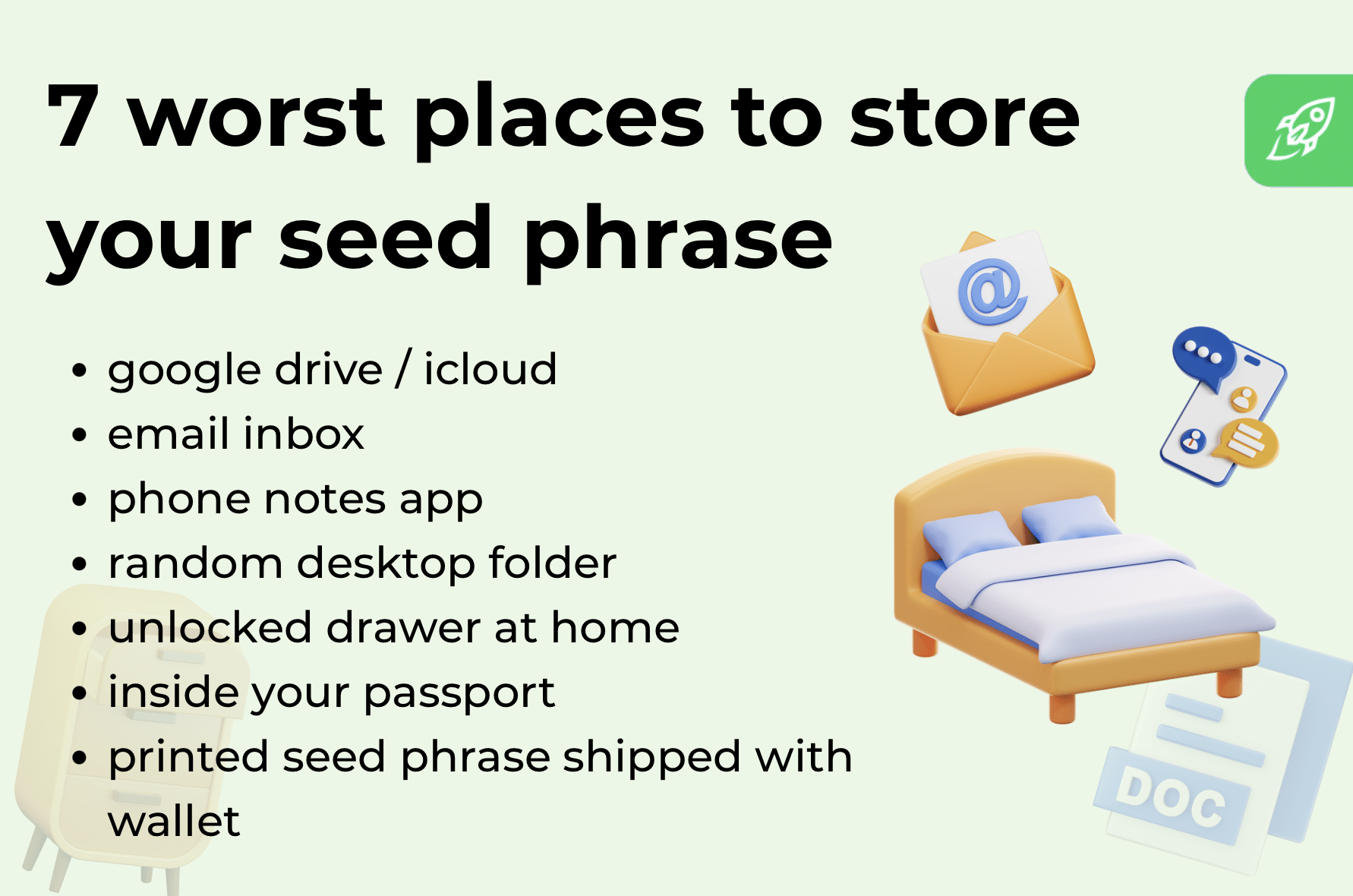
I’ve read stories of users who saved their recovery phrases in Google Docs, cloud notes, or even sent them to their own email for “safekeeping.” One person lost $655,000 this way after hackers got into their iCloud and found a screenshot of their MetaMask backup. On a slightly different note, a Reddit user stayed in a hotel where their credit cards and passport were stolen. The seed phrase had been kept inside that passport. They later realized someone very likely copied it.
Others keep the phrase on paper but leave it in a desk drawer, a folder labeled “crypto,” or a generic home safe. These aren’t secure. They’re easy to find, and they’re vulnerable to fire, water, or even nosy visitors.
How to avoid this mistake:
- Never store your seed phrase in any digital format that touches the internet. No screenshots. No note apps. No photos.
- Use durable materials. Paper fades and burns. Many users now use metal seed storage plates for better protection.
- Keep backups in separate, secure locations. Think bank deposit boxes or a hidden waterproof container.
- Make sure only you (or someone you trust with an access plan) can find and use them.
Mistake #3: Sharing Your Private Keys or Seed Phrase
This one shouldn’t need to be said, and yet… Well, human nature is a thing, and sometimes we might get a brain fart and accidentally blurt out a 12 word pass phrase.
…okay, maybe this sounds a bit unrealistic. Still, crypto investors sharing their private keys and seed phrases with others is a common issue. Of course, it rarely happens for no reason—typically, scammers force them out of unsuspecting victims using emotional manipulation tactics.
A seed phrase is not like a password you can reset. If someone else gets it, they get your wallet. Period. You won’t get any alerts. You won’t be able to reverse it.
Scammers know this, and they exploit it. They’ll pose as tech support, wallet providers, or even friends. I’ve also seen people send their seed phrase to themselves by email or store it in a shared document to “remember it later.” In some cases, they give it to a trusted friend or partner, only to have the relationship fall apart.
How to avoid this mistake:
- Never share your seed phrase or private keys with anyone: not your friend, not your partner, not “tech support.”
- No legit company will ever ask for your seed phrase. Anyone who does is trying to steal from you.
- If you need to plan for inheritance or emergencies, use proper legal tools or a multisig wallet, not text messages or verbal instructions.
- Keep your recovery info completely under your control. If someone else has it, you don’t.
Stay Safe in the Crypto World
Learn how to spot scams and protect your crypto with our free checklist.

Mistake #4: Buying Hardware Wallets from Unofficial Sources
It’s easy to get tempted by faster shipping or a discount. But buying a cold wallet from the wrong place can cost you every coin you own.
I’ve come across cases where people have ordered hardware wallets from online marketplaces or third-party sellers and ended up with tampered devices. Some were pre-configured with a recovery phrase. Others had hidden software modifications. Check out this forum post—it’s from 2018, but still relevant to this day!
If you didn’t initialize the device yourself, there’s no way to trust it. Even if it looks sealed and official, scammers have found ways to reseal boxes and insert malicious firmware before.
How to avoid this mistake:
- Only buy hardware wallets directly from the manufacturer or from verified, authorized resellers.
- When your device arrives, check the packaging and tamper-evident seals carefully.
- Always generate your own recovery phrase during setup. If the device comes with one already printed or pre-set, don’t use it.
- Follow the manufacturer’s steps to verify the device’s authenticity before transferring funds to it.
Mistake #5: Ignoring Firmware and Software Updates
Some users set up their cold wallet once and never touch it again. That sounds safe in theory, until a known vulnerability goes unpatched and someone exploits it.
Hardware wallet manufacturers regularly release firmware updates to fix bugs and close security loopholes. Ignoring those updates means staying exposed. The same goes for the software that connects to your device, like Ledger Live or Trezor Suite. If it’s outdated, it may not warn you about suspicious transactions or support newer protections.
How to avoid this mistake:
- Check for firmware updates directly from the manufacturer before every major use.
- Keep your wallet’s companion software up to date. Use the official site or app store only.
- Before updating firmware, have your recovery phrase nearby, just in case something goes wrong and you need to restore.
- Watch for fake update prompts or phishing emails. Never install anything unless you’ve verified the source.
Mistake #6: Blind-Signing Transactions Without Verification
Just because your hardware wallet asks for approval doesn’t mean the transaction is safe. I’ve seen users blindly confirm transactions on their device without checking what they’re actually signing. In many DeFi scams, the attacker doesn’t try to steal your seed phrase, they trick you into giving permission. Once you approve a malicious smart contract, your wallet becomes an open door.
In early 2025, Group‑IB investigated a phishing campaign targeting crypto users in Europe. The attackers impersonated tax agencies and directed victims to fake “declaration portals.” These sites prompted users to “connect their wallet” to verify holdings. Once connected, the site asked for transaction approval, but what users were really signing was a smart contract granting full access to their wallet. The attackers would then use it to empty accounts instantly.
How to avoid this mistake:
- Always read what the device screen says before approving anything, not just your computer screen.
- Use wallets that support clear-signing (meaning: “what you see is what you sign”).
- Avoid interacting with unknown dApps or contract addresses. If something looks unfamiliar or garbled, don’t approve it.
- Keep your device firmware updated so you can benefit from improved transaction previews and warnings.
- Double-check destination addresses on the device. Malware can replace them on your PC without you noticing.
There is less crypto being stolen now, but the threat is still very much real. Source: coinledger.io/research/crypto-crime-report.
Mistake #7: Using Your Cold Wallet on Insecure Devices
Here’s where quite a lot of people slip up. A cold wallet is only as safe as the computer you plug it into. Many users regularly connect their hardware wallets to everyday devices—the same laptops they use for browsing, downloading, or work. That adds risk. If your system is compromised, malware can wait silently until you approve a transaction. It might swap an address, trick you into blind-signing, or silently escalate access.
OneKey’s security team recently warned that using your daily laptop or phone for crypto interactions opens the door to phishing scripts and malware already on the machine. And a16z pointed out that most hacks don’t happen because the wallet failed, but because the device you trusted was already compromised.
How to avoid this mistake:
- Only connect your cold wallet to a clean or dedicated device, ideally one used only for crypto.
- Use a live operating system (like Tails or Ubuntu from a USB) when signing large transactions.
- Don’t treat your cold wallet like a hot wallet. Keep regular spending funds elsewhere.
- Avoid browser extensions, opened dApps, and email tabs while using your wallet.
Bonus: Storing Your Wallet in Obvious “Crypto Safe Places”
Some people put serious thought into backing up their seed phrase, and then store the backup like it’s labeled “steal me.” Even if your home feels safe, you can’t assume everyone who visits (cleaners, contractors, roommates, friends, etc.) won’t stumble upon it. The same goes for leaving your hardware wallet in plain sight. If someone knows what it is and takes it, you’ve got a real problem.
Obvious locations invite trouble. Desk drawers. Nightstands. The family safe everyone knows about. Thieves search those first—housemates and visitors can stumble upon them too. Single-point storage also hurts you. One obvious spot can fail in a burglary or a quick search.
How to avoid this mistake:
- Store your recovery phrase and hardware wallet in unlabeled, discreet, and secure locations.
- Avoid obvious hiding spots like desk drawers, safes marked “important,” or anything crypto-related.
- Consider using fireproof and waterproof containers, but keep them hidden.
- If you need to label or track something for yourself, use vague language that only you understand.
Conclusion
A cold wallet can be one of the safest ways to store your crypto, but only if you use it correctly. Backups, physical security, trusted sources, firmware updates, and caution during signing all matter. Miss just one, and you could lose everything.
None of these mistakes are hard to avoid. But they do require attention. A little bit of effort now can save you from a lot of regret later.
Disclaimer: Please note that the contents of this article are not financial or investing advice. The information provided in this article is the author’s opinion only and should not be considered as offering trading or investing recommendations. We do not make any warranties about the completeness, reliability and accuracy of this information. The cryptocurrency market suffers from high volatility and occasional arbitrary movements. Any investor, trader, or regular crypto users should research multiple viewpoints and be familiar with all local regulations before committing to an investment.


