


The importance of decentralization in file sharing
Decentralized file sharing revolutionizes data access by eliminating dependence on centralized servers and utilizing P2P technology to distribute files across a network of nodes.
Distributing and accessing data without depending on a centralized server is possible with decentralized file sharing. Rather, files are kept on a network of linked nodes, frequently through the use of peer-to-peer (P2P) technology.
To enable file sharing, each network user can provide bandwidth and storage space. BitTorrent and InterPlanetary File System (IPFS) are two well-known instances of decentralized file-sharing protocols.
The decentralization of file sharing has completely transformed the way users access and store digital content. In contrast to conventional centralized file-sharing systems, which store files on a single server, decentralized file-sharing uses a P2P mechanism. Dispersing files among a network of linked nodes promotes a more robust and secure system.
Key components of decentralized file sharing
Decentralized file sharing depends on a number of essential elements to allow for a dispersed and safe data exchange.
Firstly, P2P networks, which enable direct user contact in the absence of a centralized server, are the backbone of a decentralized file-sharing system. By doing this, a robust system where participants directly share files is fostered.
Blockchain technology is essential to maintaining integrity and trust in decentralized file-sharing networks. It improves the general security of transactions and file transfers by enabling transparent and impenetrable record-keeping. Smart contracts are self-executing contracts with pre-established rules that automate tasks like access control and file verification.
Furthermore, files are distributed throughout a network of nodes using decentralized storage systems, which often use protocols like BitTorrent or IPFS. This approach eliminates the need for a central server and enhances the availability and reliability of data due to its redundant nature.
Cryptographic methods also protect the integrity and privacy of data. User confidence in decentralized file-sharing systems is increased by end-to-end encryption, which guarantees that only authorized parties may view the content. Together, these elements essentially provide a safe and dispersed setting for easy file sharing via the decentralized web.
How does decentralized file sharing work?
Decentralized file sharing operates on P2P networks by leveraging a distributed architecture rather than relying on a central server.
Peer discovery
Participants in the network (peers) need a way to discover one another, which is accomplished by using distributed hash tables (DHTs) or decentralized protocols. Peers build a network without a central authority by keeping track of other peers with whom they are linked.
DHTs are decentralized systems that enable distributed storage and retrieval of key-value pairs across a network, while decentralized protocols enforce communication rules that enable peer-to-peer interactions without relying on a central authority or server.
File distribution
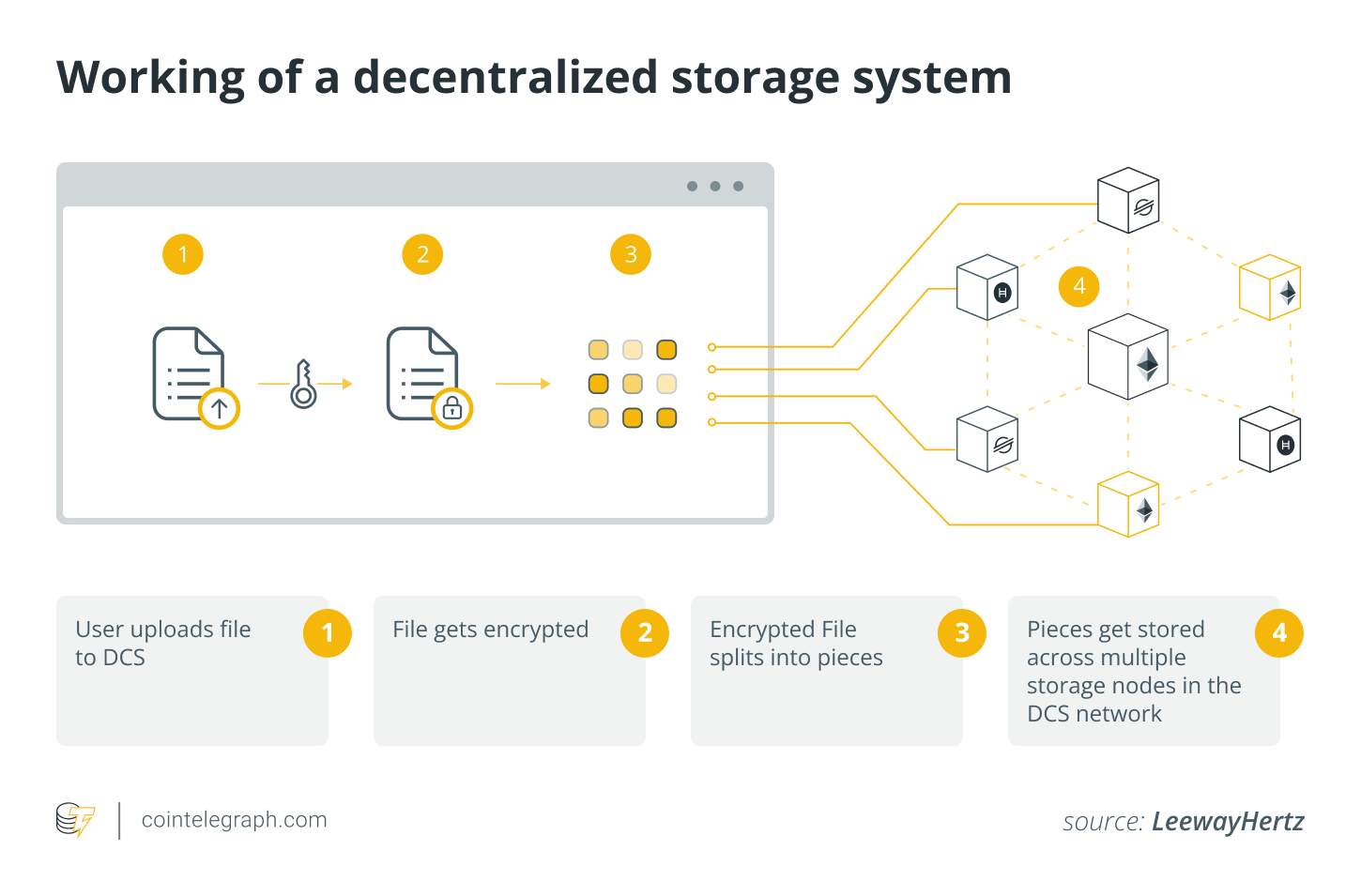
A file is split up into smaller parts where every component is dispersed among several network peers. This approach enhances file availability, as it is not stored in a single location, ensuring better accessibility and reliability.
Dispersed storage
By distributing file portions over several nodes, decentralized storage systems lessen reliance on a single server. For instance, IPFS employs a content-addressed approach, in which files are recognized by their content as opposed to their physical location.
Peer interaction
Peers request and share file portions directly with one another. The coordination of file transfers no longer requires a central server, thanks to this direct connection. Every peer participates in the file distribution process by serving as both a client and a server.
Blockchain and smart contracts
Blockchain technology is incorporated into several decentralized file-sharing systems to increase security and transparency. Smart contracts are self-executing contracts with pre-established rules that can automate tasks such as access restriction and file verification and reward participants with tokens.
Often, decentralized file-sharing systems use cryptographic techniques like end-to-end encryption to provide privacy and security for the shared files. This ensures that the content can only be accessed and deciphered by authorized users.
Advantages of decentralized file sharing
The benefits of decentralized file sharing include enhanced resilience, improved privacy, scalability and censorship resistance.
By removing a single point of failure, it improves reliability and resilience. In a peer-to-peer network, where files are dispersed among several nodes and peers, the system continues to function even in the event that some nodes go down.
Also, decentralized file sharing, by its very nature, offers enhanced security and privacy. By ensuring that only authorized users can access and decode shared content, cryptographic solutions like end-to-end encryption help lower the danger of unauthorized spying or data breaches.
Better scalability can also be attained as the network expands. In decentralized networks, more users add to the network’s capacity, allowing it to accommodate more demand and traffic without requiring modifications to the centralized infrastructure.
Additionally, decentralized file sharing encourages resistance against censorship. It is harder for any organization to censor or limit access to particular files or information because there isn’t a single entity in charge of the network.
Furthermore, decentralized file sharing frequently incorporates incentive mechanisms through token economies or other reward systems to encourage users to contribute resources like bandwidth and storage, thereby creating a cooperative and self-sufficient environment.
Challenges and limitations of decentralized file sharing
Challenges associated with decentralized file sharing involve scalability issues, consistency concerns, user adoption complexities, security risks and regulatory uncertainties.
Firstly, as the network grows, scalability issues become more pressing. A poor user experience may result from increased involvement if it causes slower file retrieval times and greater bandwidth requirements.
Moreover, in decentralized systems, problems with consistency and coordination could surface. It may be difficult to maintain consistency in file versions throughout the network in the absence of a central authority, which could result in conflicts and inconsistent data.
Complicated interfaces and user acceptance present another difficulty. When compared to centralized options, decentralized file-sharing platforms frequently have a higher learning curve, which may put off consumers who are not familiar with P2P networks or blockchain technology.
Furthermore, security vulnerabilities still exist, especially in the early phases of decentralized file-sharing deployments. As these systems grow more widely used, they are targeted by different types of attacks, which makes the continuous development of strong security measures necessary.
Regulatory uncertainty is another difficulty. The adoption and long-term viability of decentralized file-sharing platforms may be impacted by the changing legal environment surrounding cryptocurrency and decentralized technology.
The future landscape of decentralized file sharing
The future of decentralized file sharing involves blockchain technology, P2P networks and tokenization for secure, efficient and collaborative data exchange, which challenge traditional models.
Decentralized file sharing is expected to bring about a more inclusive, secure and productive environment. Distributed ledger and blockchain technology will be essential in guaranteeing tamper-proof and transparent transactions and facilitating file sharing among users without depending on centralized intermediaries.
Decentralized protocols powering peer-to-peer networks will enable direct data transmission between users, cutting down on latency and reliance on centralized servers. Strong encryption techniques will allay privacy concerns and provide consumers with more control over their data.
Furthermore, tokenization could encourage resource sharing among users, resulting in the development of a collaborative ecosystem. Innovative file-sharing services will probably proliferate as decentralization gains pace, upending established paradigms and promoting a more robust and democratic digital environment.


